Technion scientists measure ultrafast quantum light pulses for the first time
A Technion team measured single bright squeezed vacuum pulses for the first time, finding they last just 27.2 femtoseconds.

 Edited By: Joseph Shavit

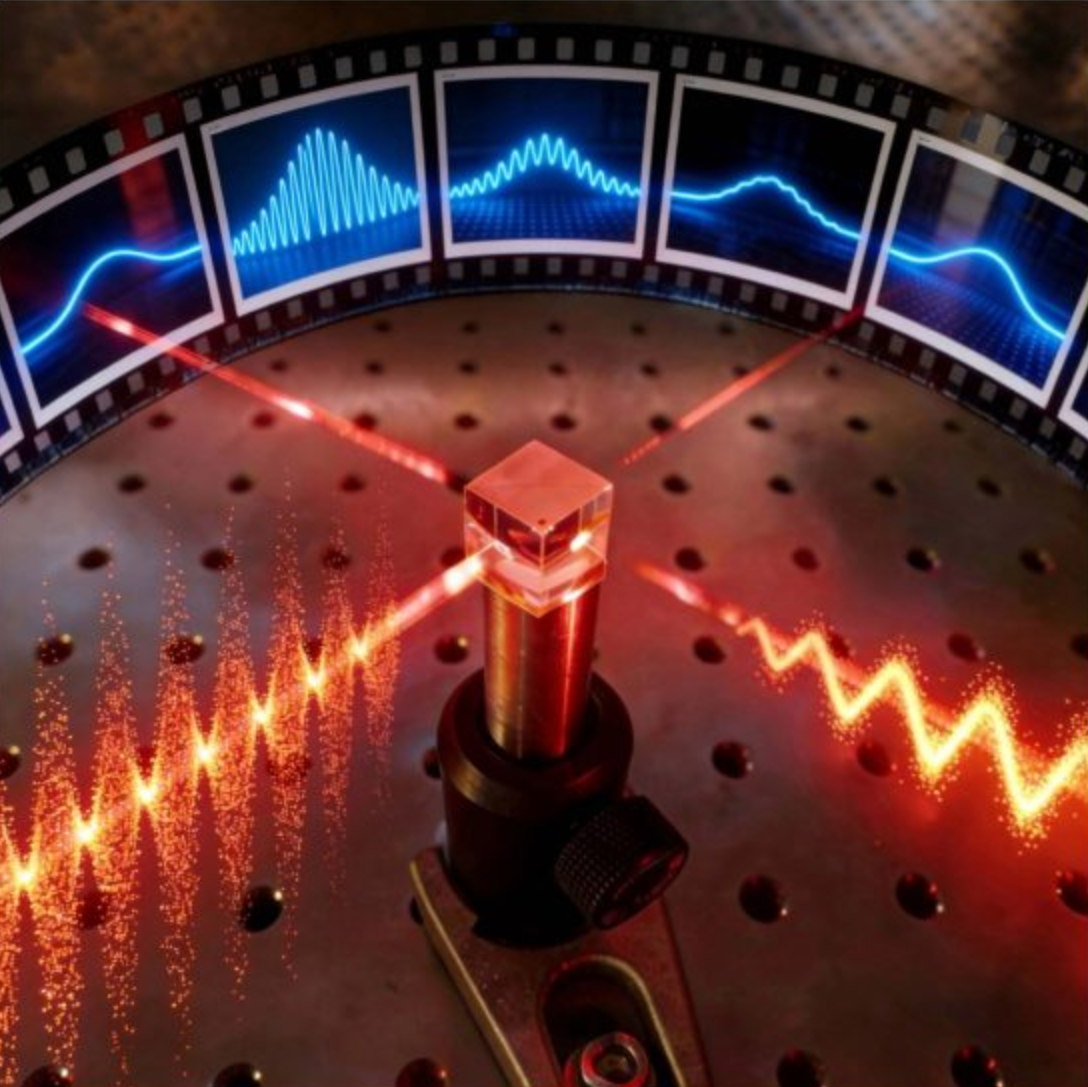
A visual illustration of a bright squeezed vacuum—a quantum state of light characterized by an exceptionally high level of noise—as it interferes with a regular laser pulse at a beam splitter. By recording the resulting interference patterns, the real-time characteristics of the laser pulse can be reconstructed.
(CREDIT: Dr. Michael Krüger, Yuval Kern, Ido Nisim, and Dr. Adi Goldner)
A light pulse is technically empty, yet capable of carrying a trillion photons in a single burst.
That is part of what makes bright squeezed vacuum, or BSV, so strange. It is formally treated as a vacuum state of light, meaning its average electric field is zero. Yet in single shots, its quantum fluctuations can swell into extremely intense pulses. In the new Technion study, researchers finally pinned down how long those individual pulses last, and the answer lands deep in the ultrafast realm: about 27.2 femtoseconds.
The work, published in Optica, comes from researchers at the Technion, Israel Institute of Technology, led by Dr. Michael Krüger and Ph.D. student Yuval Kern. The team also included Prof. Oren Cohen, Prof. Pavel Sidorenko, and Prof. Ido Kaminer, with contributions from Andrei Rasputnyi of the Max Planck Institute for the Science of Light in Erlangen, Germany.
A quantum pulse with a split personality
Ordinary intense laser light, described as coherent-state light, has only weak quantum fluctuations. BSV behaves very differently. Its average field stays at zero, but the fluctuations are so large that single pulses can become extraordinarily bright. The source material notes that individual BSV shots can reach photon numbers of up to 10¹² in a single pulse.
That mix of emptiness and intensity has made BSV attractive for extreme optics. It has already been used to drive nonlinear effects such as low-order harmonic generation, multiphoton electron emission from nanotips, high-harmonic generation from solids and gases, and strong-field photoemission. But one basic measurement had remained out of reach: the temporal duration of a single BSV pulse.
Earlier work at 1600 nanometers could only recover an average pulse shape, around 25 femtoseconds long. What researchers still lacked was a shot-by-shot picture of the pulse itself, including its spectral phase and time structure.
Reading a pulse through interference
To get there, the Technion team turned to single-shot spectral interferometry. They generated BSV at a central wavelength of 1040 nanometers by strongly pumping an unseeded optical parametric amplifier. In simple terms, they amplified fluctuations from the quantum vacuum itself. The setup used the 515 nanometer second harmonic of 1030 nanometer laser pulses from a Yb-based amplified laser system.
The researchers then interfered each unknown BSV pulse with a stable, fully characterized reference laser pulse. That reference pulse had been spectrally broadened to cover most of the BSV bandwidth. When the two beams met in a beam recombiner, they produced dense spectral interference fringes. From those fringes, the team could retrieve the spectrum and relative phase of each BSV shot.
They recorded 16,000 shots in total, then focused on 1,009 single-peak spectra with strong overlap with the reference pulse. From that subset, they reconstructed the time-domain profile of individual BSV pulses.
The average pulse duration came out to 27.2 femtoseconds, measured as full width at half-maximum intensity. The transform-limited pulse duration tied to the average spectrum was 19.3 femtoseconds. The standard deviation of pulse duration across the analyzed shots was 5.5 femtoseconds.
One result stood out. The BSV pulses were far shorter than the laser system’s 178 femtosecond output pulse and also shorter than the estimated 126 femtosecond duration of the second-harmonic pump. According to the paper, the exponential scaling of BSV with pump intensity concentrates emission in time, so it occurs mainly near the peak of the pump pulse envelope.
Signs of quantum randomness
The interference data also captured a key fingerprint of BSV: a π-radian phase ambiguity. In the experiment, the amplified vacuum could emerge with one of two possible phase relations. That showed up directly in the recorded fringe patterns.
Across a sequence of 200 pulses, the two phases appeared in a 105:95 distribution. The paper says that ratio is compatible with randomness in the phase of the quantum vacuum. The researchers also observed nodal structure in the fringes, linked to the fact that zero crossings occurred at the same frequencies for each shot.
These details matter because BSV is not just another short-pulse source. Its quantum statistics differ sharply from those of ordinary laser light. The source material notes that femtosecond BSV pulses can drive nonlinear processes more efficiently than coherent light with the same mean intensity, partly because rare high-photon-number shots weigh heavily in nonlinear interactions.
Full time-domain characterization
The team argues that a full time-domain characterization of each pulse is an important prerequisite for attosecond science. Ultrashort, intense pulses are used to study electron motion and other sub-cycle processes, especially in condensed matter systems. In this study, BSV at 1040 nanometers also aligns with the broad use of Yb-based laser systems in ultrafast science.
The paper does include limits. The authors say their method depends on a fully characterized reference pulse, and undetected systematic errors in the reference pulse’s FROG reconstruction can carry over into the BSV reconstruction. They also note that side peaks in the time-domain pulse profiles are likely caused by imperfections in that reference reconstruction. Their analysis further focused only on a subset of single-peak shots, leaving other spectral shapes outside the scope of the work.
“This is just the beginning,” Krüger said. “Bright squeezed vacuum opens exciting possibilities for studying ultrafast electron dynamics and pushing the boundaries of nonlinear optics.”
Practical implications of the research
This work gives researchers a way to measure the electric field of individual BSV pulses in time, not just as an average over many shots.
That could make BSV more useful in experiments that depend on tracking ultrafast light-matter interactions pulse by pulse.
Because BSV has already been linked to efficient nonlinear processes and to experiments beyond conventional damage thresholds, this measurement method may help researchers test how quantum light behaves in extreme optical conditions with finer control.
Research findings are available online in the journal Optica.
The original story "Technion scientists measure ultrafast quantum light pulses for the first time" is published in The Brighter Side of News.
Related Stories
- MIT scientists built photonic 'ski jumps' that beam light off chips for faster quantum computing
- Global first: Physicists use light to reveal quantum vibrations in a superconducting material
- Excitons Let Scientists Reshape Quantum Materials With Less Light
Like these kind of feel good stories? Get The Brighter Side of News' newsletter.
Shy Cohen
Writer