The case for water plumes on Europa just got much harder to make
Hubble’s old Europa plume signal now looks weaker, but the moon’s escaping hydrogen atmosphere stands out more clearly.

 Edited By: Joshua Shavit

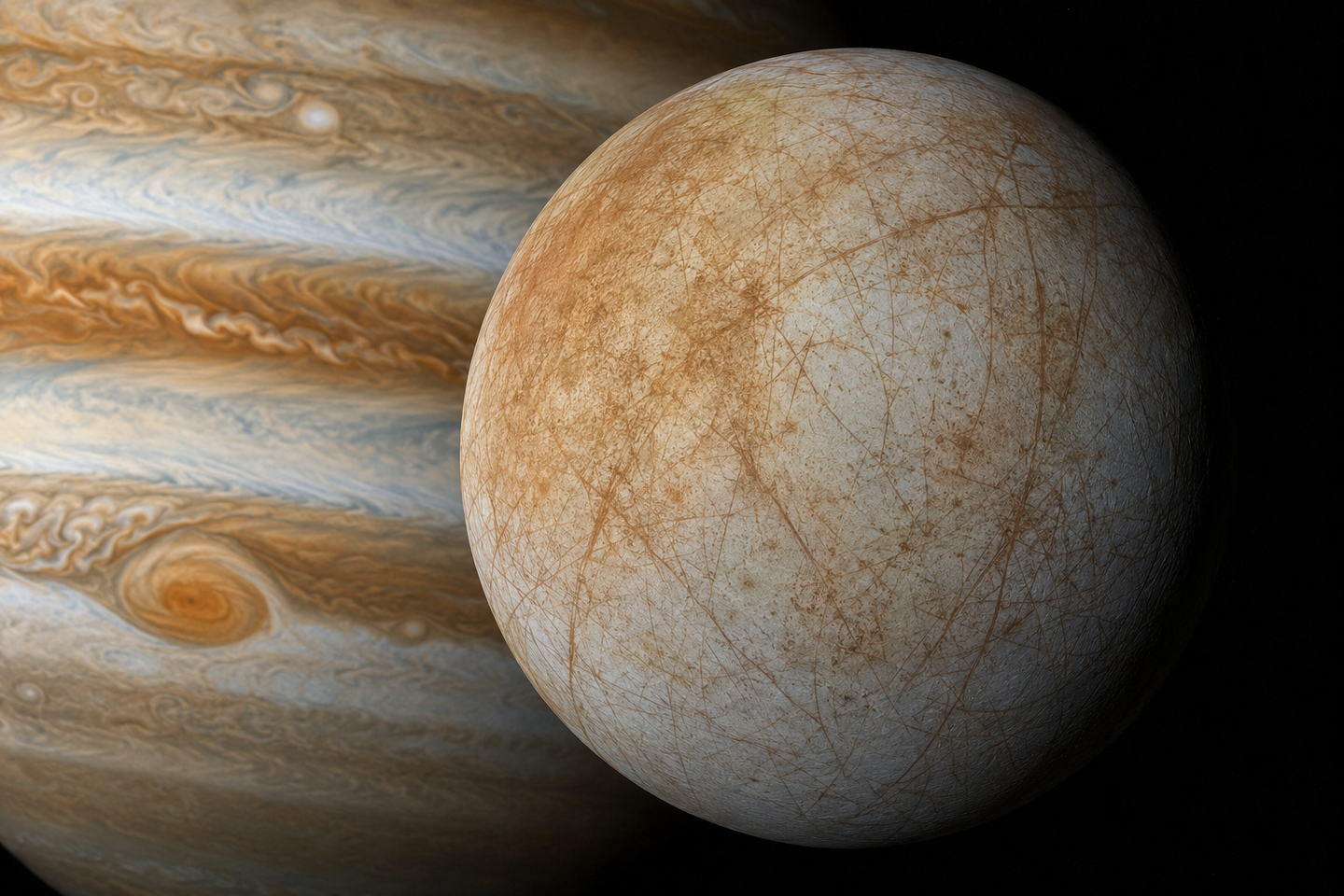
Reanalysis of 14 years of Hubble data weakens evidence for Europa plumes and sharpens the picture of its hydrogen atmosphere. (CREDIT: Wikimedia / CC BY-SA 4.0)
Europa’s faint glow in ultraviolet light once looked like a possible water plume punching through ice. After 14 years of Hubble data, that signal now looks far less certain. Meanwhile, a different picture of the moon’s escaping hydrogen atmosphere comes into sharper view.
Europa has long tempted scientists with the same question. If a salty ocean lies beneath its ice, can any of that buried water break through to space?
For a time, one set of Hubble observations seemed to hint that the answer might be yes. A bright patch seen in ultraviolet light near the moon’s limb was interpreted in 2014 as possible evidence of a faint water vapor plume. Now, after a much broader reanalysis of Europa observations from 1999 and 2012 through 2020, that case has weakened sharply.
“The evidence for water vapor plumes on Europa isn’t as strong as we first understood it,” Southwest Research Institute scientist Kurt Retherford said. Retherford was part of the team behind the earlier plume claim and is also an author of the new reanalysis.
The revised work does not say plumes are impossible. It says this particular dataset no longer provides solid evidence that they were there.
A signal that depended on a few pixels
The team revisited 23 Hubble Space Telescope observations made with the Space Telescope Imaging Spectrograph. They focused on Europa’s Lyman-alpha emissions, which is a specific ultraviolet wavelength tied to hydrogen. That glow can help researchers study both Europa’s thin atmosphere and any localized burst of material near the surface.
Back in the earlier analysis, the interpretation rested in part on where Europa was placed within the image. That turned out to matter a great deal.
“One of the difficulties in interpreting the data back then was determining where to place Europa within its context,” Retherford said. “The way Hubble works left some uncertainty in terms of placement relative to the center of the image. If Europa’s placement was off even just by a pixel or two, it could affect how the data gets interpreted.”
That is exactly what the reanalysis found.
The new model accounted for several sources of ultraviolet light at once. There were foreground emissions from Earth’s own hydrogen exosphere and interplanetary hydrogen. In addition, sunlight reflected from Europa’s icy surface and a broad hydrogen exosphere surrounding Europa itself were included. When those known contributors were fitted together, the once-notable local excess faded into something much less persuasive.
Lead author Lorenz Roth of the Royal Technical Institute in Sweden said the team’s earlier confidence dropped steeply. “Our reanalysis took our original 99.9% confidence in the plumes’ existence and reduced it to less than 90% confidence,” Roth said. “That’s simply not enough evidence to support the certainty of claims we made at the time.”
That shift came from two main changes. There was a revised estimate of Europa’s exact position on the detector. Integration of Europa’s hydrogen exosphere, which earlier work had not yet fully accounted for, was also important.
What Hubble did find more clearly
Even as the plume case weakened, the same observations sharpened another result. Europa appears to have a more substantial escaping hydrogen exosphere than some earlier estimates suggested.
Europa’s atmosphere is extremely thin and is constantly replenished as charged particles from Jupiter’s magnetosphere strike the moon’s frozen surface. That irradiation helps break apart water ice, producing molecules such as oxygen and hydrogen. Molecular oxygen dominates close to the surface, while lighter hydrogen can spread farther out and escape more easily.
Using the reprocessed Hubble data, the researchers found hydrogen exosphere emissions in all but one of the 23 observations. They derived vertical hydrogen column densities of about 1.4 × 10^12 cm^-2 for observations from 2012 to 2015. Observations from 2018 to 2020 showed about 1.1 × 10^12 cm^-2.
That points to roughly a 25% drop between the two observing periods.
The team also estimated an effective hydrogen temperature of about 1000 kelvin for the earlier period. Higher values are still possible within the uncertainties. Those numbers matter because they shape how easily hydrogen escapes Europa’s weak gravity. Based on the inferred density and temperature, the researchers estimated a hydrogen source rate of about 1.1 × 10^27 atoms per second.
That is a large escape flow.
It is also awkward to explain.
A harder puzzle under the ice
The researchers argue that simple photodissociation, where sunlight breaks apart atmospheric molecules, is unlikely to be the main source of Europa’s atomic hydrogen. That process would tend to produce hydrogen atoms much hotter than the relatively modest temperatures inferred here.
Electron impacts on atmospheric hydrogen-bearing molecules may be more efficient than sunlight. However, the analysis suggests that route also struggles to supply enough hydrogen. In particular, it appears difficult to reconcile the needed production rate with the behavior expected for molecular hydrogen. Much of this should escape before it can be dissociated.
That leaves open the possibility that some hydrogen is produced more directly from Europa’s surface ice through sputtering or photolysis. Yet the authors note that those pathways are still poorly constrained. This is especially true when it comes to the amount of hydrogen they can produce and the energies involved.
The observed difference between the earlier and later Hubble periods adds another wrinkle. One possible explanation is that small changes in Europa’s surface temperature could alter radiolysis yields enough to change atmospheric production rates. The paper notes that even a 3% rise near Europa’s average surface temperature could, under some laboratory-based assumptions, produce an increase of about 28% in radiolytic yield. This is close to the shift seen in the hydrogen data.
Still, that remains more suggestion than proof.
The team also found that some of the measured signal was affected by Earth itself. Hydrogen in Earth’s exosphere can attenuate Europa’s Lyman-alpha signal, especially when Europa’s velocity relative to Earth is small. Accounting for that effect helped explain why some observations looked weaker than others.
Why plume claims remain unsettled
The new work does not erase all past interest in Europa plumes. Other studies have proposed signs of intermittent activity using different methods and at different locations. But the broader picture remains patchy.
That is part of what makes Europa so compelling. The moon’s surface appears to cover a vast saltwater ocean. Cracks in the ice could, in principle, provide pathways for subsurface water to rise. Similar plume activity has been confirmed on Saturn’s moon Enceladus. Jupiter’s moon Io throws sulfur dioxide high into space as well.
Europa, though, is still holding back its answer.
Retherford said the current dataset does not rule out the earlier plume idea, but it no longer supports it as concrete evidence. “The description of the phenomena just doesn't hold up the same way anymore,” he said. “The new data has made us reconsider the strength of the previous paper’s conclusion regarding water vapor plumes.”
For now, the safest conclusion is narrower and more interesting than a simple retraction. Hubble’s ultraviolet record seems to say less about a dramatic jet of water and more about a global, dynamic hydrogen envelope that scientists still do not fully understand.
That mystery will not last forever.
NASA’s Europa Clipper mission is expected to arrive in the Jupiter system in 2030. There it will make repeated close passes of Europa and search for signs of active plumes. Clipper will bring a much richer set of instruments than Hubble could bring to bear from Earth orbit.
Practical implications of the research
This reanalysis raises the bar for future claims about Europa plumes. It shows how easily weak signals can be shaped by image alignment, background treatment, and unmodeled atmospheric components.
At the same time, it gives scientists a better baseline for Europa’s escaping hydrogen. This matters for understanding how the moon’s surface is weathered. It also affects how material moves from the ice into space, and how Europa interacts with Jupiter’s magnetic environment.
That makes the findings useful well beyond the plume debate. This is especially true as Europa Clipper prepares to test these ideas up close.
Research findings are available online in the journal Astronomy and Astrophysics.
The original story "The case for water plumes on Europa just got much harder to make" is published in The Brighter Side of News.
Related Stories
- New study uncovers the formative conditions that made Io dry and Europa watery
- Salty ice may hold the key to life on Jupiter’s moon Europa
- NASA’s Juno spacecraft offers fresh insight into Europa's icy ocean and its potential to support life
Like these kind of feel good stories? Get The Brighter Side of News' newsletter.
Joseph Shavit
Writer, Editor-At-Large and Publisher
Joseph Shavit, based in Los Angeles, is a seasoned science journalist, editor and co-founder of The Brighter Side of News, where he transforms complex discoveries into clear, engaging stories for general readers. With vast experience at major media companies like The Los Angeles Times, Times Mirror and Tribune Publishing, he writes with both authority and curiosity. His writing focuses on space science, planetary science, quantum mechanics, geology. Known for linking breakthroughs to real-world markets, he highlights how research transitions into products and industries that shape daily life.