The Sun could be one of thousands of solar twins moving through the Milky Way
Astronomers find evidence the Sun joined a mass migration of Sun-like stars moving away from the Milky Way’s center billions of years ago.

 Edited By: Joseph Shavit

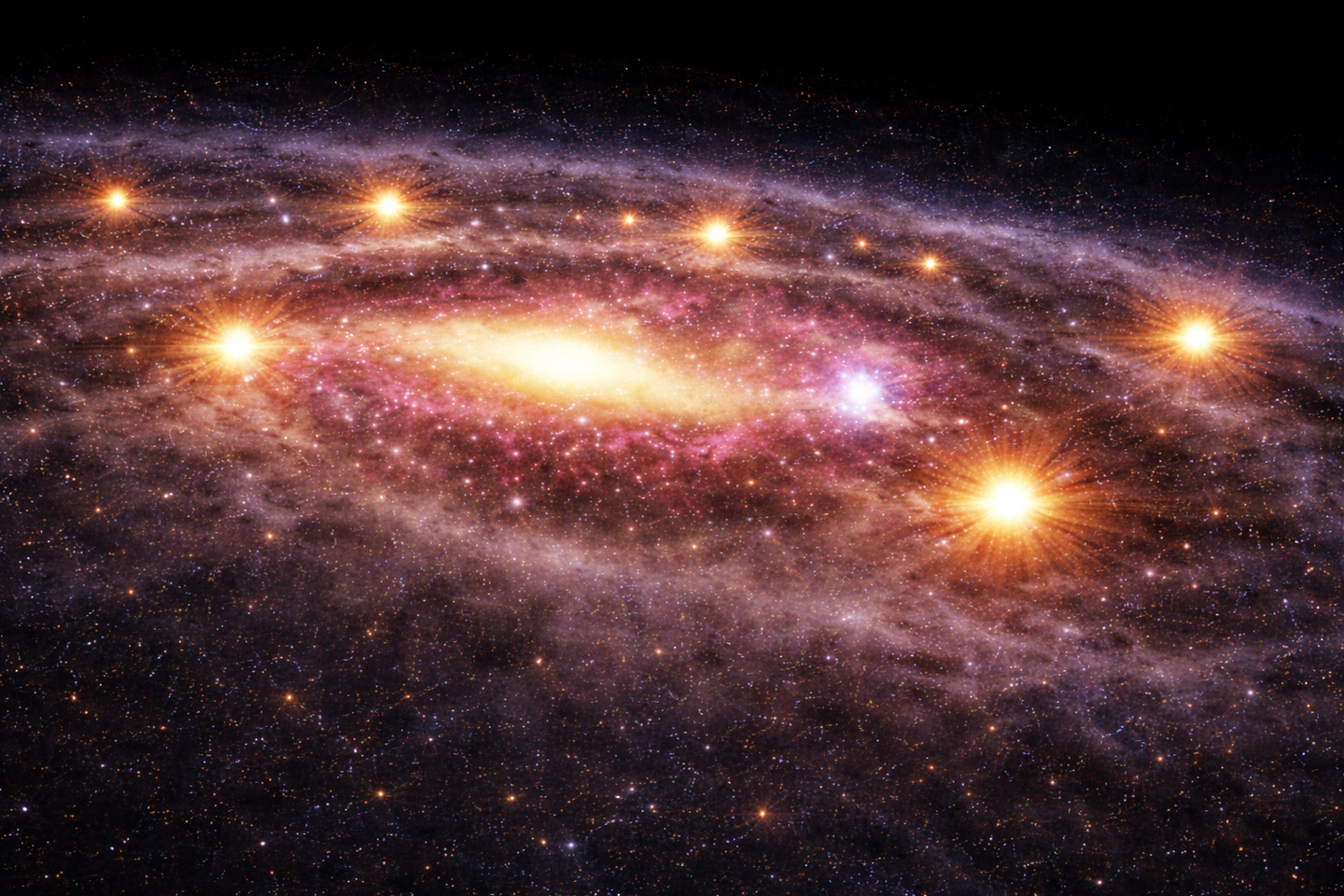
Study of 6,594 solar twins suggests the Sun migrated outward from the Milky Way’s center 4–6 billion years ago. (CREDIT: AI-generated image / The Brighter Side of News)
For billions of years before reaching its current location, the Sun may have slowly travelled as part of a large group, or “wave,” of stars drifting out from the inner parts of the Milky Way. This ancient migration is what astronomers believe enabled the Sun to travel to the outer regions of the Galaxy. Although, the Sun was confined to the more densely populated areas near the center due to gravitational interactions with other stars.
Assistant Professors Daisuke Taniguchi from Tokyo Metropolitan University and Takuji Tsujimoto from the National Astronomical Observatory of Japan have found evidence that many of the stars closely resembling our Sun, known as solar twins, are associated with each other. They possibly were moving together around the Milky Way billions of years ago. This has helped to resolve an ongoing mystery for scientists as to how the Sun arrived at its current position in the Milky Way. In fact, the Sun was limited to the inner parts.
The scientists constructed the largest catalogue of solar twins to date, consisting of 6,594 stars. Because solar twins evolve in similar ways, astronomers were able to determine their ages very accurately. Using data provided by the European Space Agency’s Gaia satellite and the catalogue of solar twins, researchers were able to create an enormous statistical database. This database provides an unparalleled opportunity for studying the Sun’s evolutionary history.
Gaia has recorded the characteristics of around 2 billion stars, giving scientists the opportunity to study stellar properties across large regions of the Milky Way. The researchers selected solar twin candidates using this enormous data set based on similar temperatures, metallicities, and gravitational accelerations as the Sun. After removing stars with uncertain measurements and binary companions, the researchers compiled their final solar twin catalogue for analysis.
Stellar Ages Reveal a Hidden Pattern
The ages of the Sun-like stars provide evidence of a distinct pattern. Upon evaluating the age distribution of stars in their catalogue, the researchers noticed a wide peak between 4 billion and 6 billion years old. The Sun, created approximately 4.5 to 4.6 billion years ago, falls within that range.
The clustering points toward many of these stars being formed in the same area of the Galaxy and gradually dispersing outward over time. Therefore, the Sun likely did not randomly move to its current location. Instead, it is part of a more extensive migration involving many stars of similar age.
The Mystery of the Galactic Barrier
For a long time, astronomers thought such significant movement would be unlikely. The Milky Way's centre contains a rotating bar structure of stars and gas that produces what astronomers call a corotation barrier. This barrier can trap stars within specific regions of their orbit.
Research suggests that the Sun formed approximately 10,000 light-years closer to the Galactic Centre than its current position. A key question arises: since the barrier limits stars’ ability to move away from the centre of the Galaxy easily, how did the Sun travel so far outward?
The new research provides a possible explanation. It is possible that the migration of the Sun to its current location occurred while the galactic bar was still forming. The structure may not have been fully developed when this migration took place.
Because the bar was still forming, the barrier may not have been as strong. This weaker barrier could have allowed larger groups of stars to move outward together.
The ages of the solar twins provide clues about when this migration occurred. The fact that most of them fall within the 4 to 6 billion year range suggests that many solar twins formed during the same general period as this migration.
Galactic Archaeology: Reading the Milky Way’s Past
This type of research is often referred to as galactic archaeology. Much like an archaeologist studies ancient artefacts to reconstruct the past of a human culture, astronomers study stars to reconstruct how the different components of the Milky Way have evolved.
In this approach, the ages of stars, their chemical compositions, and their orbital motions provide evidence of what occurred in the past. By combining these clues, astronomers can piece together how the Galaxy developed over billions of years.
Solar twins are especially valuable in this process because the precision of their properties allows astronomers to reduce the potential for systematic measurement errors. By comparing stars that are extremely similar, scientists can make more accurate measurements.
This precision results in better estimates of stellar ages using stellar evolution models, also known as isochrones. These models describe how stars evolve over time and allow researchers to estimate when stars formed.
In addition, the Gaia dataset enabled researchers to determine the orbital properties of the stars. This information helped them reconstruct the possible locations where these stars originally formed.
A Safe Home for Life
The potential impact of the Sun’s migration on life on Earth may have been substantial. Conditions near the centre of the Milky Way are significantly harsher than those found where the Sun is located today.
Near the Galactic Centre, the density of stars is much higher. High-energy radiation and the frequent occurrence of supernova explosions create a much less stable environment for planetary systems.
If the Sun did form near the centre of the Galaxy and later migrated outward, this movement may have helped place the Earth in a more stable region of the Galaxy. Such an environment would be far more suitable for life to develop and persist over long periods of time.
Practical Applications of the Research
The new solar-twin catalogue provides astronomers with an excellent tool for understanding the history of the Milky Way. With thousands of solar-type stars gathered in one catalogue, researchers can statistically model the ages of stars, their chemical evolution, and the migration of stars throughout the Galaxy.
In addition to helping explain the Sun’s migration, the findings may improve scientists’ understanding of how spiral galaxies evolve and how their central structures form. These insights could also aid the search for habitable planets throughout the universe.
Research findings are available online in the journal Astronomy and Astrophysics.
The original story "The Sun could be one of thousands of solar twins moving through the Milky Way" is published in The Brighter Side of News.
Related Stories
- Earth’s distance from the Sun found to dramatically alter seasons
- Astronomers find clearest evidence yet of a dark matter subhalo near the Sun
- Astronomers map the Sun’s shifting atmospheric edge for the first time
Like these kind of feel good stories? Get The Brighter Side of News' newsletter.
Joshua Shavit
Writer and Editor
Joshua Shavit is a NorCal-based science and technology writer with a passion for exploring the breakthroughs shaping the future. As a co-founder of The Brighter Side of News, he focuses on positive and transformative advancements in technology, physics, engineering, robotics, and astronomy. Joshua's work highlights the innovators behind the ideas, bringing readers closer to the people driving progress.