White hydrogen found in billion-year-old Canadian rock could fuel clean energy production
Deep boreholes at Kidd Creek show ancient Canadian rocks can release hydrogen for years, with possible energy uses.

 Edited By: Joseph Shavit

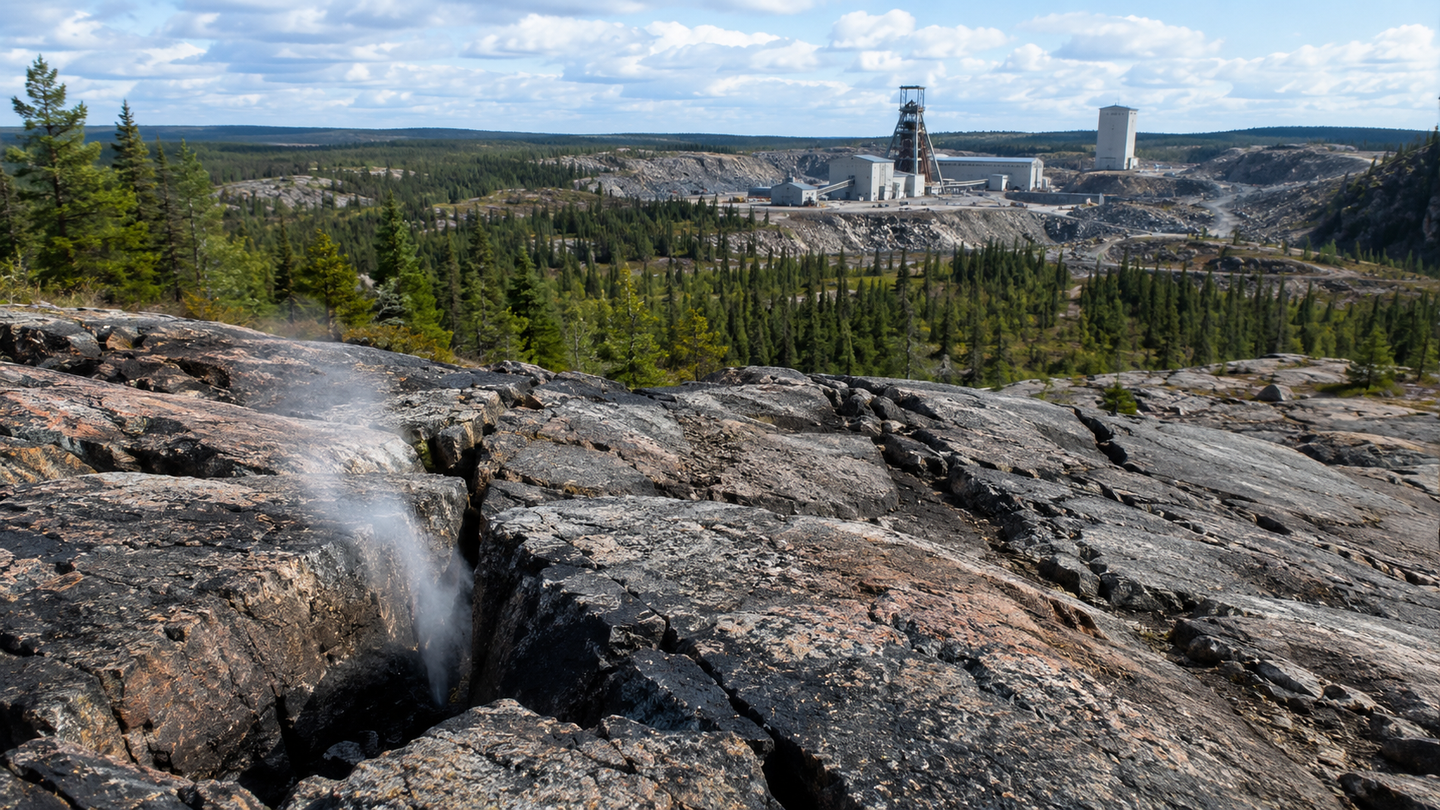
Ancient rocks in Canada’s Shield are releasing measurable white hydrogen, offering a possible new local energy source. (CREDIT: Wikimedia / CC BY-SA 4.0)
Deep beneath northern Ontario, some of Earth’s oldest rocks are quietly giving off hydrogen.
At Kidd Creek mine near Timmins, geochemists tracked gas seeping from boreholes drilled two to nearly three kilometers below the surface. What they found was not a one-off puff or a short-lived flare. The hydrogen kept coming, in measurable amounts, over months. In some cases, it lasted for more than a decade.
That matters because hydrogen already plays a central role in modern industry, especially in fertilizer, methanol, and steel production. Yet most of it still comes from fossil fuels or other energy-intensive processes. The new work suggests some of that supply might instead come straight from the crust. This would be possible in places where the right rocks already lie under active mining districts.
Researchers from the University of Toronto and the University of Ottawa report that all 35 boreholes they analyzed at Kidd Creek released hydrogen. Across the dataset, the average discharge came to 0.008 tonnes per borehole per year. When extrapolated across the mine’s 14,801 boreholes, that works out to more than 140 tonnes of hydrogen annually at atmospheric pressure. This represents an energy equivalent of about 4.7 million kilowatt-hours per year.
“The data from this study suggests there are critical untapped opportunities to access a domestic source of cost-effective energy produced from the rocks beneath our feet,” said Barbara Sherwood Lollar, a University Professor in the Department of Earth Sciences at the University of Toronto and the lead author.
A long view from deep underground
The project stands out because it is built on measurements, not just modeling.
Natural hydrogen, sometimes called white hydrogen, has drawn growing interest in recent years. Much of that excitement has rested on theory, limited surface seeps, or isolated reports from a few gas wells. This analysis instead followed hydrogen directly in a working mine. It used boreholes spread across a large underground area and records that stretched from months to 11 years.
At the 6,800-foot level, or about 2.04 kilometers below land surface, the team sampled 27 boreholes drilled through a mix of rock units before ending in ultramafic rocks. Every borehole produced hydrogen. Concentrations ranged from less than 1% to 12.7% of the free gas phase. In three boreholes monitored for 11 months, hydrogen stayed between 2% and 12.7%. Total gas flow remained at roughly 2 to 10 liters per minute through the sampling period.
The deeper observatory at the 7,850-foot level offered an even longer record. One borehole, numbered 12299, held hydrogen concentrations from 2.17% to 6.5% between 2008 and 2019. It averaged 4.25% over those 11 years. Flow rates varied, but the long-term average stayed above 3 liters per minute.
Those steady discharges are central to the study’s argument. For hydrogen exploration, the question is not just whether gas exists. It is also about whether it appears at useful concentrations, in useful volumes, and for long enough to matter economically.
The rock is the clue
The researchers tie the hydrogen to water-rock reactions in ancient crust, especially in mafic and ultramafic rocks common across the Canadian Shield.
“Natural hydrogen is produced over time through underground chemical reactions between rocks and the groundwaters in those rocks,” Sherwood Lollar said. “Canada is blessed that vast amounts of its territories, especially on the Canadian Shield, contain the right rocks and minerals to create this natural hydrogen.”
That point may be especially important for Canada because the same geologic settings have long been targets for mining. Northern Ontario and Quebec, along with Nunavut and the Northwest Territories, contain major deposits of nickel, copper, diamonds, and critical minerals. The new findings suggest those places may also host hydrogen resources. These would be located close to where energy is already needed.
“The common link is the rock,” said Oliver Warr, an assistant professor in the Department of Earth and Environmental Sciences at the University of Ottawa and a co-author of the study. “Natural hydrogen is produced in the same rocks where Canada’s nickel, copper and diamond deposits are found, and that are currently under exploration for critical minerals such as lithium, helium, chromium and cobalt.”
That overlap could solve one of hydrogen’s stubborn problems. Transport and storage are expensive, and large new infrastructure projects take time. If hydrogen can be used close to where it forms, some of those costs may fall.
Not every setting will work
The work also pushes back against some of the hype surrounding natural hydrogen.
The authors note that many recent exploration programs have relied on near-surface measurements in the parts-per-million range or on broad prospectivity models rather than long-term subsurface records. At Kidd Creek, by contrast, the team documented percent-level hydrogen concentrations and sustained gas flow directly underground.
Still, the findings do not mean every hydrogen-bearing rock body will become a practical energy source.
One major uncertainty is loss. Hydrogen can disappear into abiotic reactions that generate methane and other hydrocarbons, or it can be consumed by microbes underground. The study points to groundwater circulation as a key screening tool. In places where surface waters have moved deep underground, microbial activity may be stronger. This could reduce how much hydrogen remains available. Kidd Creek appears favorable in part because its waters show long isolation, low biomass, and little evidence of recent recharge.
The authors also say more case-by-case work is needed on extraction, gas handling, and economics. Kidd Creek’s estimate is conservative, based on long-term average discharge rather than the higher bursts seen in some boreholes. It also comes from one site. However, its total annual estimate is broadly similar to figures previously inferred for a mine in Albania.
Even so, the study gives the field something it has lacked: a measured baseline.
A local energy play, not just a global one
Rather than framing natural hydrogen only as a commodity for a future global market, the researchers make a more practical case for local use.
Remote mines and northern communities already spend heavily on imported fuel. The paper compares Kidd Creek’s estimated 4.7 million kilowatt-hours of annual hydrogen energy with energy investments at Diavik Diamond Mine in the Northwest Territories. At Diavik, Rio Tinto reported a $30 million wind and solar project producing 4.2 million kilowatt-hours annually. The comparison does not show that natural hydrogen can simply replace those systems. Still, it suggests the scale is large enough to take seriously.
The analysis also notes that associated gases may raise the value further. At Kidd Creek, methane and helium occur alongside hydrogen. Methane presents a climate problem if vented, but using or converting it could reduce emissions. Helium, increasingly expensive and important for technologies such as MRI and quantum computing, could provide another revenue stream.
Beyond energy, the dataset has scientific value. Long-term records of hydrogen release help researchers think about fracture permeability, crustal porosity, and the conditions that support deep microbial life. Kidd Creek has already played an important role in studies of ancient groundwaters and subsurface habitability. This work adds another layer to that picture.
There is also a caution tucked inside the optimism. The best targets for hydrogen may not be the most biologically active ones. As the authors put it, exploration should avoid locations “where the microbes may have gotten to the hydrogen before us.”
Practical implications of the research
The findings suggest natural hydrogen exploration can move beyond speculation and begin with places where geology, mining activity, and local energy demand already meet. In Canada, that could mean focusing on shield regions with ultramafic and mafic rocks, active or historic mines, and nearby industrial users or northern communities that currently rely on imported fuel.
The work also argues for a different exploration strategy. Instead of chasing surface seeps alone, companies and governments may need to evaluate groundwater history, microbial activity, fracture networks, and long-term gas discharge together. That approach could help identify sites where hydrogen is not only produced, but also preserved.
For mines, the immediate appeal is simple. A gas that is already being vented during routine operations might become an on-site energy source that lowers fuel costs and cuts carbon emissions. For the broader hydrogen economy, the study does not promise a quick replacement for industrial production, but it does offer real numbers from real rock, and that is a meaningful step forward.
Research findings are available online in the journal PNAS.
The original story "White hydrogen found in billion-year-old Canadian rock could fuel clean energy production" is published in The Brighter Side of News.
Related Stories
- Vast white hydrogen reserve discovered hidden beneath the Earth's surface
- Researchers discover massive hydrogen system beneath the Pacific Ocean
- Scientists create sustainable green hydrogen using soda cans and seawater
Like these kind of feel good stories? Get The Brighter Side of News' newsletter.
Rebecca Shavit
Writer
Based in Los Angeles, Rebecca Shavit is a dedicated science and technology journalist who writes for The Brighter Side of News, an online publication committed to highlighting positive and transformative stories from around the world. Having published articles on MSN, AOL News, and Yahoo News, Rebecca's reporting spans a wide range of topics, from cutting-edge medical breakthroughs to historical discoveries and innovations. With a keen ability to translate complex concepts into engaging and accessible stories, she makes science and innovation relatable to a broad audience.