Why don’t giant prehistoric insects still exist?
Giant prehistoric insects could have breathed today’s air, a new Nature study finds — dismantling the oxygen theory of insect gigantism.

 Edited By: Joseph Shavit

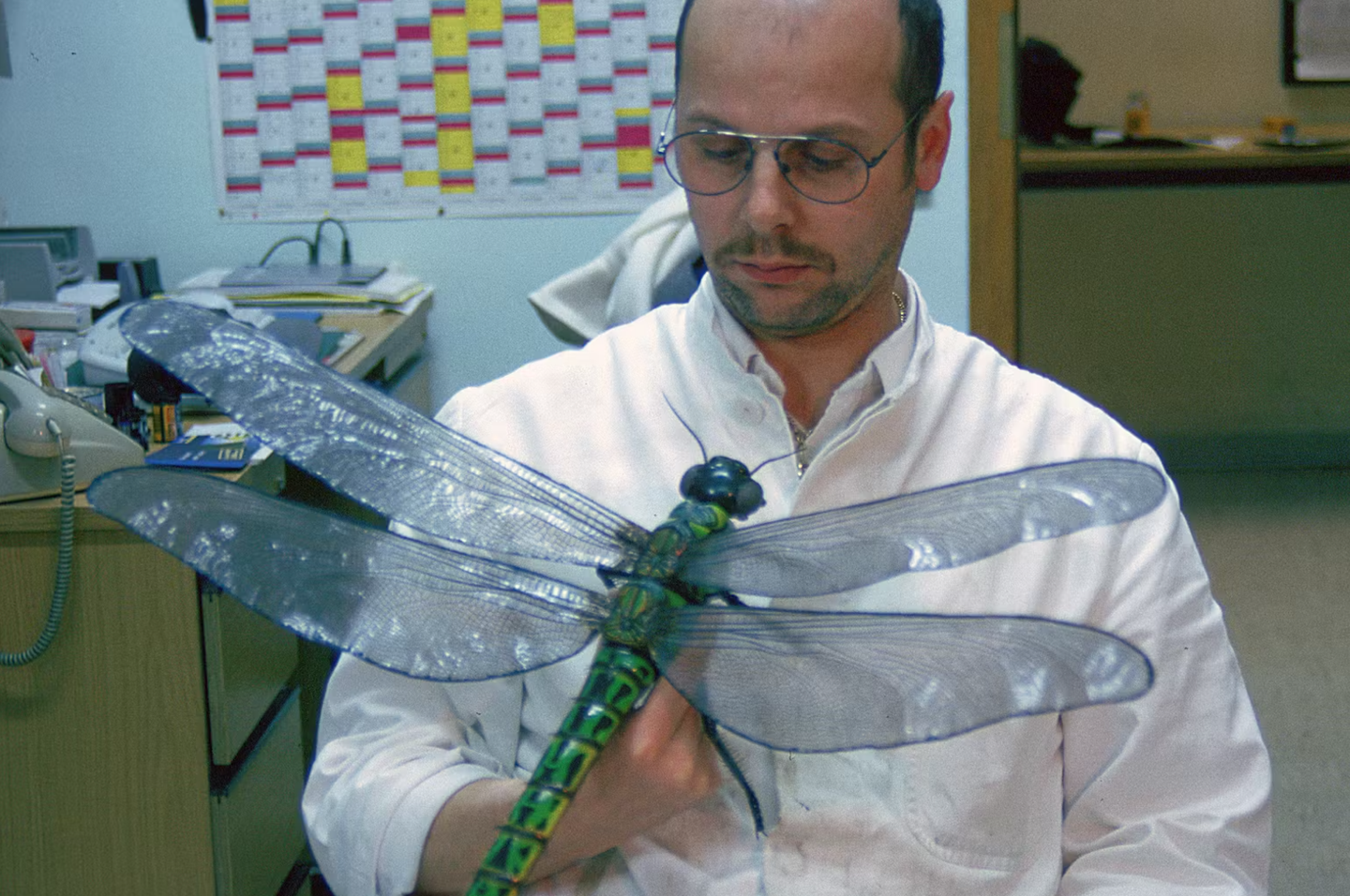
The griffinfly, now extinct, once stretched its wings nearly 70 centimeters wide. (CREDIT: Werner Kraus / Wikimedia / CC BY-SA 4.0)
Three hundred million years ago, dragonfly-like creatures with wingspans stretching 70 centimeters patrolled the skies of a world nothing like our own. These griffinflies, as paleontologists call them, were the largest flying insects ever to exist, roughly five times the size of any dragonfly alive today. For three decades, scientists thought they knew why such animals could never return: modern air simply doesn't contain enough oxygen to power them.
New research published in Nature dismantles that explanation entirely.
A team working across five years and more than a thousand microscope images has found that the respiratory structures of insect flight muscles occupy so little anatomical space that insects could, in principle, easily compensate for lower oxygen levels by growing more of them. The oxygen content of Earth's ancient atmosphere, the theory goes, was not the reason griffinflies grew enormous. And it almost certainly is not the reason giant flying insects don't exist today.
That second question, what actually does limit insect size, now has no clean answer.
The Thirty-Year Assumption
The standard explanation for prehistoric insect gigantism is elegant and intuitive. Ancient insects breathe through a branching system of air-filled tubes called tracheae, which divide into microscopic dead-end branches called tracheoles where oxygen diffuses directly into muscle tissue. Unlike vertebrates, insects have no complex lungs to actively pull oxygen through tissue. They rely on diffusion, a process governed by concentration differences and the physical distances involved.
Around 300 million years ago, Earth's atmosphere contained approximately 30 percent oxygen, compared with today's 21 percent. Giant insects lived during that hyperoxic period. When it ended, giant insects disappeared. The correlation seemed to confirm the mechanism: more atmospheric oxygen drives a steeper diffusion gradient, which allows more oxygen to reach the mitochondria in flight muscles, which supports a larger, more energetically demanding body.
This argument appeared convincing enough to anchor itself in textbooks.
The problem emerged when researchers began examining exactly how much space those tracheoles actually take up.
Looking inside 44 living insect species
The team measured tracheolar volume density, essentially how much of the cross-sectional area of flight muscle is occupied by oxygen-delivering tracheoles, in 44 species of flying insects spanning nearly the entire range of body sizes that exist today. The project required 1,320 transmission electron micrographs and five years of work.
The finding was consistent and startling. Tracheoles occupy roughly 1 percent of flight muscle volume, and that fraction barely changes across a 10,000-fold range in body mass, from a 0.334-milligram citrus psyllid to a 7.74-gram goliath beetle.
For comparison, the blood-filled capillaries supplying oxygen to the aerobic flight and cardiac muscles of birds and mammals occupy up to 10 percent of tissue volume. Mitochondria in insect flight muscle typically occupy around 20 percent. The tracheoles that deliver all the oxygen those mitochondria consume take up one-tenth as much space as their vertebrate equivalents.
Significant Implications
That disproportion carries a significant implication. If an insect needed to increase its oxygen supply to support a larger body or lower atmospheric oxygen, it could multiply its tracheoles substantially without meaningfully crowding out the mitochondria or structural proteins the muscle needs to function. A sensitivity analysis the researchers ran on a standard locust model showed that tripling tracheolar volume density would increase the oxygen-delivering capacity of the system more than fourfold, while reducing maximum mechanical work rate by only about 2 percent.
"This indicates that flying insect size is unlikely to be constrained by atmospheric oxygen levels, as the insects could easily compensate for different levels by adjusting the number of these specialist structures in the muscle, as they take up so little space," said Dr. Nicholas Payne, a co-author from Trinity College Dublin's School of Natural Sciences.
The researchers extended their analysis further. Using the known scaling relationship between body mass and tracheolar density, they projected what the tracheolar investment of the extinct griffinfly Meganeuropsis permiana, estimated at around 100 grams, would likely have been. The answer: approximately 1 percent, the same as modern insects. There is no sign that the tracheal system was operating anywhere near its physical limits in the largest flying insects that ever lived.
The Question That Remains
Demonstrating that oxygen transport did not limit griffinfly size does not explain what did. The researchers are candid about this.
One observation that held up for much of insect evolutionary history is that maximum insect size tracked atmospheric oxygen fairly well, at least until roughly 135 million years ago. After that point, the correlation breaks down. The leading candidate for that breakpoint is the rise of birds and bats. Large insects make conspicuous prey. In an ecosystem with aerial vertebrate predators capable of hunting on the wing, being very large becomes a significant liability rather than a neutral trait.
Three hundred million years ago, no birds or bats existed. Griffinflies ruled the skies with few vertebrate competitors and essentially no aerial predators. That alone may explain their size, not atmospheric chemistry.
"It's a bit of a headscratcher as to why living insects don't really invest a lot into their oxygen supply infrastructure as they get larger, and it also raises a bunch of questions about other animals going forward," Payne said.
The researchers note several alternative candidates for what might ultimately cap insect size. Heat dissipation during powered flapping flight may become unmanageable in very large bodies. The mechanical demands of lifting large masses may require more power than flight muscles can generate. The open circulatory system that insects use for transporting fuel may struggle to supply energy fast enough to enormous bodies. The exoskeleton may face structural limits, particularly during molting when an insect is temporarily soft and vulnerable.
None of these have been tested as rigorously as the oxygen transport hypothesis, and none currently has the evidence to displace it as a leading explanation.
Beyond Fossil Entomology
The research carries implications beyond fossil entomology.
One active area of concern in climate science involves how rising ocean temperatures are pushing oxygen from seawater, a process that could affect the size of fish as oceans warm. Those debates invoke similar geometric arguments about diffusion limits, surface area, and body volume.
If the insect research suggests that animals can compensate for oxygen supply challenges more flexibly than simple diffusion geometry implies, it may complicate predictions about how marine animals will respond to deoxygenation.
Payne flagged the connection directly: "Right now there's a lot of debate about how climate change is pushing oxygen from our oceans and whether this might cause fish to shrink in the future. Those debates center around geometry, and how evolution may be shackled by anatomical limits, as the insect study considered. But clearly we still have a lot to learn about how oxygen impacts animal size."
Practical Implications
For paleontology, the finding removes the primary physiological explanation for one of prehistoric life's most striking phenomena. If griffinflies could have breathed modern air, their extinction becomes a problem of ecology rather than atmospheric chemistry, tied to the changing predator landscape as vertebrates diversified and eventually took flight themselves.
For evolutionary biology more broadly, the study highlights how rarely anatomical limits are genuinely tight. The oxygen delivery system of flying insects, which powers some of the most metabolically demanding tissue in the animal kingdom, operates with enormous structural headroom.
That headroom suggests evolution has not been pushing against a wall in this system, which in turn raises the question of what is actually setting the boundaries on insect size, and whether those same boundaries apply in predictable ways to other animals navigating a warming, deoxygenating world.
The griffinfly is gone. But the question it poses is very much alive.
Research findings are available online in the journal Nature.
The original story "Why don't giant prehistoric insects still exist?" is published in The Brighter Side of News.
Related Stories
- Scientists reveal the staggering number of insects flying in the sky above the US
- Scientists rethink animal consciousness: Reptiles, fish, and insects may be sentient
- Why are there so few insects in the ocean?
Like these kind of feel good stories? Get The Brighter Side of News' newsletter.
Hannah Shavit-Weiner
Medical & Health Writer
Hannah Shavit-Weiner is a Los Angeles–based medical and health journalist for The Brighter Side of News, an online publication focused on uplifting, transformative stories from around the globe. Passionate about spotlighting groundbreaking discoveries and innovations, Hannah covers a broad spectrum of topics—from medical breakthroughs and health information to animal science. With a talent for making complex science clear and compelling, she connects readers to the advancements shaping a brighter, more hopeful future.