1.7 million satellites and space mirrors may put the night sky at risk
A new ESO study says huge satellite fleets could brighten the sky and erase critical telescope observations.

 Edited By: Joseph Shavit

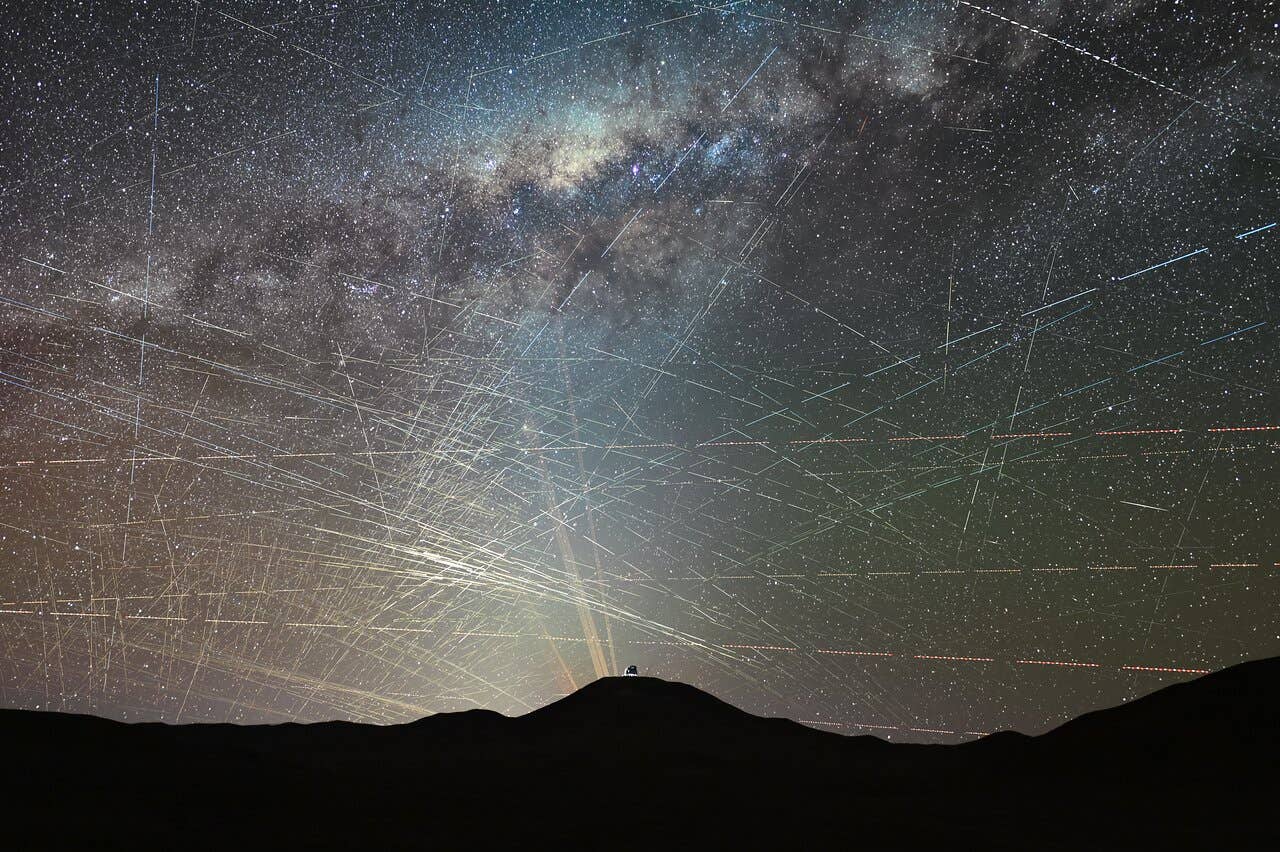
This image shows satellites crossing the night sky above the northern Atacama Desert in Chile, over a period of just one hour. (CREDIT: F. Kamphues, ESO/M. Kornmesser)
The night sky above the world’s best observatories has long been prized for one thing above all: darkness. Now that darkness is under pressure from a flood of satellites, and one new analysis argues the threat is no longer limited to a few bright streaks across telescope images.
An astronomer at the European Southern Observatory has calculated what happens if today’s plans for low-Earth orbit move forward, including proposals that would place more than 1.7 million new satellites overhead. His conclusion is stark. To preserve modern astronomy, Earth should have no more than 100,000 satellites in orbit, and those satellites should be faint enough to stay below naked-eye visibility from a dark site.
That limit comes from a peer-reviewed study by ESO astronomer Olivier Hainaut, accepted for publication in Astronomy and Astrophysics. The work is the first to estimate not just the direct damage from satellite trails, but also how constellations can brighten the entire sky through scattered and diffuse light.
“Until now we have managed, but it’s getting worse,” Hainaut said.
A sky filling with machines
The number of satellites in orbit has climbed quickly since 2019. More than 14,000 are now circling Earth, a total dominated by SpaceX’s Starlink system. If dead satellites and debris are counted, the figure rises to about 32,000.
What concerns astronomers even more is what comes next.
SpaceX has proposed sending up one million satellites for space-based data centers. Other projects, including E-Space’s Cinnamon and China’s CTC-1 and CTC-2 constellations, would add hundreds of thousands more. Hainaut’s study found that for large parts of the night, hundreds of satellites would be visible at once, and at some times several thousand would cross the sky, roughly matching the number of stars a person can see with the naked eye under good conditions.
That changes more than the look of the heavens. It changes what telescopes can do.
“Satellites, illuminated by the Sun, are much brighter than distant galaxies,” Hainaut said. “When a satellite crosses what we observe, it makes a bright streak on our image, zapping whatever is behind it.”
To measure the scale of the problem, he simulated the positions, motion, and brightness of current and proposed constellations, then tested their effects on instruments including ESO’s Very Large Telescope in Chile and the Vera C. Rubin Observatory camera in the United States.
When a trail becomes a wall
For a more typical near-future case, about 60,000 telecommunications satellites that meet the recommended faintness threshold would still leave a mark, but one the study classed as manageable. The real trouble begins when the population rises into the hundreds of thousands or millions.
For SpaceX’s proposed one-million-satellite data-center constellation, Hainaut found that a large share of each night would contain multiple satellite trails in telescope images. Two hours into the night, dozens of trails could appear in each image from the VLT’s FORS2 camera, causing field-of-view losses of up to 28%.
The Rubin Observatory could fare even worse. Its camera is especially vulnerable because a bright trail can saturate the detector and trigger ghost trails across other parts of the image. If the satellites are only slightly brighter than the recommended limit, Hainaut found, a Rubin-like camera could have most of its images rendered unusable for several hours every night.
The study points to visual magnitude 7 as a critical threshold. That is faint enough to keep satellites below naked-eye visibility under excellent dark-sky conditions, and faint enough to avoid saturating instruments such as Rubin’s camera. Once satellites become brighter than that, the damage rises quickly.
Hainaut’s broader modeling found that if satellites meet that faintness goal, the total population still needs to stay under about 100,000 to keep losses near the level astronomers already accept from technical failures and other routine problems.
“This is not a hard number, like 99 999 is good and 100 001 is bad: clearly I’d prefer 50 000,” Hainaut said. “But 100 000 causes losses at about the level of other technical losses, such as equipment failure.”
The brightest proposal of all
The study reserves some of its harshest warnings for Reflect Orbital, a U.S. start-up that wants to use large mirror-like satellites to beam sunlight onto Earth at night. The company plans to begin with a prototype and says it hopes to build a fleet of 50,000 by 2035.
These satellites would not just cross the field of view. They would rival the brightest objects in the sky.
Hainaut calculated that the full Reflect Orbital constellation would place hundreds of extremely bright satellites overhead. Outside any direct beam, each one would still shine about as brightly as Venus. For people standing inside a reflected beam, the satellite would appear four times brighter than the full Moon.
Even if observatories are never targeted directly, the background glow would surge. With 50,000 such satellites in orbit, the night sky could become three to four times brighter overall. At prime observatory sites, that would push conditions from pristine darkness toward a level closer to semi-suburban skies, making deep observations of faint galaxies and planets far harder.
From a light-polluted city such as Munich, Hainaut noted, those satellites could become the only “stars” visible at night.
The implications run beyond astronomy. Hainaut noted that very bright constellations could disrupt ecosystems and biological clocks, while the launches and re-entries required to maintain huge fleets would also affect the atmosphere. But he kept his focus on the sky itself.
“My job is astronomy, so I quantify the effects on astronomy,” he said. “I hope others will evaluate the other impacts in their field of expertise.”
A decision beyond observatories
The paper has already moved into policy debates. SpaceX and Reflect Orbital have both filed with the U.S. Federal Communications Commission for launch approval. ESO, the Royal Astronomical Society, and the International Astronomical Union used the new study as the basis for responses to those filings.
“The FCC received over 1800 comments regarding Reflect Orbital and nearly 1500 comments on the application by SpaceX,” said Betty Kioko, ESO’s institutional affairs officer. “The ball is now in the FCC’s court, and we wait to see the determinations they make on both filings. For optical astronomy, this is an existential threat, and we hope that the regulators will share that view.”
ESO Director General Xavier Barcons framed the issue in broader terms.
“Astronomy generates huge value for humankind, including scientific, technical, economical, and educational, and helps us understand our place in the Universe,” Barcons said. “The large number of planned satellites in low-Earth orbit challenges that capacity, underscoring the need to limit future satellite launches and for astronomers, engineers, satellite operators and other stakeholders to work together to adopt strict mitigation measures.”
Practical implications of the research
The analysis turns a long-running concern into a concrete policy benchmark. It suggests that regulating satellite brightness matters just as much as regulating satellite numbers, and that modest departures from current recommendations could cripple some of the world’s most sensitive observatories.
The analysis also gives regulators a simpler test: if constellations cannot stay faint and limited in total size, the cost is not abstract.
It shows up as lost images, longer exposure times, fewer detectable asteroids, weaker searches for Earth-like planets, and a brighter night sky for everyone.
Research findings are available online in the journal Astronomy and Astrophysics.
The original story "1.7 million satellites and space mirrors may put the night sky at risk" is published in The Brighter Side of News.
Related Stories
- SpinLaunch looks to slingshot satellites into space
- Earth’s magnetic field is shifting — and satellites are feeling it
- Space debris sensor promises safer future for satellites
Like these kind of feel good stories? Get The Brighter Side of News' newsletter.
Joshua Shavit
Writer and Editor
Joshua Shavit is a NorCal-based science and technology writer with a passion for exploring the breakthroughs shaping the future. As a co-founder of The Brighter Side of News, he focuses on positive and transformative advancements in technology, physics, engineering, robotics, and astronomy. Having published articles on AOL.com, MSN, Yahoo News, and Ground News, Joshua's work highlights the innovators behind the ideas, bringing readers closer to the people driving progress.