250-million-year-old fossil proves that mammal ancestors laid eggs
A fossil embryo inside an egg helps explain how Lystrosaurus survived Earth’s deadliest extinction event.

 Edited By: Joseph Shavit

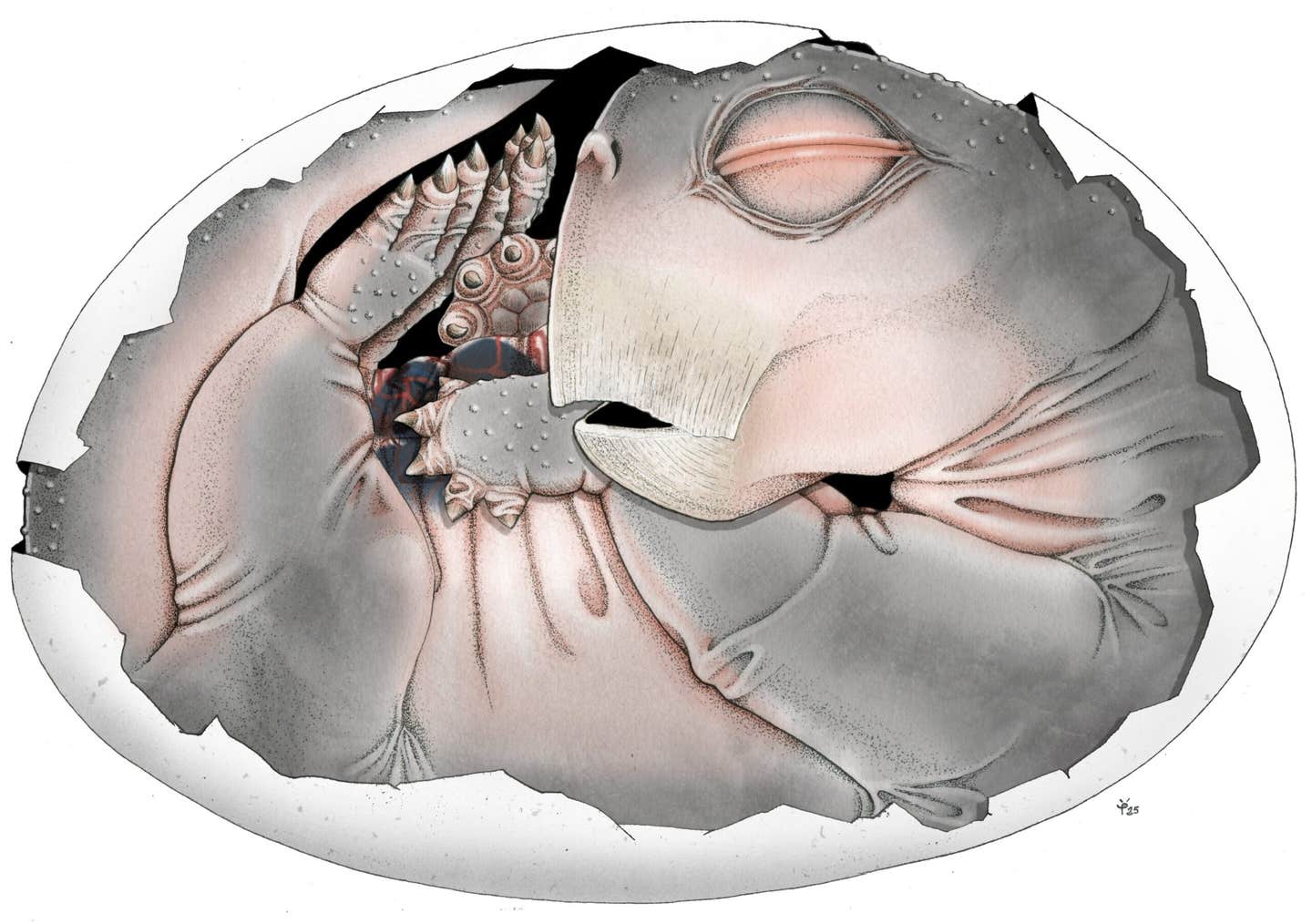
Live reconstruction by artist Sophie Vrard. Fossil evidence shows mammal ancestors like Lystrosaurus laid eggs and used reproduction to survive mass extinction. (CREDIT: Julien Benoit and Sophie Vrard)
The little skeleton was curled so tightly it looked as if it had never really entered the world.
For years, that mattered because paleontologists suspected they were looking at something unusual, a baby Lystrosaurus that may have died before hatching. But suspicion is not proof, and this question had lingered for decades, not just for this fossil, but for a much bigger mystery in evolution. Did the ancestors of mammals lay eggs?
A new analysis of a tiny Lystrosaurus specimen from South Africa now gives the clearest answer yet: yes, they did. The fossil, dating to roughly 250 million years ago, appears to preserve an embryo still inside its egg, making it the first known egg from a mammal ancestor.
That matters because Lystrosaurus was no obscure reptile-like relic. It was one of the great survivors of the end-Permian mass extinction, the catastrophe about 252 million years ago that wiped out vast numbers of species. In the brutal aftermath, with heat, drought, and ecological collapse reshaping life on land, Lystrosaurus did not merely persist. It flourished.
A fossil that had to wait for its answer
The specimen at the center of the study was found during a 2008 field excursion led by Professor Jennifer Botha from the Evolutionary Studies Institute, University of the Witwatersrand, South Africa. At first, it looked modest, just a small nodule with flecks of bone. As preparation continued, the shape of a tiny hatchling emerged.
“This fossil was discovered during a field excursion I led in 2008, nearly 17 years ago. My preparator and exceptional fossil finder, John Nyaphuli, identified a small nodule that at first revealed only tiny flecks of bone. As he carefully prepared the specimen, it became clear that it was a perfectly curled-up Lystrosaurus hatchling. I suspected even then that it had died within the egg, but at the time, we simply didn't have the technology to confirm it,” Botha said.
That technology finally arrived through advanced X-ray imaging and synchrotron scans, which let researchers inspect the specimen in striking detail without destroying it. Professor Julien Benoit and Dr. Vincent Fernandez used those scans to study the skull, jaw, limbs, pelvis, and the overall posture of the young animal.
The result was not based on one feature alone. It was a stack of clues. The skeleton lay in a curled position inside a space consistent with the size and shape of an egg. Parts of the body were weakly ossified. The pelvis and ribs were not robust enough to support the animal’s weight outside the egg. Most telling, the lower jaw had not fully fused.
“When I saw the incomplete mandibular symphysis, I was genuinely excited,” Benoit said.
The jaw that changed the story
That unfused jaw may sound like a narrow anatomical detail, but it became one of the strongest pieces of evidence in the case.
The lower jaw of Lystrosaurus consisted of two halves that needed to come together firmly for feeding. In this fossil, that process had not finished. According to the researchers, the animal would not have been able to feed itself in that state.
“The mandible, the lower jaw, is made up of two halves that must fuse before the animal can feed. The fact that this fusion had not yet occurred shows that the individual would have been incapable of feeding itself,” Benoit said.
That helped separate this specimen from two other very young Lystrosaurus fossils examined in the same study. Those other juveniles were still tiny, but their development was slightly further along. Their jaws had closed more fully, and one had features suggesting it had already moved around after hatching. The curled specimen appeared to represent an earlier stage, one still inside the egg.
For South African paleontology, the find also breaks a long dry spell. No fossil egg from a therapsid, the broader group that includes mammal ancestors, had been conclusively identified before.
“It is also thrilling because this discovery breaks entirely new ground. For over 150 years of South African paleontology, no fossil had ever been conclusively identified as a therapsid egg. This is the first time we can say, with confidence, that mammal ancestors like Lystrosaurus laid eggs, making it a true milestone in the field,” Botha said.
Big eggs in a hard world
The study goes beyond proving egg-laying. It also points to how Lystrosaurus may have managed to dominate one of Earth’s bleakest landscapes.
The researchers estimate that the egg was relatively large for the animal’s body size. In living egg-laying animals, larger eggs usually contain more yolk, enough to support more complete development before hatching. That often goes with young that are more independent from the start.
In other words, Lystrosaurus may have entered life ready to move, feed, and cope quickly.
That is an important distinction because the study argues Lystrosaurus probably did not produce milk for feeding its young. Modern monotremes, the egg-laying mammals alive today, lay relatively small eggs and make up for the limited yolk by feeding hatchlings with milk. Lystrosaurus seems to have followed a different path, one based on large, yolk-rich eggs and young that were likely precocial.
Large soft-shelled eggs may also have helped in another way. Bigger eggs are less vulnerable to drying out, and that would have mattered in the arid, unstable conditions after the end-Permian extinction. The world Lystrosaurus inherited was not generous. Food was limited, ecosystems were stripped down, and juvenile mortality was high.
So the winning strategy may have been brutally simple: grow fast, hatch ready, and reproduce early.
That fits what paleontologists already knew about the animal’s place in post-extinction ecosystems. Lystrosaurus was widespread, abundant, and remarkably successful while many other lineages faltered.
A clue to the deeper mammal story
The discovery also touches a bigger evolutionary question, one tied to the origins of milk itself.
For years, scientists have argued that early mammalian milk may have started not as food, but as a secretion that helped protect or moisten eggs. That idea only really works if early members of the synapsid line were laying eggs in the first place. This fossil gives direct support to that broader framework.
“This research is important because it provides the first direct evidence that mammal ancestors, such as Lystrosaurus, laid eggs, resolving a long-standing question about the origins of mammalian reproduction,” Benoit said.
The study also hints that not all mammal ancestors handled reproduction the same way. Compared with more mammal-like later relatives, Lystrosaurus seems to sit at an earlier point, before milk feeding became part of the package.
Practical implications of the research
This fossil does more than settle a debate about ancient reproduction. It gives scientists a clearer view of how survival can hinge on life history, not just teeth, claws, or size.
In the case of Lystrosaurus, large eggs, early development, and fast maturity may have helped the species endure a time of intense heat, drought, and ecological disruption. That deep-time example matters now because it offers a way to think about resilience under environmental stress.
By understanding which biological strategies worked during one of Earth’s worst crises, researchers may better frame how species respond when climates shift rapidly and ecosystems come under pressure.
Research findings are available online in the journal PLOS One.
The original story "250-million-year-old fossil proves that mammal ancestors laid eggs" is published in The Brighter Side of News.
Related Stories
- The odd ways mammals descend trees and what it means for primate evolution
- 500,000-year-old elephant bone tool reveals advanced planning and skill in early human ancestors
- 250-million-year-old mammal ancestor could hear sounds long before modern mammals evolved
Like these kind of feel good stories? Get The Brighter Side of News' newsletter.
Hannah Shavit-Weiner
Medical & Health Writer
Hannah Shavit-Weiner is a Los Angeles–based medical and health journalist for The Brighter Side of News, an online publication focused on uplifting, transformative stories from around the globe. Having published articles on AOL.com, MSN and Yahoo News, Hannah covers a broad spectrum of topics—from medical breakthroughs and health information to animal science. With a talent for making complex science clear and compelling, she connects readers to the advancements shaping a brighter, more hopeful future.