AI can detect hypertension and diabetes by looking at your face and eyes
Facial videos and routine eye scans could become powerful AI screening tools for hypertension, diabetes and dementia.

 Edited By: Joseph Shavit

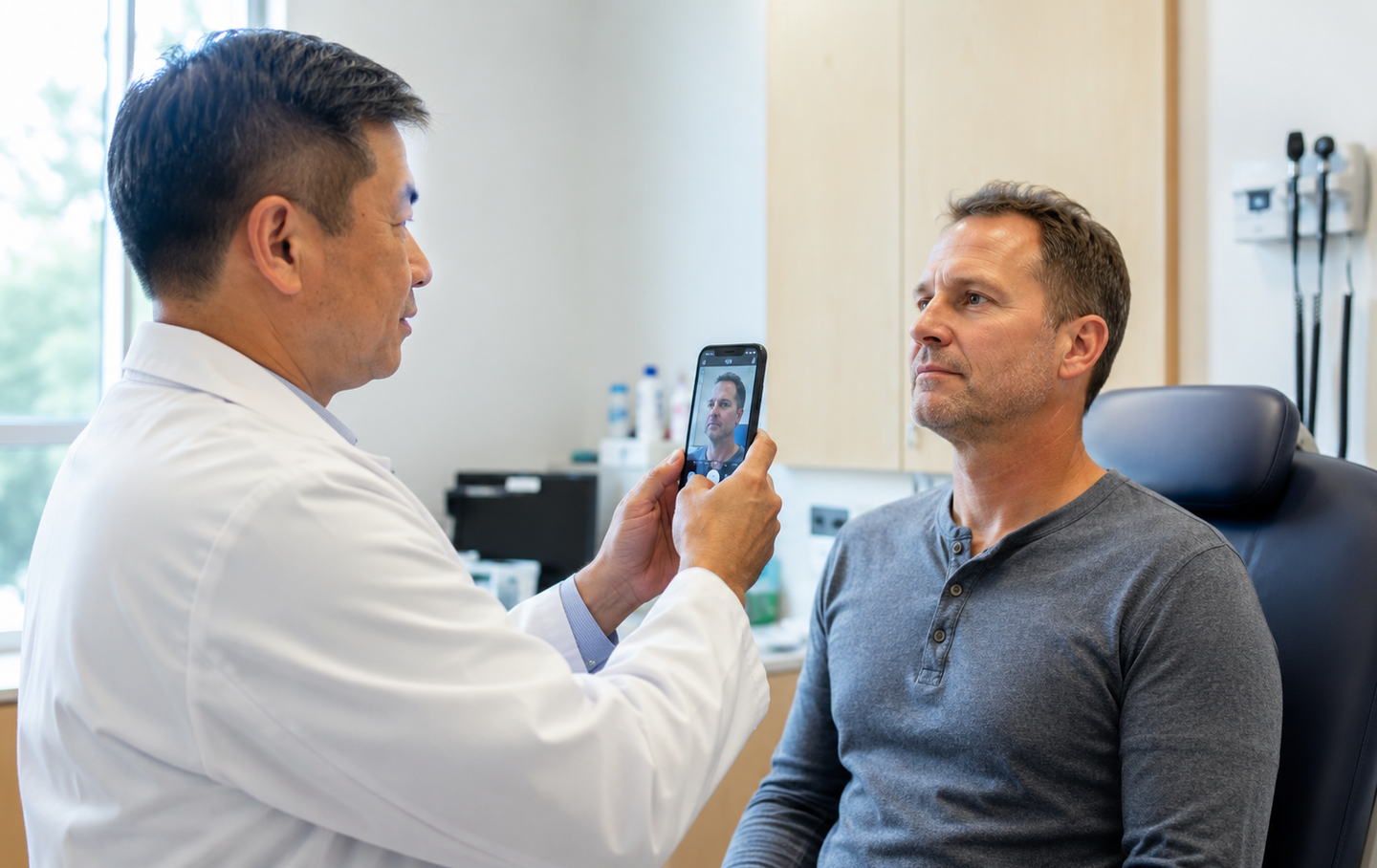
AI can detect hypertension and diabetes from facial videos while retinal scans may help identify people at risk of dementia. (CREDIT: Shutterstock)
- AI systems are being developed to detect hidden health risks from ordinary-looking images of the face, palms and eyes.
- A Japanese study detected hypertension and diabetes from facial videos as short as five seconds, while a Scottish project is training AI on nearly one million retinal scans to identify dementia risk.
- Both approaches could eventually move screening beyond hospitals and clinics, although researchers say larger and more diverse validation studies are still needed.
A five-second video of your face could someday help flag high blood pressure or diabetes. A routine eye exam could potentially reveal warning signs of dementia years before a traditional diagnosis.
Two research efforts are exploring how artificial intelligence can extract health information from images that clinicians already know contain clues about the body.
Researchers from Japan have developed an AI system that analyzes facial videos for signs of hypertension and diabetes. Meanwhile, researchers led by the University of Edinburgh are training algorithms on nearly one million retinal scans to estimate dementia risk.
The approaches target different diseases, but they share an underlying goal: finding serious conditions earlier without relying entirely on specialized tests or dedicated hospital visits.
Detecting disease from a five-second video
Researchers from the University of Tokyo and Institute of Science Tokyo investigated whether subtle changes visible in facial and palm videos could reveal cardiovascular and metabolic disease.
Their prospective, single-center study included 215 diagnosed patients and healthy volunteers. Each participant had a short, high-speed video recorded using a spectroscopic camera.
The system analyzed pulse-wave dynamics, skin blood-flow patterns and the spectral characteristics of skin color. Participants also received conventional testing for hypertension and diabetes.
The hypertension results will be presented at ESC Congress 2026.
Using 30-second videos of the face and palms, the algorithm detected hypertension with 95% accuracy. Sensitivity reached 89.2% for hypertension and 100% for normal blood pressure.
Even a five-second recording produced 90.3% accuracy.
For diabetes, the researchers focused on facial blood-flow patterns. The algorithm achieved 88.2% accuracy from a 30-second facial video and 81.2% from a five-second recording.
“We aimed to develop an AI algorithm that enables contactless screening in everyday environments to detect common conditions earlier and at scale,” presenter Ryoko Uchida said.
Trying to measure blood pressure without a cuff
The system could also estimate systolic blood pressure using only facial video.
Its mean absolute percentage error for systolic pressure was 8.6%. The average error was minus 2.6 millimeters of mercury, within the Association for the Advancement of Medical Instrumentation limit of plus or minus 5 mmHg.
However, variability remained too high.
The standard deviation of the error reached plus or minus 12 mmHg, exceeding the AAMI criterion of plus or minus 8 mmHg. The researchers plan to work with larger, multicenter datasets and improve the features used by the algorithm.
That limitation means the system is not yet a replacement for established blood pressure testing.
Still, a validated contactless system could broaden screening because hypertension and diabetes often remain undiagnosed.
An estimated 1.4 billion adults ages 30 to 79 have hypertension worldwide, while 589 million people live with diabetes.
“Our machine-learning algorithm accurately detected hypertension and diabetes from facial spectroscopic video recordings as short as 5 seconds,” Uchida said.
The eye may provide another route into the body
In Scotland, another AI project is looking much deeper than facial blood flow.
The NeurEYE research team, led by the University of Edinburgh in partnership with Glasgow Caledonian University, is developing software that could help optometrists identify people at elevated risk of dementia during ordinary eye examinations.
Researchers have collected close to one million retinal scans from optometrists across Scotland.
The images are linked anonymously with information including demographics, treatment histories and pre-existing conditions. The team is using artificial intelligence and machine learning to search for patterns associated with dementia risk.
The rationale comes from the close biological relationship between the retina and brain.
“The eye can tell us far more than we thought possible,” said Baljean Dhillon, professor of clinical ophthalmology at the University of Edinburgh and NeurEYE co-lead. “The blood vessels and neural pathways of retina and brain are intimately related.”
Unlike the brain, however, the retina can be viewed directly using equipment already available in optometry practices.
Bringing dementia screening into eye clinics
NeurEYE ultimately aims to develop a predictive tool that optometrists could use to assess risk for diseases including Alzheimer’s.
The software could also help optometrists decide when patients should be referred to other health services if signs associated with brain disease appear.
That could create an additional route for identifying people before symptoms become severe.
Miguel Bernabeu, professor of computational medicine at the University of Edinburgh’s Usher Institute and a NeurEYE co-lead, said representative datasets will be critical.
“In order to develop algorithms that are equitable and unbiased, we need to train them on datasets that are representative of the whole population at risk,” Bernabeu said.
The project is funded by NEURii, a collaboration involving Eisai, Gates Ventures and the University of Edinburgh. Permission to use the health data came from NHS Scotland’s Public Benefit and Privacy Panel for Health and Social Care.
Screening without waiting for symptoms
Both projects reflect a shift in how AI could enter everyday health care.
Instead of waiting for symptoms to send someone to a specialist, researchers are testing whether algorithms can identify subtle warning signals during routine activities such as looking into a camera or having an eye exam.
The Japanese facial-video system still requires broader validation across more diverse groups, particularly because its blood pressure estimates showed more variability than accepted standards allow.
NeurEYE is also still being developed as a predictive diagnostic system rather than a finished clinical test.
But both approaches point toward a similar possibility: familiar images may contain far more medical information than people can see with the naked eye.
If researchers can reliably extract that information, some of the first warnings of cardiovascular, metabolic or neurological disease may eventually appear long before a patient reaches a specialist’s office.
Dig deeper into AI screening, retinal imaging and contactless health monitoring
These studies and reviews examine how AI is being used to extract cardiovascular, neurological and metabolic information from facial videos and retinal images, while also highlighting the validation challenges that remain.
Artificial intelligence–based retinal imaging for brain health assessment: a scoping review: This 2026 review evaluates 60 studies using AI and retinal imaging to assess neurological and cerebrovascular health. It highlights the technology’s screening potential while emphasizing the need for external validation, representative datasets, transparency and real-world clinical testing. (The Lancet Digital Health, 2026)
Artificial intelligence in retinal imaging for early Alzheimer's disease detection: A review: This review examines 63 studies of AI-based retinal imaging for Alzheimer’s detection, including fundus photography, OCT and OCT angiography. It identifies demographic representation, dataset heterogeneity and model interpretability as major barriers to widespread clinical use. (Journal of Alzheimer’s Disease, 2026)
AI-driven multimodal retinal imaging for early detection and risk stratification of vascular and neurodegenerative diseases: This review examines how retinal images combined with AI may help identify vascular and neurodegenerative diseases, including hypertension, stroke risk, Alzheimer’s disease and Parkinson’s disease. It also explores how these systems could eventually integrate with other medical data. (Graefe's Archive for Clinical and Experimental Ophthalmology, 2026)
Early detection of dementia through retinal imaging and trustworthy AI: Researchers developed an AI system using 5,751 retinal OCT angiography images from 1,671 participants. The model showed strong performance in detecting early-onset Alzheimer’s disease and mild cognitive impairment, supporting retinal imaging as a potential noninvasive screening approach. (npj Digital Medicine, 2024)
Estimating blood pressure using video-based PPG and deep learning: This study developed a pipeline that extracts remote photoplethysmography signals from facial videos and uses deep learning to estimate systolic and diastolic blood pressure. It provides broader evidence for the potential of camera-based cardiovascular monitoring without direct physical contact. (Image and Vision Computing, 2025)
The original story "AI can detect hypertension and diabetes by looking at your face and eyes" is published in The Brighter Side of News.
Related Stories
- Breakthrough AI-tool predicts risk of dementia from retinal eye scans
- Groundbreaking eye scanner detects Diabetes, Heart Disease, Alzheimer's
- Eye scans revolutionize the early detection and monitoring of kidney disease, study finds
Like these kind of feel good stories? Get The Brighter Side of News' newsletter.
Shy Cohen
Writer