MIT’s new ‘bifur-circuits’ let smart devices change shape without losing power
New 3D-printed metamaterial blocks can reshape themselves while staying electrically connected and recognizing each configuration.

 Edited By: Joshua Shavit

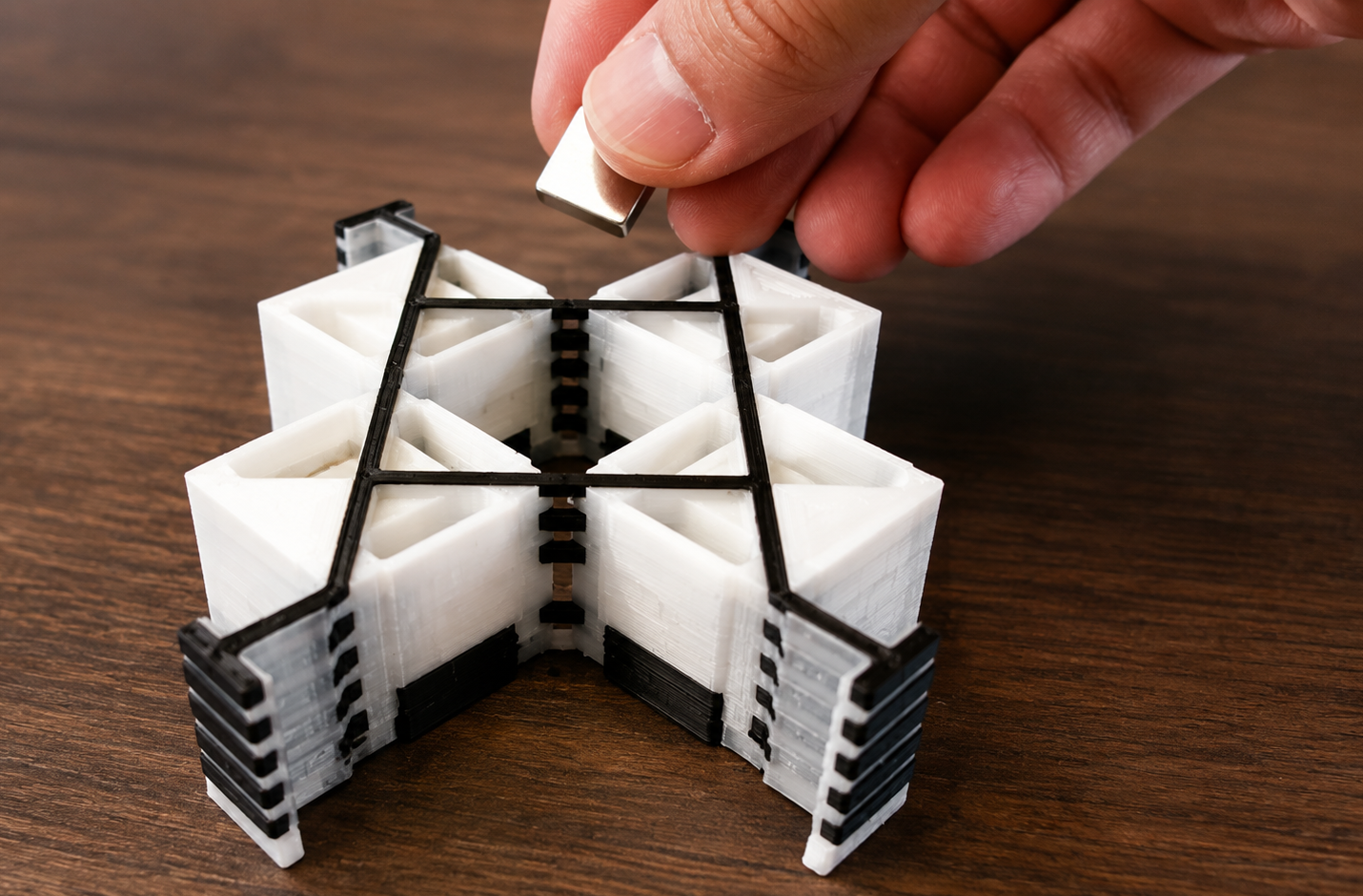
MIT’s 3D-printed bifur-circuits let smart structures change shape while preserving electrical connections and sensing their form. (CREDIT: Marwa AlAlawi et al, HCI Engineering)
- MIT researchers developed 3D-printed building blocks that can change into many shapes while maintaining electrical connections throughout the structure.
- Called “bifur-circuits,” the modular metamaterials can recognize their own configuration, allowing furniture, controllers and other devices to respond when their shape changes.
- Tests showed the conductive connections survived more than 10,000 compression cycles, although larger assemblies currently take longer to identify their complete shape.
A chair can become a table, collapse flat for storage and still recognize which form it has taken. The same basic building blocks could create a controller that launches different games depending on its shape.
Behind both devices is a new type of 3D-printed mechanical metamaterial that combines physical reconfiguration with electrical connectivity.
MIT researchers call the system “bifur-circuits.” Unlike many modular structures, its electrical connections remain intact as components rotate, compress, stretch or bend into different configurations. The structure can also detect those configurations without requiring external wires between its building blocks.
The work, led by mechanical engineering graduate student Marwa AlAlawi, will be presented at the ACM Symposium on User Interface Software and Technology. Researchers from MIT, the University of Tokyo and the University of Michigan contributed.
“Metamaterials can make complex mechanical assemblies easy to manufacture just by using repeating units. Our work expands on this design space. If we think of mechanical metamaterials as building blocks, then our work is one way to take advantage of their geometry to embed intrinsic intelligence into hardware, which could open many possibilities,” AlAlawi said.
Building more possibilities into metamaterials
Mechanical metamaterials are structures whose behavior comes largely from the geometry of repeating units. Changing those units can make a structure bend, twist or deform in carefully controlled ways.
The MIT team focused on auxetic metamaterials. Unlike ordinary materials that become narrower when stretched, auxetic structures can become wider.
In earlier work, the researchers used auxetic metamaterials to create reconfigurable antennas. Those antennas could adopt three shapes, allowing their frequency range to change as their geometry changed.
But three states presented a clear limitation.
Bifur-circuits expand that range by combining modular construction with a phenomenon called mechanical bifurcation. A bifurcation occurs when a structure suddenly changes its behavior after reaching a critical threshold.
A plastic ruler offers a simple example. Bend it gradually and it resists the force until reaching a point where it abruptly buckles.
With bifur-circuits, connected blocks can rotate around pivot points and settle into new configurations. Adding units increases the number of possible configurations exponentially.
“Bifurcation allow us to significantly expand on this reconfigurability space. Just adding one extra unit gives us so many more combinations out of the same structure,” AlAlawi said.
A structure that knows its own shape
Creating more shapes was only part of the challenge. The researchers also wanted the objects to recognize how they were configured.
Each metamaterial unit contains conductive material along sections that touch when the unit enters particular states. Bringing those surfaces together activates a unique electrical circuit.
The information can then move through the connected assembly, allowing the system to map the state of its individual units and determine its overall shape.
This integration addresses a limitation of many modular systems. Mechanical components may be rearrangeable, while electrical parts require separate wiring or reassembly.
Bifur-circuits combine both functions.
The building blocks and connectors contain conductive paths inside nonconductive structural material. Their joints provide electrical contact while still allowing physical movement.
One major challenge was finding a conductive material flexible enough to survive repeated bending without making electrical transmission impractical.
“The conductive material was a constraint we had to work around in the design process, and it dictated how the sensing between blocks would happen,” AlAlawi said.
Electrical connections survive 10,000 cycles
The team put that design through repeated mechanical testing.
Researchers compressed metamaterial samples 10,000 times in different orientations while periodically measuring electrical resistance. The structures maintained mechanical and electrical connectivity throughout the tests.
Shape recognition became slower as assemblies grew.
In a test involving 20 connected units, identifying the complete topology took about five seconds. Detection time increased linearly with the number of connections, reflecting both the communication method and electrical resistance in the 3D-printed conductive material.
That conductive material also creates another limitation. Its resistance prevents reliable power delivery throughout large assemblies.
For now, each connector carries its own rechargeable lithium-polymer battery. The researchers report about 45 minutes of operation during continuous sensing. They suggest future flexible conductors could eventually allow one block to power an entire structure.
From a chair to a game controller
To demonstrate the system at human scale, the researchers built reconfigurable furniture from 24 metamaterial units and 24 connector blocks.
Fully expanded, the structure becomes a tea table. Retracted into another configuration, it forms a chair with storage underneath. Remove and rotate the corner connectors, and the furniture collapses into a flat form that can be stored.
The structure recognizes these changes and updates an electronic display to match its current use.
A second demonstration turned the technology into a reconfigurable game controller. One configuration acts as a steering-wheel grip and launches a racing game. Another becomes a sponge-like block for a car-washing interaction. Compressing it like a pump controls a tire-inflation activity.
The team also created a Fusion 360-based design tool and shape-recognition software. A multimaterial 3D printer can fabricate the conductive and nonconductive portions of the structures.
Reconfigurable robots and assistive devices could follow
The researchers see possibilities beyond furniture and controllers.
Bifur-circuits could form adaptable rehabilitation devices, reconfigurable robotic grippers or shelters that change configuration after natural disasters. Related metamaterial designs could also support antennas that alter their shapes to adjust operating frequencies.
Several hurdles remain. Bending is recognized by the software but is not yet visually simulated. Larger structures take longer to map, and the conductive material limits power distribution.
Future versions could add capacitive touch sensors, accelerometers or inertial measurement units. The researchers also want to investigate triangular, hexagonal, rectangular and curved components.
For AlAlawi, the larger goal is to push mechanical structures beyond simply changing shape.
“Bifur-circuits are one step toward developing mechanical building blocks with integrated intelligence. It would be interesting to build on this work and come up with building blocks that allow us to create a structure with any form or shape we want, and which are structurally stable and can be actuated,” she said.
Dig deeper into shape-changing metamaterials and smart devices
These resources explore recent advances in programmable metamaterials, shape-changing interfaces and structures that combine geometry with sensing, computation or reconfigurable mechanical behavior.
Metamaterials that learn to change shape: Researchers developed mechanical metamaterials that can be trained to perform multiple shape changes, including multistable configurations used for reflex-like gripping and locomotion. The work shows how mechanical structures themselves can acquire increasingly complex functions. (Nature Physics, 2026)
Reprogrammable metamaterial robot with embodied versatile computation and mechanical intelligence: This research demonstrates a metamaterial robot whose mechanical structure can be reprogrammed for different computing and robotic behaviors. It illustrates a broader movement toward embedding information processing and physical intelligence directly into engineered structures. (Nature Communications, 2026)
Mechanical Metamaterial With Shape-Encoded Reprogrammable Properties: The authors created a system that can be reconfigured into many distinct shapes, with each geometry linked to different mechanical behavior. Demonstrations included adaptable energy absorption, mechanical memory and refreshable Braille displays. (Advanced Functional Materials, 2026)
Shape-morphing metamaterials: This review examines the major mechanisms and design principles behind materials that alter their geometry, including approaches relevant to robotics, medical technology and wearable systems. It provides a broad scientific framework for understanding how geometry can program material behavior. (Nature Reviews Materials, 2025)
Sparsely actuated modular metamaterials for shape changing interfaces: This work uses 3D-printed mechanical metamaterials with adjustable flexibility and localized actuators to create customizable shape-changing interfaces. A design and simulation toolkit lets users modify structures and test their movements before fabrication. (Proceedings of the ACM International Conference on Tangible, Embedded, and Embodied Interaction, 2025)
Research findings are available online in the journal HCI Engineering.
The original story "MIT’s new ‘bifur-circuits’ let smart devices change shape without losing power" is published in The Brighter Side of News.
Related Stories
- Reprogrammable artificial muscle can change its shape, recover from damage, and even be reused
- Scientists create 4D bioprinted tissue that changes shape just like real tissues do
- Life-changing robotic glove restores hand function for paralysis patients
Like these kind of feel good stories? Get The Brighter Side of News' newsletter.
Shy Cohen
Writer