Antarctica’s ice shelves face a growing threat from warm waters below
A long-term ocean study finds warm deep water edging toward Antarctica, where it can melt vulnerable ice shelves from below.

 Edited By: Joseph Shavit

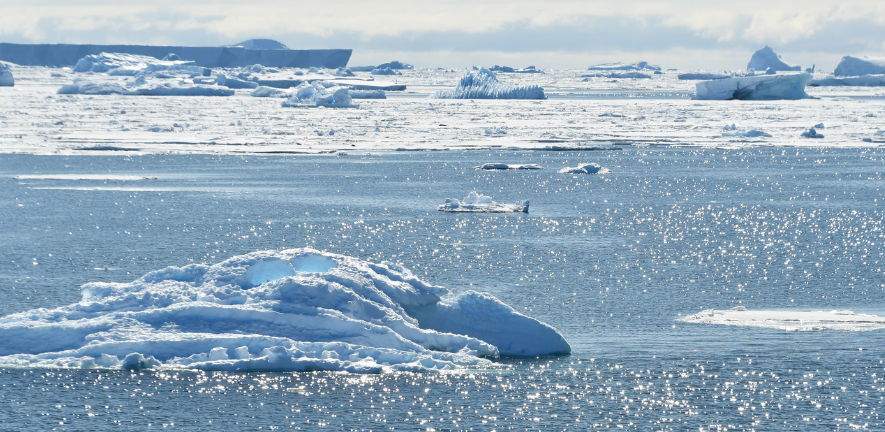
Ice shelves in Bellinghausen Sea, Antarctica, taken onboard the R/V Falkor (too) in 2025. (CREDIT: Laura Cimoli, University of Cambridge)
For years, climate models warned that warm deep water around Antarctica could edge closer to the continent’s icy fringe. Now the ocean itself appears to be confirming it.
A decades-long analysis of ship records and robotic float data found that a mass of relatively warm water called circumpolar deep water has expanded and shifted toward Antarctica’s continental shelf over the past 20 years. That matters because this water can slip beneath floating ice shelves and melt them from below.
“It’s concerning, because this warm water can flow beneath Antarctic ice shelves, melting them from below and destabilizing them,” said Joshua Lanham, lead author of the study at Cambridge Earth Sciences.
Ice shelves already sit in a precarious role. They act like braces along the edge of the continent, helping hold back inland glaciers and ice sheets. Those ice reserves together contain enough freshwater to raise global sea level by about 58 metres.
The new work, led by the University of Cambridge with collaborators from UCLA and UCSD, draws on long-running ocean observations to show this change across the Southern Ocean, the vast ring of water that surrounds Antarctica.
A clearer picture from ships and floats
Scientists had hints before, but not enough evidence to track the shift directly. Ship-based measurements offered detailed slices of the Southern Ocean, including temperature, salinity, and nutrients from top to bottom. However, those transects were often repeated only about once a decade.
That left long gaps.
To get around that problem, the researchers combined ship observations with data from Argo floats, autonomous instruments that drift through the upper ocean and provide ongoing measurements. The float network does not go back as far as the ship record. But it fills in the missing months and years that older surveys could not capture on their own.
Using machine learning, the team merged those two streams into monthly snapshots spanning the last four decades. That let them detect a broad shift in where ocean heat is sitting.
“It’s the first time that scientists have observed the shift in deep-ocean heat throughout the Southern Ocean,” Lanham said. “It’s something that had been predicted by climate models due to global warming, but we hadn’t seen it in data.”
The study found that the change is strongest in the upper 2000 metres of the ocean. Near Antarctica, the warm-water layer thickened. Farther north, it thinned. Taken together, the pattern points to a poleward movement of the warm water mass.
The cold barrier is weakening
One reason this shift matters so much is that Antarctica’s ice shelves were not always as exposed.
“In the past, the ice sheets were protected by a bath of cold water, preventing them from melting. Now it looks like the ocean’s circulation has changed, and it’s almost like someone turned on the hot tap and now the bath is getting warmer!” said Prof. Sarah Purkey, one of the senior authors of the study from Scripps Institution of Oceanography.
That “cold bath” was linked to dense, very cold water forming near Antarctica and sinking into the deep ocean. This dense water, including dense shelf water and Antarctic Bottom Water, helped create a barrier that limited how easily warmer circumpolar deep water could reach the ice.
The new study suggests that barrier is shrinking in some places.
In the Weddell Sea and parts of East Antarctica, the expansion of circumpolar deep water near the continent was matched by a contraction in Antarctic Bottom Water and dense shelf water. In West Antarctica, where those colder waters are much less prominent in the upper 2000 metres, the expanding warm layer was instead paired with a reduction in Antarctic Intermediate Water.
The researchers also found that north of the Antarctic Circumpolar Current, the warm deep water shrank while Subantarctic Mode Water expanded.
That may sound technical, but the broader point is simple: as warm water moves south, neighboring water masses shift around it.
A signal large enough to measure
The study did more than identify the pattern. It also measured its pace.
Using the Argo-based record, the researchers estimated a circumpolar mean poleward migration of the warm-water boundary of 1.26 kilometres per year, with a 95 percent confidence interval of 0.53 to 1.98 kilometres per year. The movement was strongest in the Weddell Sea at 2.39 kilometres per year. It was intermediate in East Antarctica at 1.31 kilometres per year, and weaker in West Antarctica at 0.80 kilometres per year.
Within the 60 to 65 degrees south latitude band, the ocean heat content within the circumpolar deep water layer increased at a rate of 2.81 terawatts, with a 95 percent confidence interval of 2.0 to 3.6 terawatts.
The researchers say that warming along the Antarctic margin fits what models have suggested for years. Climate simulations have indicated that warming air and added freshwater from melting ice would reduce the formation of the cold, dense water that normally forms near Antarctica. As that dense water retreats, warmer deep water can move in.
“We can now see this scenario is already emerging in the observations,” said Lanham. “This isn’t just a possible future scenario suggested by models; it’s something that is happening now, bringing wider implications for how carbon, nutrients and heat are cycled through the global ocean.”
One striking result from the analysis was that this poleward shift emerged as the leading mode of non-seasonal variability in the warm-water layer over the last two decades.
What may be driving it
The study does not pin the shift on a single cause.
The authors say one possible driver is the observed contraction of Antarctic Bottom Water and dense shelf water, which would remove part of the cold barrier near the continent. Another is changing wind patterns over the Southern Ocean. The westerly winds have strengthened in recent decades. Climate models project they may keep shifting poleward under continued warming. Either process, or both together, could help push warm deep water closer to Antarctica.
The researchers were careful to note limits in their analysis. They assumed that certain biogeochemical end members stayed unchanged during the Argo period, and they acknowledged that selecting those end members has an unavoidable subjective element. They also noted uncertainty in how best to represent source waters through time.
Still, they say the main finding held up across sensitivity tests, including tests involving stronger warming of Antarctic Bottom Water and different model setups.
Practical implications of the research
The immediate concern is ice.
Circumpolar deep water is the main source of ocean heat near the Antarctic shelf, so a southward shift puts more of that heat in position to reach ice shelves from below. If those shelves thin or weaken, the glaciers behind them can flow more easily into the ocean. This adds to sea level rise.
But the consequences do not stop at Antarctica’s edge. The Southern Ocean helps regulate how the planet stores heat and carbon. It also plays a central role in the global overturning circulation, the deep system of currents that helps move water, nutrients, and dissolved gases around the world.
“The Southern Ocean plays a key role in regulating global heat and carbon storage, so changes in heat distribution here have wider implications for the global climate system,” said Prof. Ali Mashayek, one of the senior authors of the study from Cambridge Earth Sciences.
Research findings are available online in the journal Communications Earth & Environment.
The original story "Antarctica’s ice shelves face a growing threat from warm waters below" is published in The Brighter Side of News.
Related Stories
- Melting Antarctic ice could cripple a deep ocean climate engine
- Ocean storms under Antarctic ice found to rapidly boost melting
- Three million years of climate history, captured in Antarctic ice
Like these kind of feel good stories? Get The Brighter Side of News' newsletter.
Rebecca Shavit
Writer
Based in Los Angeles, Rebecca Shavit is a dedicated science and technology journalist who writes for The Brighter Side of News, an online publication committed to highlighting positive and transformative stories from around the world. Having published articles on MSN, AOL News, and Yahoo News, Rebecca's reporting spans a wide range of topics, from cutting-edge medical breakthroughs to historical discoveries and innovations. With a keen ability to translate complex concepts into engaging and accessible stories, she makes science and innovation relatable to a broad audience.