Ancient squirrel droppings reveal 700,000 years of lost ecosystems
Scientists uncover 700,000 years of ecosystems using ancient DNA from frozen squirrel droppings in Yukon permafrost.

 Edited By: Joseph Shavit

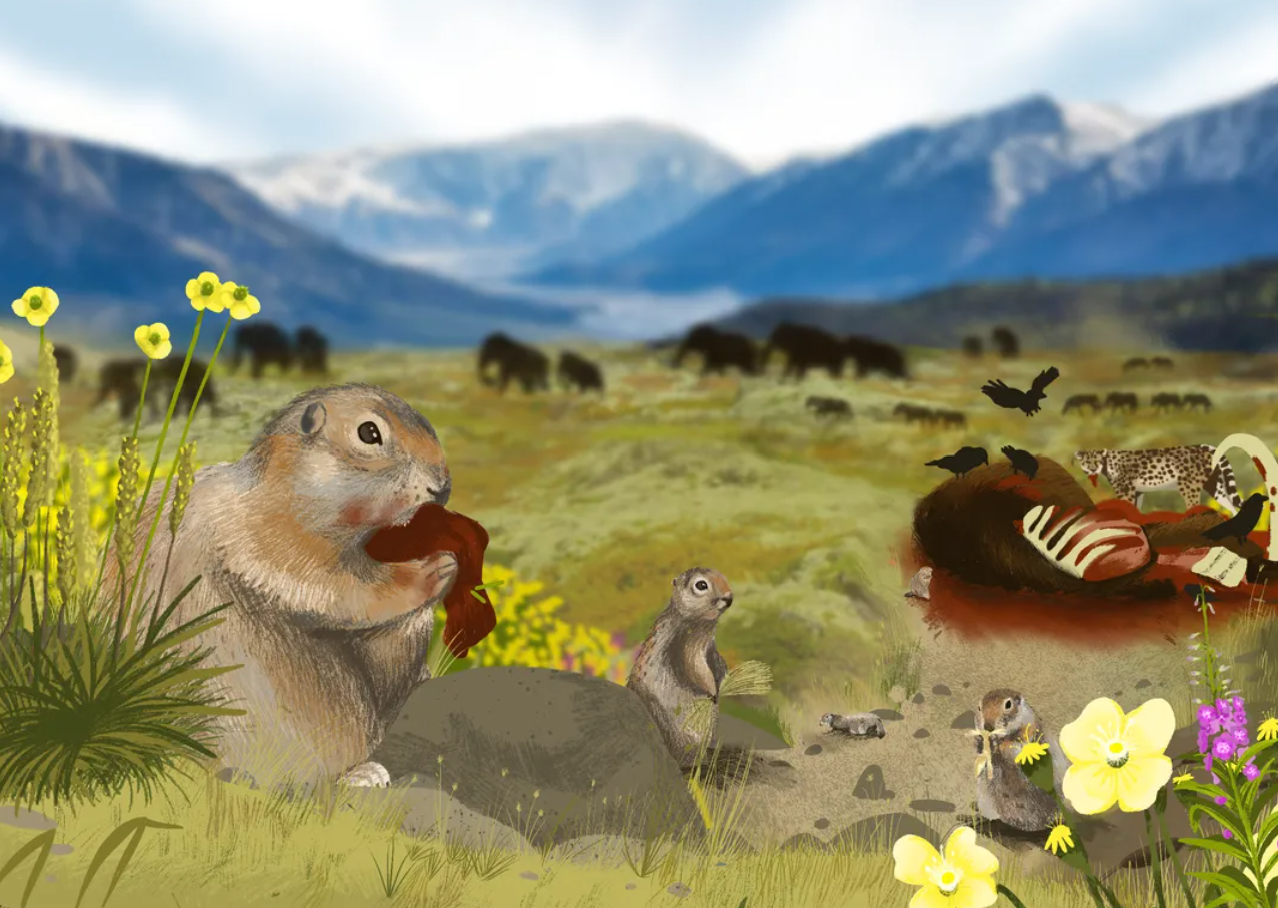
Artistic reconstruction. Fossilized squirrel droppings reveal ancient ecosystems, offering rare genetic insights into life during the Ice Age. (CREDIT: Mecerdes Minck, Hakai Institute)
Frozen deep beneath the Yukon’s permafrost, small pellets left behind by ancient ground squirrels have preserved a record of life that stretches back hundreds of thousands of years. What appears unremarkable at first glance has now become one of the richest sources of ancient DNA ever studied.
In new research, scientists report that these fossilized droppings contain genetic material from entire ecosystems. The findings offer a rare window into a world that no longer exists, capturing plants, animals, and microbes from as far back as 700,000 years ago.
The work was led by researchers from McMaster University, the Hakai Institute, and the University of Alberta. Together, they analyzed samples taken from long-sealed burrows in the Yukon, where frozen conditions preserved the material in remarkable detail.
A Time Capsule Frozen In Ice
The Arctic ground squirrel, known scientifically as Urocitellus parryii, plays a central role in this discovery. These animals dig burrows into the soil and hibernate for months at a time. During this period, they store food, gather materials, and leave behind waste.
Over thousands of years, these burrows remained frozen and undisturbed. The result is a natural archive of biological material, sealed away from decay.
“The research shows us that ground squirrel coprolites, or droppings, preserve remarkably diverse genetic snapshots of ancient Beringia,” said Hendrik Poinar of McMaster University.
Each pellet acts like a snapshot in time. It contains traces of what the squirrel ate, what lived nearby, and what the environment looked like at that moment.
Reconstructing A Vanished World
The research team examined samples dating from about 30,000 years ago to nearly 700,000 years ago. These time periods span multiple ice ages and warmer intervals.
Using advanced DNA sequencing, the scientists identified more than 200 types of plants, along with insects, microbes, and large animals. The samples also yielded more than 18 mitochondrial genomes from species including ground squirrels, horses, and steppe bison.
Among the most striking discoveries was the presence of DNA from woolly mammoths and ancient predators such as wolves and large cats. These findings help confirm the existence of a once-thriving ecosystem known as the mammoth steppe.
This ancient landscape was dominated by grasses and flowering plants. It supported a wide range of large animals that have since disappeared.
Unexpected Diversity In Ancient Species
The study revealed surprising genetic diversity among ground squirrels themselves. One lineage, dating back about 700,000 years, no longer exists in the Yukon today.
Instead, its closest relatives now live in western Siberia. This suggests that populations shifted over time as climates changed and habitats moved.
Until now, scientists believed that ancient squirrels in the region belonged to the same species seen today. The new findings challenge that assumption and point to a more complex evolutionary history.
“Climate changes and species move, hence the importance to know how animals and plants responded to drastic climatic shifts in the past,” researchers noted.
How Diet Preserved An Entire Ecosystem
Ground squirrels act as natural collectors of environmental material. They gather seeds, plants, and small animal remains and bring them back to their burrows.
“So they’ll go into the landscape, and they’ll collect a whole bunch of different bits of plant material and bones, seeds, and they’ll bring it back to their burrow,” said Tyler Murchie of the Hakai Institute.
Their varied diet adds another layer of information. The droppings contain DNA from many sources, including plants, insects, and even meat.
Modern observations show that these animals are opportunistic feeders. They consume a wide range of food, including fungi and small animals. This behavior helps explain why their droppings contain such diverse genetic material.
DNA That Outlasts Time
One of the most surprising findings is how well the DNA survived. The coprolites preserved genetic material better than many bones or surrounding soil samples.
The cold, stable conditions of permafrost slow down decay. Over time, this creates an ideal environment for preserving fragile DNA.
Researchers also developed specialized methods to extract and analyze the material. Ancient DNA is often damaged and fragmented, making it difficult to study.
By refining their techniques, the team was able to recover high-quality genetic information from samples that are hundreds of thousands of years old.
Tracing Climate Change Through Genetics
The study offers more than a snapshot of ancient life. It also provides clues about how ecosystems responded to major climate shifts.
Over time, the region changed from open grasslands to forests dominated by trees such as spruce and birch. These changes are reflected in the DNA preserved within the droppings.
By comparing samples from different periods, scientists can track how species adapted, moved, or disappeared.
“It helps reconstruct paleoenvironments in much deeper time, providing insights into environmental change, megafaunal evolution, dispersal and ultimately extinction,” Poinar said.
A Tool For Understanding The Future
The findings highlight the growing importance of ancient DNA research. By studying how ecosystems responded to past climate changes, scientists hope to better understand what may happen in the future.
“We can look at genes under selection due to climate change in the past and that may help us think about how animals today may, or may not, adapt to our current warming climate,” Poinar added.
The research also underscores the value of Arctic regions as natural archives. The cold conditions preserve biological material in ways that are rarely possible elsewhere.
Looking Ahead
This study represents only a first step. Researchers believe that many more burrows remain to be explored across the Yukon and beyond.
Each new sample could reveal additional details about ancient ecosystems. Together, they may help build a more complete picture of life during the Ice Age.
The work was conducted with permission from the Tr’ondëk Hwëch’in First Nation, whose traditional lands include the study area. Continued collaboration will be essential for future research.
In the end, these small pellets offer a powerful reminder. Even the most ordinary traces of life can hold extraordinary stories about the past.
Practical Implications of the Research
This research has important implications for both science and society. By providing detailed genetic records of ancient ecosystems, it helps scientists understand how species responded to dramatic climate shifts over long periods. This knowledge can improve models that predict how modern ecosystems may change as global temperatures rise.
The findings also offer insights into extinction patterns. Understanding why certain species disappeared while others survived may help guide conservation efforts today. Scientists can use this information to identify species that are more vulnerable to environmental change.
In addition, the study advances methods for recovering and analyzing ancient DNA. These techniques can be applied to other environments, expanding the scope of paleogenomics research. This could lead to new discoveries about human history, biodiversity, and evolution.
Finally, the research highlights the importance of preserving Arctic environments. As permafrost thaws due to climate change, valuable biological records may be lost. Protecting these regions ensures that future generations can continue to study Earth’s deep history.
Research findings are available online in the journal Nature Communications.
The original story "Ancient squirrel droppings reveal 700,000 years of lost ecosystems" is published in The Brighter Side of News.
Related Stories
- Researchers discover prehistoric giant flying squirrel
- Oldest preserved Arctic ecosystem discovered in Norwegian cave
- Ocean sediment reveals climate extremes and ecosystem upheaval from millions of years ago
Like these kind of feel good stories? Get The Brighter Side of News' newsletter.
Hannah Shavit-Weiner
Medical & Health Writer
Hannah Shavit-Weiner is a Los Angeles–based medical and health journalist for The Brighter Side of News, an online publication focused on uplifting, transformative stories from around the globe. Having published articles on AOL.com, MSN and Yahoo News, Hannah covers a broad spectrum of topics—from medical breakthroughs and health information to animal science. With a talent for making complex science clear and compelling, she connects readers to the advancements shaping a brighter, more hopeful future.