Astronomers discover three distinct groups of merging black holes
Gravitational-wave data suggests black hole mergers fall into three distinct cosmic groups.

 Edited By: Joseph Shavit

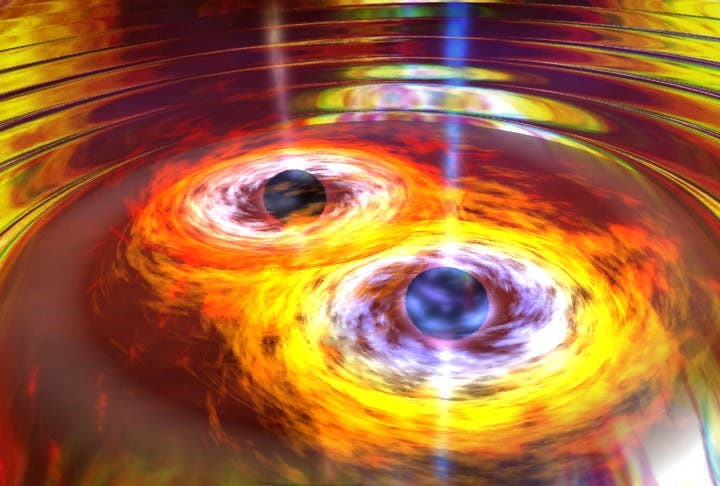
Astronomers find three distinct groups of merging black holes hidden in gravitational-wave data. (CREDIT: NASA)
Black hole collisions do not appear to come from one simple cosmic recipe.
After studying more than 150 mergers detected through gravitational waves, astronomers say the growing catalog points instead to three distinct groups of merging black holes. Each group seems to carry its own signature in mass, spin, and how often the mergers happened across cosmic time. Taken together, the pattern suggests that these violent collisions are being built in more than one kind of environment.
The new work comes from Anarya Ray of Northwestern University and the NSF-Simons AI Institute for the Sky, Shirsha Mukherjee of the University of Oklahoma, Michael Zevin of the Adler Planetarium, Northwestern University and the NSF-Simons AI Institute for the Sky, and Vicky Kalogera of Northwestern and the NSF-Simons AI Institute for the Sky.
Their analysis focuses on the fourth gravitational-wave transient catalog from the LIGO-Virgo-KAGRA Collaboration, known as GWTC-4. That catalog includes more than 150 detected black hole mergers, enough for researchers to stop treating these events as a single blended population and start asking whether different families are hiding inside the data.
Not one family, but three
One clue came from the masses.
When the researchers looked across the full sample, they did not see a smooth spread. Instead, they found a strong concentration around 10 solar masses and another feature near 35 solar masses. Similar transitions also appeared in spin behavior and in the balance between the two black holes in a pair.
That matters because a single formation pathway would be expected to produce a smoother overall distribution. The jagged structure in the data hinted that several mechanisms may be feeding the merger population at once.
To test that idea, the team used mixture models, a statistical approach that lets several underlying groups combine into one observed population. Their best fit pointed to three subpopulations.
The first is by far the largest. It makes up about 79% of the overall sample and clusters around lower masses, with a peak near 10 solar masses. These systems tend to spin slowly, with very little wobble, and their spins are generally aligned with the orbit.
That pattern fits best with isolated binary evolution. In that scenario, two stars are born together, live together, exchange mass, and both eventually collapse into black holes that remain paired until they merge.
The middleweight group
The second group accounts for nearly 14.5% of detected binaries and helps explain the feature around 35 solar masses.
These black holes tend to have more equal masses than the systems in the third group, and their spins look more chaotic than those in the first. The team found equal fractions of aligned and misaligned spins, along with stronger signs of wobbling.
That points away from the quiet life of a stellar pair and toward rougher surroundings.
The researchers say this middle group likely formed through dynamical processes in crowded environments such as globular clusters, where close interactions between many objects can shuffle black holes into new pairings. Triple systems could also contribute, since a distant third object can disturb an inner pair and reshape its orbit and spin behavior.
This group sits in an interesting middle ground. It is not as orderly as the low-mass binaries that likely formed together from birth. It is also not as extreme as the heaviest systems, which seem to carry signs of an even stranger history.
The heaviest mergers may have ancestors
The third subpopulation is small, only about 2.5% of the total, but it stands out.
These are the high-mass systems, and they often involve black holes of unequal mass. Their spin behavior is more complex, with noticeable wobbling. The team argues that this group is most consistent with hierarchical mergers, where at least one black hole is itself the remnant of an earlier merger.
In other words, some black holes may be colliding, surviving as a larger remnant, and then merging again.
That kind of genealogy has been discussed before, but the new work strengthens the case that it is showing up as a distinct component in the observed population. The researchers also note that hierarchical mergers can more easily push black holes into very high masses, making them a natural explanation for the upper end of the distribution.
One of the broader results is that the relative contributions of these channels appear to change across cosmic time. The paper says the fractions evolve with more than 99% confidence, suggesting that the universe did not produce merging black holes in the same way at every epoch.
A strong pattern, not a final verdict
The authors are careful not to oversell the claim.
Their paper states, “While these conclusions are reasonably robust, the direct association of subpopulations with single channels remains elusive.”
That caution runs throughout the study. The team says the astrophysical interpretation is still limited by theoretical uncertainties in binary stellar evolution, black hole formation through stellar collapse, and the properties of the environments where mergers happen.
There are also specific channels that muddy the picture. The authors note that active galactic nucleus disks, for example, may be capable of producing features consistent with all three subpopulations, depending on how the disk physics is modeled. For the second group in particular, the current data cannot cleanly separate mergers assembled in dense star clusters from those influenced by triple-system dynamics.
So the three-population picture looks persuasive, but the identities of the factories making those black holes are not fully locked down yet.
That may change soon. The team points to upcoming LIGO-Virgo-KAGRA data releases as the next chance to sharpen the picture. More detections should help reveal whether these groups remain stable, split further, or start to favor one physical explanation over another.
Practical implications of the research
This research gives astronomers a more organized way to think about black hole mergers. Instead of treating all of them as variations on one theme, they can now test whether different cosmic environments leave distinct fingerprints in gravitational-wave data.
That could help scientists better understand how massive stars die, how black holes grow, and how crowded places like star clusters shape some of the universe’s most violent events.
It also means future gravitational-wave catalogs may do more than count mergers. They may start tracing the life stories behind them.
Research findings are available online in the journal arXiv.
The original story "Astronomers discover three distinct groups of merging black holes" is published in The Brighter Side of News.
Related Stories
- Astronomers discover the first neutron star–black hole merger with an eccentric orbit
- Rare black hole-star merger creates the longest gamma-ray burst ever
- Scientists are close to proving that primordial black holes exist
Like these kind of feel good stories? Get The Brighter Side of News' newsletter.
Joshua Shavit
Writer and Editor
Joshua Shavit is a NorCal-based science and technology writer with a passion for exploring the breakthroughs shaping the future. As a co-founder of The Brighter Side of News, he focuses on positive and transformative advancements in technology, physics, engineering, robotics, and astronomy. Having published articles on AOL.com, MSN, Yahoo News, and Ground News, Joshua's work highlights the innovators behind the ideas, bringing readers closer to the people driving progress.