Bee venom helps preserve memory in new Parkinson’s disease study
Mice given bee venom with standard Parkinson’s drugs showed stronger motor recovery and preserved recognition memory.

 Edited By: Joseph Shavit

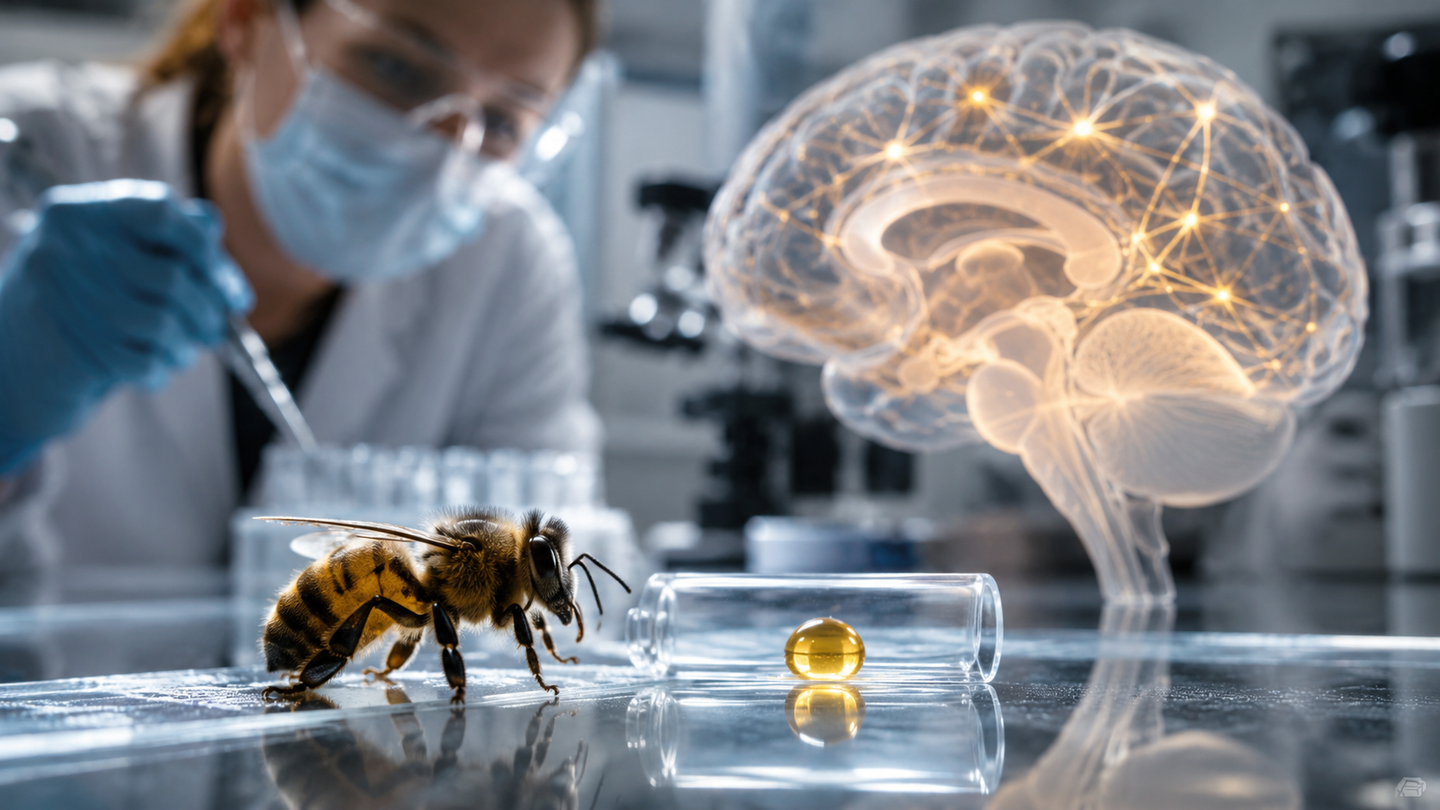
Bee venom Parkinson’s treatment improved movement and memory when added to levodopa in mice, though its mechanism remains unknown. (CREDIT: Wikimedia / CC BY-SA 4.0)
- Bee venom enhanced the effects of levodopa and carbidopa in mice with Parkinson’s-like brain damage, improving several movement measures.
- Mice receiving the combination maintained more balanced forelimb use and performed better in a corridor test than mice given standard treatment alone.
- The combination group also showed stronger recognition memory, although it already performed better before treatment, which complicates that result.
- The study did not measure neuron survival, dopamine, inflammation, or oxidative stress, so it cannot prove neuroprotection or show that bee venom would help people with Parkinson’s disease.
A treatment drawn from honeybee venom improved movement and memory in mice with Parkinson’s-like brain damage, suggesting it may strengthen the effects of levodopa. The work remains early, however, and offers no evidence yet that the approach would help people.
Researchers at the University of Guadalajara tested freeze-dried bee venom alongside levodopa and carbidopa, the standard drug combination used to restore dopamine and ease Parkinson’s symptoms. Their study appeared May 20, 2026, in the journal Neuroprotection.
Parkinson’s disease gradually destroys dopamine-producing neurons, particularly those connected to movement control. The resulting dopamine shortage can cause tremors, muscle stiffness, slow movement and poor balance. Cognitive problems may also emerge as the disease advances.
Levodopa can improve movement by helping the brain make more dopamine. Carbidopa keeps more of the drug from breaking down before it reaches the brain. Yet the treatment does not stop neurodegeneration, and long-term use can bring motor fluctuations and involuntary movements known as dyskinesias.
“We aimed to explore whether bee venom could potentiate the effects of standard therapy in a 6-hydroxydopamine (6-OHDA) model of Parkinson’s disease,” explained lead author Professor Alma Karen Lomeli-Lepe from the University of Guadalajara.
Testing movement after a targeted brain lesion
The experiment involved adult male CD-1 mice. Researchers injected 6-hydroxydopamine into one side of the striatum, a brain region involved in movement. The toxin damages dopamine pathways and creates one-sided motor problems that resemble selected features of Parkinson’s disease.
The mice were divided into four groups. One received sham surgery, another received the lesion without treatment, a third received levodopa and carbidopa, and a fourth received those drugs plus bee venom.
Treatment began 13 days after surgery and continued through day 30. The team used several behavioral tests to measure forelimb use, paw dragging, recognition memory and the tendency to retrieve food from one side of a corridor.
In the cylinder test, healthy mice used both forelimbs about equally. By day 21, untreated lesioned mice showed a sharp imbalance, while both treated groups maintained nearly symmetrical use.
By day 30, the difference became clearer. Mice given levodopa and carbidopa alone showed renewed impairment, with a median symmetry score of 30.4 percent. The combination group remained near normal at 50.9 percent and performed significantly better than both the untreated and standard-treatment groups.
Bee venom strengthened some motor gains
Paw dragging followed a related pattern. All lesioned groups showed similar impairment before treatment. By days 21 and 30, both drug-treated groups dragged the affected paw less often than untreated mice.
The bee venom group recorded the lowest median dragging score on day 30, at 5.54 percent, compared with 6.65 percent for levodopa and carbidopa alone. The study did not report a significant difference between those two treated groups for this measure.
A corridor task produced a stronger separation. Untreated mice retrieved only 20 percent of pellets from the side affected by the lesion. Mice receiving levodopa and carbidopa reached 43 percent, while the bee venom combination reached 58.5 percent.
That combination group performed significantly better than both the untreated animals and those receiving standard therapy alone. The result suggests that bee venom added functional benefit in this test of one-sided motor behavior.
The study also examined short-term recognition memory. Mice normally spend more time inspecting a new object than one they have already seen. Untreated lesioned mice and those receiving levodopa and carbidopa alone continued to show memory deficits.
Mice receiving bee venom with standard therapy maintained a stronger preference for the novel object on days 21 and 30. Their day-30 discrimination score was 0.52, compared with weaker performance in the other lesioned groups.
An early difference complicates the memory result
The memory findings require caution. On day 13, before treatment began, the future bee venom group already performed significantly better than the untreated and standard-treatment groups.
That baseline difference makes it harder to determine how much of the later memory advantage resulted from bee venom. Random assignment was used, but the small groups included only six or seven animals each, leaving room for chance differences.
The researchers also did not count surviving dopamine neurons or measure dopamine levels, inflammation, oxidative stress or electrical activity. Their tissue analysis only confirmed that the injections reached the intended brain region and caused no major visible damage from the procedure.
Bee venom contains melittin, phospholipase A2 and apamin. Earlier research has linked these compounds to anti-inflammatory, antioxidant and neuroactive effects. Apamin can cross the blood-brain barrier and affect channels involved in neuronal excitability.
Those properties offer possible explanations for the behavioral changes, but the current experiment did not test them. It therefore cannot establish that bee venom protected neurons, reduced inflammation or slowed disease.
“Our findings demonstrate promising behavioral benefits of bee venom as an adjunct to L-DOPA/carbidopa therapy, but further research is needed to understand the underlying mechanisms,” noted Prof. Lomeli-Lepe.
Practical implications of the research
The results identify bee venom as a candidate for further preclinical testing, not as a ready treatment for Parkinson’s disease. Future studies would need to confirm the behavioral effects in larger groups and measure dopamine neurons, inflammatory markers, oxidative damage and brain signaling directly.
Researchers would also need to determine which venom compounds contribute to the apparent benefit and whether the effects can be reproduced under different experimental conditions. Histological, biochemical and electrophysiological analyses could clarify whether the treatment changes neuronal survival or only influences behavior.
For now, the study supports a narrower conclusion. Adding bee venom to levodopa and carbidopa improved several motor and cognitive measures in a mouse model, but it did not prove neuroprotection, explain the mechanism or show that the approach can translate to patients.
Research findings are available online in the journal Neuroprotection.
The original story "Bee venom helps preserve memory in new Parkinson’s disease study" is published in The Brighter Side of News.
Related Stories
- Bee venom rapidly targets and kills aggressive breast cancer cells
- Scientists use AI to turn venom into life-saving medicine
- The plastic bottle that became a Parkinson's drug
Like these kind of feel good stories? Get The Brighter Side of News' newsletter.
Hannah Shavit-Weiner
Medical & Health Writer
Hannah Shavit-Weiner is a Los Angeles–based medical and health journalist for The Brighter Side of News, an online publication focused on uplifting, transformative stories from around the globe. Having published articles on AOL.com, MSN and Yahoo News, Hannah covers a broad spectrum of topics—from medical breakthroughs and health information to animal science. With a talent for making complex science clear and compelling, she connects readers to the advancements shaping a brighter, more hopeful future.