Scientists find evidence of a rare double supernova in the Jellyfish Nebula
The Jellyfish Nebula and a faint neighboring remnant may record two explosions from stars that once orbited each other.

 Edited By: Joshua Shavit

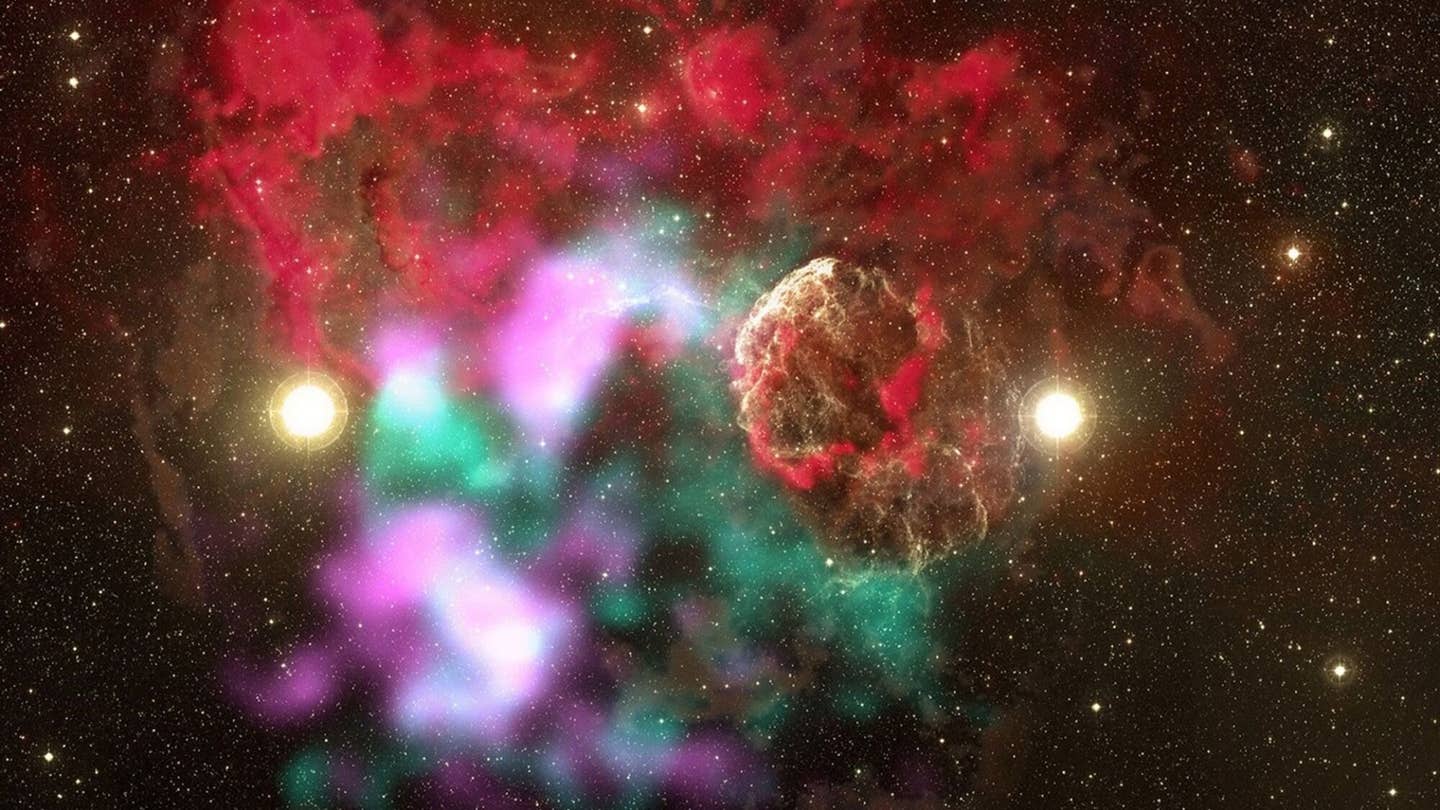
This multiwavelength scene shows the Jellyfish Nebula supernova remnant (right), the interstellar cloud it’s interacting with, and a distinctive curving filament to its upper left. (CREDIT: NASA Goddard Space Flight Center and M. Michailidis et al. 2026; optical: DSS; infrared: NASA/WISE/JPL-Caltech/UCLA; ultraviolet: NASA/Swift)
- Astronomers found evidence that the Jellyfish Nebula, or IC 443, and the fainter remnant G189.6+3.3 may have formed from two massive stars that once belonged to the same binary system.
- Data from NASA’s Fermi telescope, eROSITA and other observatories show that both remnants lie about 6,000 light-years away, overlap in the sky and appear to interact with the same interstellar cloud system.
- Gamma-ray observations revealed distinct particle-acceleration zones in G189.6+3.3: high-speed protons dominate the northern region, while energetic electrons likely produce most of the southern emission.
- Simulations suggest the first star exploded and propelled its companion through space before the second star detonated 20,000 to 100,000 years later, creating a rare laboratory for studying binary evolution, supernova shocks and cosmic rays.
Two enormous stars may have lived and died as partners, leaving behind overlapping shells of wreckage about 6,000 light-years from Earth. One exploded first. Its companion traveled through space for thousands of years before detonating too.
The proposed pairing links the Jellyfish Nebula, also called IC 443, with the fainter supernova remnant G189.6+3.3 in Gemini. Their apparent overlap has long complicated observations, especially because the Jellyfish is among the brightest gamma-ray supernova remnants known.
The findings, published in Nature Communications, combine observations from NASA’s Fermi Large Area Telescope with X-ray data from eROSITA and measurements across several other wavelengths. The international team found that the two remnants sit at roughly the same distance and overlap across much of the sky.
“Using 16 years of data from NASA’s Fermi Gamma-ray Space Telescope, our analysis uncovered gamma rays associated with a supernova remnant that was hidden in the glare of its neighbor, the Jellyfish Nebula, one of the brightest gamma-ray-emitting supernova remnants known," said Miltiadis Michailidis, a Stanford University postdoctoral fellow.
Gamma rays reveal the fainter remnant
Supernova remnants form when massive stars collapse and explode, sending shock waves and hot debris into surrounding space. Astronomers have cataloged about 300 remnants in the Milky Way, although many more may remain unidentified.
G189.6+3.3 was discovered in 1994 through X-ray observations from the ROSAT mission. It appeared as a faint shell of hot gas, but lacked the clear radio outline commonly used to confirm a supernova remnant.
The new analysis found extended gamma-ray emission that closely follows its thermal X-ray shell. The glow had previously been represented as several unrelated point sources in Fermi catalogs.
The researchers divided the emission into northern and southern regions. In the north, the gamma-ray spectrum points to high-speed protons striking dense gas. In the south, accelerated electrons appear to produce most of the gamma rays.
That division makes G189.6+3.3 unusual. Other remnants can contain both proton-driven and electron-driven emission, but the two processes are often mixed across the same regions.
Here, they appear spatially separated.
A filament ties both remnants together
A bright filament of hydrogen gas sits along the northern edge of G189.6+3.3. Gamma rays, ultraviolet emission, optical shock signatures and dense interstellar material all converge in the same area.
The evidence indicates that the remnant’s shock wave struck the gas, slowed and entered a radiative phase. Compression within the cooling material may have re-energized existing cosmic-ray protons, allowing them to produce gamma rays through collisions.
“The overlapping remnants, a connecting gas filament, and the availability of data from Fermi and other facilities motivated us to delve into this complex but little-studied region,” said co-author Marianne Lemoine-Goumard of the French National Centre for Scientific Research and the University of Bordeaux.
“With Fermi’s LAT instrument, we found gamma-ray emission associated with accelerated protons in the northern part of the fainter remnant. If both remnants are interacting with the same structure, then they must share a common distance from us.”
Both remnants appear to interact with the Sharpless 249 cloud system. Distance estimates place them near 1.8 kiloparsecs, or roughly 6,000 light-years, from Earth.
Their explosion centers are separated by about 40 light-years when projected across the sky, though the scientific analysis also considered smaller center-to-center estimates of roughly 9 to 15 parsecs.
Two explosions, thousands of years apart
Age estimates carry substantial uncertainty. The Jellyfish Nebula is likely 8,000 to 9,000 years old. G189.6+3.3 may be between 20,000 and 110,000 years old.
That leaves a possible delay of 20,000 to 100,000 years between the explosions.
The team tested whether a massive binary could produce that combination. Computer simulations followed one million binary systems through stellar evolution, matter exchange and supernova explosions.
Interacting binaries readily produced two remnants with comparable separations and delays. In many cases, the first blast disrupted the pair and launched the surviving star through space before it later exploded.
The original stars may each have exceeded 20 solar masses. Other evidence, including metal-rich X-ray plasma and elongated structures, is also consistent with massive progenitors, though it does not prove a shared origin.
The estimated chance of finding two unrelated remnants with their observed alignment and compatible distances remained below 1 percent under conservative assumptions.
“The evidence we’ve compiled — including observations across the spectrum, the chemical and physical properties of the remnants, simulations, and more — paints a compelling picture of a dual supernova event,” Michailidis said.
A rare laboratory for cosmic rays
The northern region also offers a clear target for studying proton acceleration. When cosmic-ray protons hit interstellar gas, they can create neutral pions that quickly decay into pairs of gamma rays.
Fermi can detect the resulting energy pattern. The feature helps astronomers distinguish proton-driven emission from gamma rays produced by high-energy electrons.
The Jellyfish Nebula is already considered a possible PeVatron, an accelerator capable of pushing particles toward energies high enough to approach escape from the galaxy. A second accelerator beside it may clarify how remnants reach those extremes.
The region could also support future neutrino studies because proton collisions produce both gamma rays and neutrinos. Current searches have not detected neutrinos from supernova remnants, and G189.6+3.3 is relatively faint. Its separated emission zones, however, may help researchers isolate the hadronic component.
Practical implications of the research
The possible sibling remnants provide a rare test of how massive binary stars exchange matter, separate after the first explosion and respond to supernova kicks. Their geometry and age difference can help constrain models of binary evolution and stellar collapse.
The system also gives astronomers a cleaner way to compare proton-driven and electron-driven gamma-ray production within one complex environment. Better X-ray, optical, molecular and very-high-energy observations could refine the remnants’ ages, distances and shock conditions.
“Fermi’s gamma-ray observations of supernova remnants continue to reveal the dynamic lives of stars,” said Elizabeth Hays, Fermi project scientist at NASA’s Goddard Space Flight Center. “We can now connect the glowing remains of two massive stars to a powerful pair that evolved together over thousands of years.”
Research findings are available online in the journal Nature Communications.
The original story "Scientists find evidence of a rare double supernova in the Jellyfish Nebula" is published in The Brighter Side of News.
Related Stories
- Radio observations reveal once hidden structures around the Orion Nebula
- The Eye of Sauron: Helix Nebula Reveals How Sun-like Stars Die
- Strange iron 'bar' discovered inside the Ring Nebula
Like these kind of feel good stories? Get The Brighter Side of News' newsletter.
Joseph Shavit
Writer, Editor-At-Large and Publisher
Joseph Shavit, based in Los Angeles, is a seasoned science journalist, editor and co-founder of The Brighter Side of News, where he transforms complex discoveries into clear, engaging stories for general readers. With vast experience at major media companies like The Los Angeles Times, Times Mirror and Tribune Publishing, he writes with both authority and curiosity. His writing focuses on space science, planetary science, quantum mechanics, geology. Known for linking breakthroughs to real-world markets, he highlights how research transitions into products and industries that shape daily life.