Cajon Pass appears primed for a massive earthquake crossing two major Southern California faults
Cajon Pass may act as an earthquake gate, and new modeling suggests the Southern California junction is critically stressed.

 Edited By: Joseph Shavit

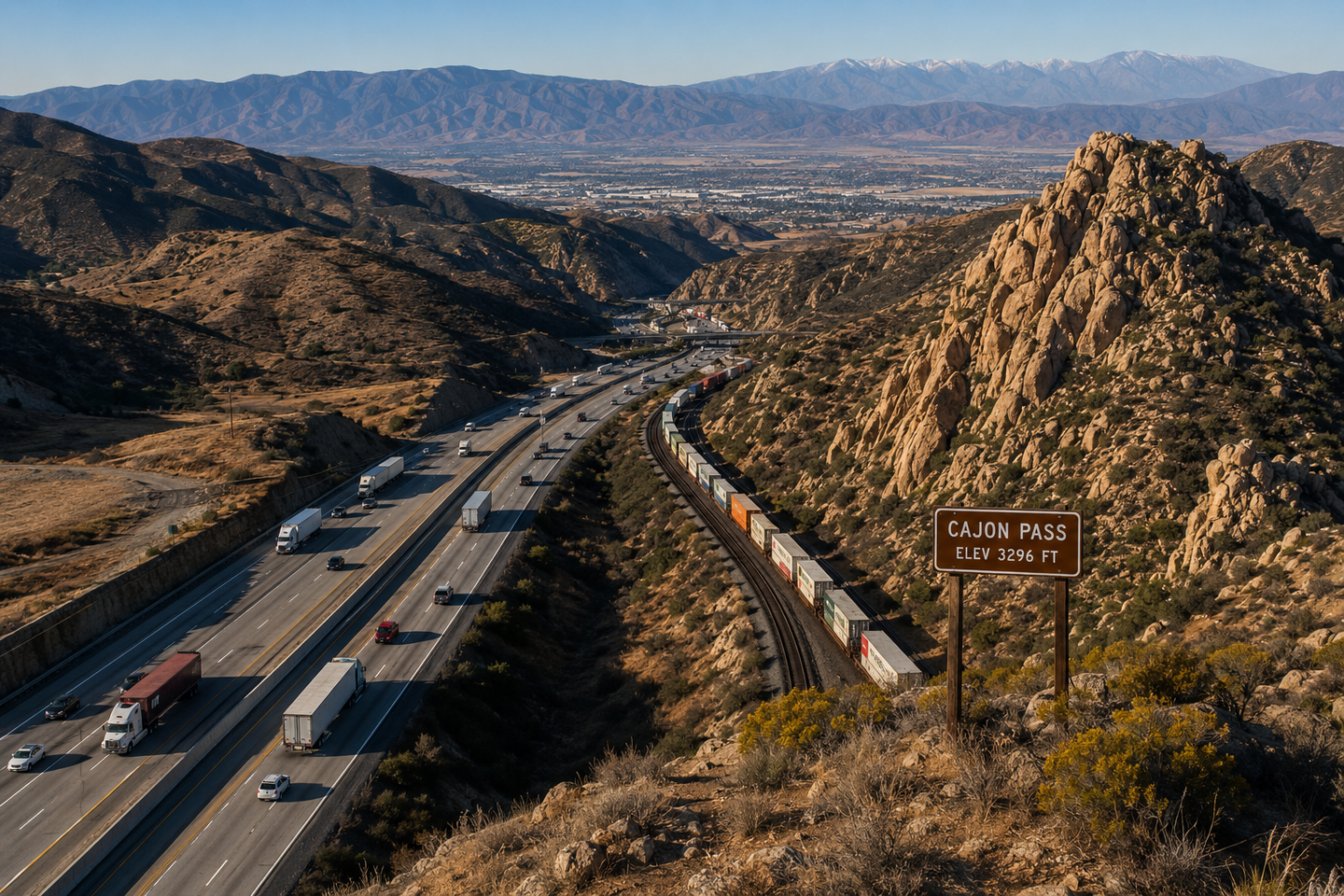
New modeling suggests Cajon Pass sits near peak stress, raising concern about a rupture crossing two major Southern California faults. (CREDIT: Wikimedia / CC BY-SA 4.0)
The ground north and east of Los Angeles holds one of Southern California’s most uneasy meeting points. At Cajon Pass, the San Andreas and San Jacinto fault systems crowd together in a tectonic bottleneck. This is a place where the next major earthquake may not simply stay in its lane.
A new study suggests that this junction is now carrying some of the highest modeled stress of the past 1,000 years. More striking still, the two fault systems appear to be loading in a pattern. In the past, this pattern has been linked to ruptures. These ruptures jumped across both systems rather than stopping at the pass.
That distinction matters. A rupture confined to one fault is dangerous enough. One that crosses both could produce a far larger event across a heavily populated and infrastructure-rich part of Southern California.
Dr. Liliane Burkhard of the University of Bern led the work with researchers from the University of Hawaiʻi at Mānoa. The team also included the U.S. Geological Survey Earthquake Science Center in Pasadena. Moreover, Scripps Institution of Oceanography at UC San Diego participated. The study appears in Journal of Geophysical Research.
A junction with a long memory
Earthquakes along major strike-slip faults do not arrive on a neat schedule. Stress builds as tectonic plates grind past one another. Faults lock, and strain accumulates over decades or centuries before being released in sudden slips.
In Southern California, the San Andreas Fault and the San Jacinto Fault together accommodate about 90% of the motion between the Pacific and North American plates. Over the past 1,000 years, they have hosted at least 36 earthquakes of magnitude 6.4 or larger.
The last giant quake to hit the wider Los Angeles region was the 1857 Fort Tejon earthquake, a magnitude 7.9 event. It tore more than 330 kilometers along the San Andreas Fault system before stopping just north of Cajon Pass. Since then, the southern San Andreas has remained unusually quiet. Paleoseismic records suggest major ruptures recur on centennial timescales.
That long quiet stretch has troubled geoscientists for years.
Four-dimensional earthquake cycle model
To examine what it may mean today, the team built a four-dimensional earthquake cycle model that simulates stress through three dimensions of space and through time. They fed it a 1,000-year earthquake history reconstructed from paleoseismic evidence. The evidence includes radiocarbon dating, tree-ring anomalies, historical accounts, and mapped ground ruptures.
“The model tracks how each earthquake changes stress on neighboring fault segments, how stress accumulates during the quiet intervals between events, and how the deeper layers of the crust slowly relax following large ruptures,” Burkhard explains.
“This simulation allows us to understand how stresses in the fault system build up over centuries,” Burkhard continues. By running the earthquake history of Southern California as a simulation, we can estimate the extent to which the fault system is already under stress today.
When the pass stays shut, and when it opens
One of the paper’s central ideas is that Cajon Pass acts as an “earthquake gate.” In that view, the junction can either stop a rupture or allow it to pass through into the neighboring fault system. It depends on the long-term stress conditions on both sides.
History offers examples of both outcomes.
The 1857 Fort Tejon earthquake stopped at Cajon Pass and did not jump onto the San Jacinto Fault. By contrast, the 1812 Wrightwood earthquake is modeled as a through-going event that ruptured across the junction and involved both systems.
“The earthquake gate concept captures something important about how fault junctions work,” Burkhard explains.
“Cajon Pass doesn't simply block or channel earthquakes: It responds to stress conditions, and those conditions change over centuries.”
The study found that what matters is not just the amount of stress on a single fault segment, but how closely the stress states of adjacent segments line up. When both systems are highly stressed at the same time and by similar amounts, the conditions appear more favorable for a rupture to cross the junction.
When those stress levels evolve out of step, large earthquakes are more likely to stop at the pass.
Stress now sits near the top of the 1,000-year record
The model’s present-day endpoint, labeled 2025 for convenience within the simulation timeline, shows elevated stress across much of the southern San Andreas fault system.
At Cajon Pass itself, the San Jacinto Bernardino segment reaches a modeled mean Coulomb stress of 3.6 megapascals, which is higher than any value seen for that segment in the 1,000-year simulation. On the Mojave South segment of the San Andreas Fault, the modeled stress reaches 2.8 megapascals, also at the high end of the millennium-scale history. The neighboring North San Bernardino segment sits at 1.8 megapascals.
Those numbers are model-based, not direct measurements underground. The authors stress that such values depend on assumptions built into the simulation. This includes slip rates, locking depths, crustal properties, fault geometry, and how stress is released during earthquakes. Still, they argue that the relative pattern matters most, and that pattern is worrying.
“So not only is it concerning that the stresses are reaching historic highs,” Burkhard says, “but also that the relative stress conditions between the two fault systems are approaching the range we associate with major ruptures crossing both faults simultaneously—and that is a scenario with much larger consequences for the region.”
The model also tested hypothetical present-day rupture scenarios. A tripartite rupture involving all three key segments around Cajon Pass produced the largest simulated stress decreases on two of those segments. This shows how much built-up strain such an event could release at once.
A bigger hazard corridor than a single-fault quake
The practical concern is geographic as much as geological. Cajon Pass is not a remote mountain junction. Instead, it is a crucial transportation and energy corridor tied to the greater Los Angeles area, San Bernardino, Riverside, and the Coachella Valley. Highways, rail lines, and energy infrastructure all thread through or near the pass.
A rupture that crosses both the San Andreas and San Jacinto systems would likely pose a more severe regional hazard than an earthquake confined to one fault alone.
“The question of when and how the next major earthquake will occur in this region is one of the most pressing problems in applied geoscience. Our results provide a clearer, physics-based picture of the current stress state of the fault system. Also, the framework we developed is applicable not just to California, but also to other complex fault junctions worldwide,” Burkhard says.
The study does not claim to predict when the next major earthquake will happen. The authors are explicit on that point.
“However,” Burkhard emphasizes, “the study is not a prediction of when an earthquake will occur. What we can say is that the system is critically stressed and that physics-based models like ours give a clearer picture of the range of scenarios we should be prepared for. This information is important for hazard assessment, infrastructure planning, and emergency preparedness.”
Practical implications of the research
This work sharpens the way earthquake hazard can be framed in Southern California. Instead of treating nearby fault segments as mostly separate threats, the study points to the risk posed by their interaction at a shared junction.
That could affect how emergency planners, infrastructure agencies, and hazard modelers think about worst-case scenarios in and around Cajon Pass.
The broader value is methodological as well: by combining paleoseismic records with long-term physics-based stress modeling, the approach offers a way to examine other complex fault junctions where a single rupture might cascade into a much larger regional event.
Research findings are available online in the journal Journal of Geophysical Research.
The original story "Cajon Pass appears primed for a massive earthquake crossing two major Southern California faults" is published in The Brighter Side of News.
Related Stories
- Tiny earthquakes reveal hidden faults where San Andreas meets Cascadia
- Catastrophic San Andreas earthquake could be triggered by the Cascadia subduction zone
- San Andreas fault earthquakes may be significantly larger in the future
Like these kind of feel good stories? Get The Brighter Side of News' newsletter.
Joshua Shavit
Writer and Editor
Joshua Shavit is a NorCal-based science and technology writer with a passion for exploring the breakthroughs shaping the future. As a co-founder of The Brighter Side of News, he focuses on positive and transformative advancements in technology, physics, engineering, robotics, and astronomy. Having published articles on AOL.com, MSN, Yahoo News, and Ground News, Joshua's work highlights the innovators behind the ideas, bringing readers closer to the people driving progress.