CERN recreates cosmic ray collisions to reveal what happens when space particles hit Earth
Proton-oxygen collisions at the LHC reveal how extreme cosmic rays trigger particle showers when they slam into Earth’s atmosphere.
 New York University Writer: James Devitt

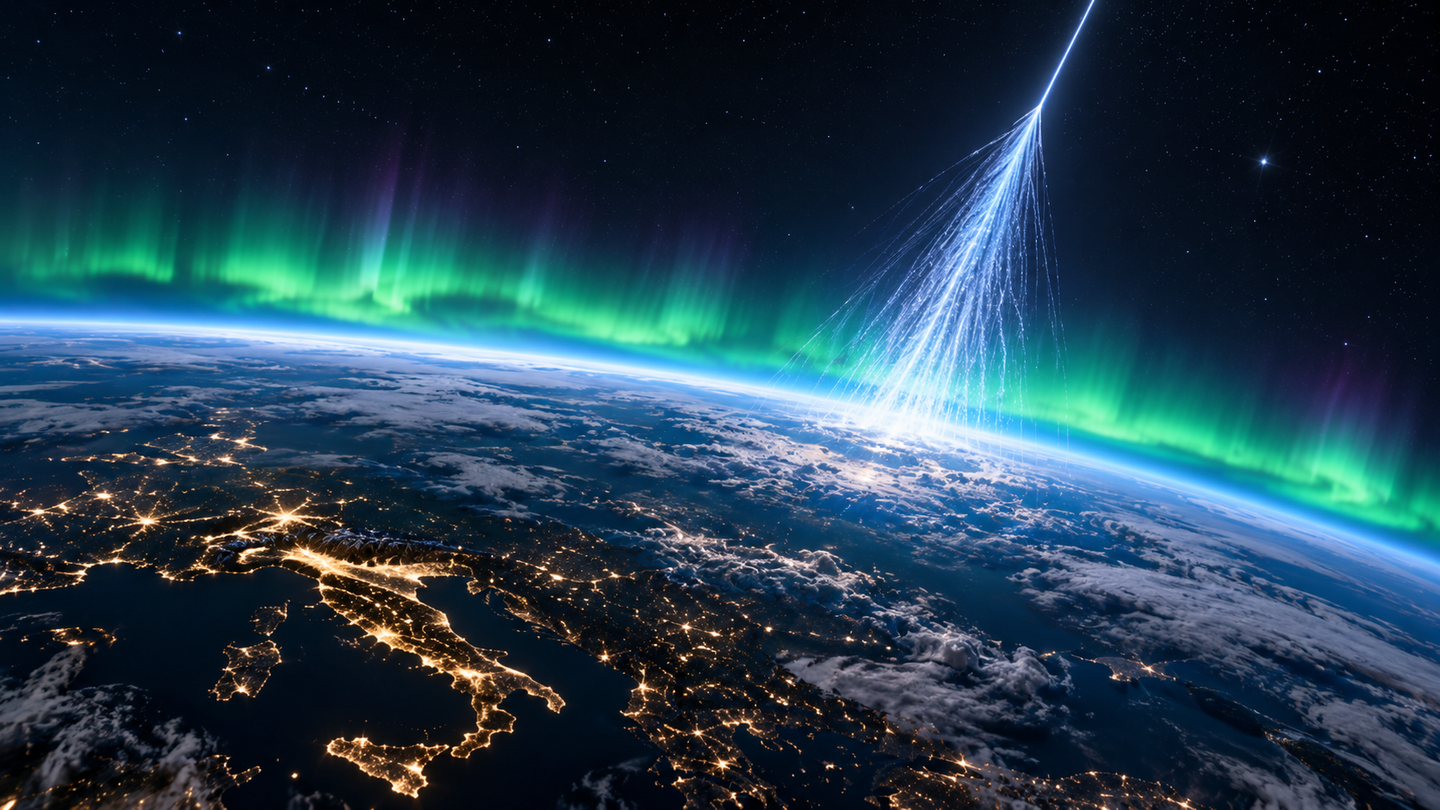
CERN recreated high-energy cosmic ray collisions with oxygen, exposing major gaps in models of particle showers in Earth’s atmosphere. (CREDIT: Shutterstock)
- Physicists at CERN have directly measured proton-oxygen collisions at 9.62 TeV per nucleon pair, closely recreating an important type of interaction that occurs when extremely energetic cosmic rays strike Earth’s atmosphere.
- The ATLAS experiment analyzed 246 million selected collisions containing more than 5.1 billion reconstructed tracks and found that no major cosmic-ray interaction model successfully reproduced all the observed particle behavior.
- The measurements could improve simulations used to determine the energies, masses and possible origins of cosmic rays that are too energetic to measure directly with instruments in space.
Earth is constantly being bombarded by particles from space, but the most energetic arrivals are difficult to understand because scientists rarely observe them directly.
Instead, researchers usually detect the vast showers of secondary particles created when a cosmic ray smashes into a molecule high in the atmosphere. Working backward from those showers requires computer models that attempt to reconstruct the original particle and the collision that started everything.
There is a problem. Different models can produce substantially different answers.
Physicists working with CERN's ATLAS experiment have now recreated one of those atmospheric collisions under controlled conditions by smashing protons into oxygen nuclei inside the Large Hadron Collider. The measurements, reported in Physical Review Letters, provide unusually direct data for improving the models used to interpret high-energy cosmic rays.
“We now have a better understanding of how particles from objects more exotic than the Sun interact with our atmosphere,” said Jesse Liu, an assistant professor of physics at New York University who led the research.
Cosmic rays create enormous particle cascades
The Northern Lights offer a familiar example of particles interacting with Earth's atmosphere, although auroras involve far lower energies than the cosmic rays examined in the new experiment.
Auroras form when charged particles associated with the Sun enter the upper atmosphere and interact with gases. High-energy cosmic rays can carry vastly more energy and may originate from violent astrophysical environments, including supernova remnants.
When one of these particles enters the atmosphere, it can collide with the nucleus of an oxygen or nitrogen atom. That initial impact creates new particles, which collide again and produce still more particles.
The result is an extensive air shower that can spread across a large area before reaching detectors on the ground.
At sufficiently high energies, the incoming cosmic rays are so rare that direct measurements by satellites become impractical. Scientists therefore infer their properties from these cascades, making the accuracy of the underlying collision models critical.
Those models depend heavily on accelerator measurements. Yet previous collider experiments have generally used collision systems that do not closely reproduce a cosmic-ray proton hitting an atmospheric nucleus.
The LHC fired protons directly into oxygen
The CERN experiment was designed to close that gap.
During a special run in July 2025, the Large Hadron Collider accelerated oxygen nuclei to 3.4 teraelectronvolts per nucleon while sending 6.8 TeV protons in the opposite direction. Their collisions produced a center-of-mass energy of 9.62 TeV per nucleon pair.
The setup closely resembles a high-energy proton cosmic ray striking an oxygen nucleus in Earth's atmosphere.
ATLAS recorded data corresponding to 634 inverse microbarns of integrated luminosity. After event selection, the researchers analyzed about 246 million collisions containing approximately 5.11 billion reconstructed particle tracks.
“These data are unique, and in our measurements, we were able to show that our previous models for this type of interaction are actually very inaccurate,” said Cigdem Issever of Humboldt University of Berlin.
The researchers measured how frequently interactions occurred along with the number, direction and transverse momentum of charged particles produced in the collisions.
The experiment recreated a 49-PeV cosmic ray collision
The laboratory collision corresponds to an extraordinary cosmic-ray energy when viewed from the perspective of a stationary atmospheric nucleus.
The researchers calculated that the proton-oxygen collisions were equivalent to a cosmic-ray proton carrying about 49 petaelectronvolts, or 49 quadrillion electronvolts, hitting Earth's atmosphere.
ATLAS measured a fiducial proton-oxygen cross section of 396 millibarns, with experimental and luminosity uncertainties. A cross section represents the probability of a particular type of particle interaction occurring.
The researchers then used the measurement to infer an inelastic proton-air cross section of 406 millibarns, with additional uncertainty arising from the theoretical conversion from oxygen to the nitrogen-oxygen mixture of Earth's atmosphere.
That result was compatible with earlier cosmic-ray measurements at similar energies, providing an important connection between accelerator physics and observations made from air showers.
The measurements also favored the lower end of the cross sections predicted by several widely used interaction models.
No simulation reproduced everything correctly
The most revealing result emerged when the researchers compared detailed particle production with seven models used in particle and cosmic-ray physics.
None reproduced all the measurements.
The models disagreed particularly strongly over particle multiplicity, meaning how many charged particles were produced in each collision. At high multiplicities, some predictions differed from the data by approximately an order of magnitude.
Other measurements performed better. A model called Angantyr, implemented in the PYTHIA particle-physics simulation framework, came closest to reproducing the observed transverse-momentum and pseudorapidity distributions.
Several models successfully captured individual aspects of the collisions but failed elsewhere. Those differences matter because small errors during the first atmospheric collision can propagate throughout an air shower and change what ground-based observatories eventually detect.
The findings therefore provide a powerful new dataset for retuning those simulations rather than demonstrating that any one existing model is universally correct.
Better models could reveal where cosmic rays come from
Improved atmospheric simulations have implications far beyond particle physics.
Scientists use air showers to estimate whether an incoming cosmic ray was a proton, helium nucleus, iron nucleus or another particle. They also need accurate models to reconstruct its original energy.
Those measurements can help determine where cosmic rays originate and how their composition changes with energy. They may eventually clarify the transition between particles produced within the Milky Way and those arriving from sources beyond our galaxy.
Cosmic-ray observatories can probe energies far beyond those directly produced by human accelerators, but interpreting those observations requires a reliable understanding of the particle interactions involved.
The LHC cannot reproduce every cosmic-ray collision. It can, however, provide controlled experimental anchors for the models scientists use when accelerator measurements run out.
By firing protons into oxygen, researchers have brought part of an atmospheric cosmic-ray shower underground and placed it inside one of the world's most precisely measured experiments.
“These new results significantly sharpen our knowledge of these subatomic interactions,” Liu said, “and will help us further explore the nature of cosmic particles raining from the sky.”
Dig deeper into cosmic rays and atmospheric particle showers
These studies examine proton-air collisions, uncertainties in air-shower simulations and the challenge of connecting accelerator measurements with the highest-energy particles reaching Earth.
Measurement of the proton-air cross-section at √s = 57 TeV with the Pierre Auger Observatory: Uses the depth of cosmic-ray air showers to measure proton-air interactions at energies well above those then available in accelerators. (Physical Review Letters, 2012)
Testing Hadronic Interactions at Ultrahigh Energies with Air Showers Measured by the Pierre Auger Observatory: Tests leading LHC-tuned interaction models against ultrahigh-energy air showers and finds more hadronic activity and muons than predicted. (Physical Review Letters, 2016)
Systematic differences due to high energy hadronic interaction models in air shower simulations in the 100 GeV-100 TeV range: Quantifies how different interaction models can produce different air-shower predictions because of uncertainties in high-energy particle production. (Physical Review D, 2019)
Spectra and composition of ultrahigh-energy cosmic rays and the measurement of the proton-air cross section: Examines how uncertainties in proton-air interactions affect attempts to determine cosmic-ray composition from atmospheric showers. (Physical Review D, 2021)
High Energy Physics in the Atmosphere: Phenomenology of Cosmic Ray Air Showers: Reviews the particle physics behind extensive air showers and explains why collider measurements are essential for interpreting extreme cosmic rays. (Annals of Physics, 2004)
Research findings are available online in the journal Physical Review Letters.
The original story "CERN recreates cosmic ray collisions to reveal what happens when space particles hit Earth" is published in The Brighter Side of News.
Related Stories
- Nearly invisible galaxy may be built mostly of dark matter, Hubble finds
- Dark matter may consist of particles with different masses
- Milky Way neutrino map predicts how many ghost particles will reach Earth
Like these kind of feel good stories? Get The Brighter Side of News' newsletter.
Joseph Shavit
Writer, Editor-At-Large and Publisher
Joseph Shavit, based in Los Angeles, is a seasoned science journalist, editor and co-founder of The Brighter Side of News, where he transforms complex discoveries into clear, engaging stories for general readers. With vast experience at major media companies like The Los Angeles Times, Times Mirror and Tribune Publishing, he writes with both authority and curiosity. His writing focuses on space science, planetary science, quantum mechanics, geology. Known for linking breakthroughs to real-world markets, he highlights how research transitions into products and industries that shape daily life.