Cleaner fish display intelligence and self-awareness — just like mammals
A reef fish used a mirror to spot a “parasite” mark fast, then dropped shrimp by the glass as if testing the reflection.

 Edited By: Joseph Shavit

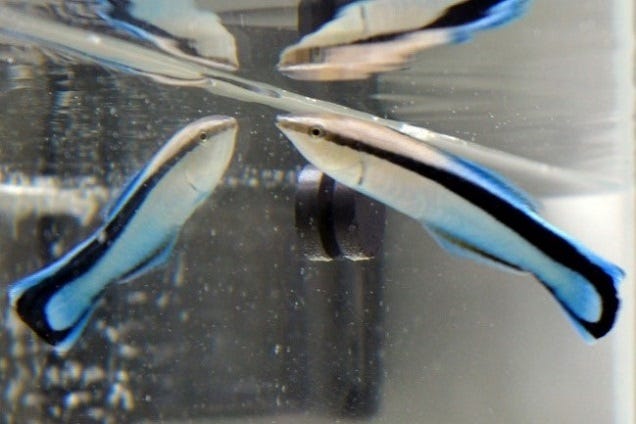
Cleaner wrasse quickly scraped off a mirror-only mark, then used shrimp scraps to probe mirror space, researchers report. (CREDIT: Osaka Metropolitan University)
A shrimp scrap drifted down the face of a mirror, and a small reef fish tracked it like it was watching a slow-motion experiment.
The fish, a blue-streak cleaner wrasse, had carried the shrimp upward, released it near the glass, and then followed its fall while repeatedly touching the mirror with its mouth. That sequence showed up days after the wrasse first met its own reflection. To the researchers watching from outside the tank, it looked less like feeding and more like curiosity aimed at the mirror itself.
A team from Osaka Metropolitan University says this is a new, higher-order kind of mirror probing in cleaner wrasse (Labroides dimidiatus), a fish already known for passing the classic “mark test” that is often used in debates about animal self-recognition.
The group, led by Specially Appointed Researcher Shumpei Sogawa and Specially Appointed Professor Masanori Kohda at the Graduate School of Science, argues the shrimp-dropping behavior fits “contingency testing,” where an animal checks how movements in the real world line up with movements in mirror space.
Mark first, mirror later
Cleaner wrasse live on coral reefs and rocky shores across the tropical and subtropical Indo-Pacific. They make their living by picking ectoparasites off the bodies of larger “client” fish. In a tank, that parasite-hunting instinct becomes a useful window into cognition, because these fish notice small changes on skin and scales.
Mirror self-recognition research usually follows a familiar rhythm: animals see a mirror for days, stop treating the reflection as a rival, then get marked in a spot they can only see in the mirror. If they try to remove the mark, researchers count that as evidence of mirror self-recognition.
This team flipped the order. They placed a colored elastomer mark on the wrasse’s throat before any mirror exposure, then introduced the mirror and watched closely for the first scraping attempt, the behavior the fish use to rub their bodies against surfaces.
“In earlier cleaner wrasse mirror studies, the procedure was typically the fish see a mirror for several days, they habituate to it and stop reacting socially, and a mark is added,” Sogawa said. “In this study, the order was reversed, the fish were marked first, then the mirror was introduced for the first time. The fish were likely aware of something unusual on their body, but they couldn’t see it. When the mirror appeared, it immediately provided visual information that matched an existing bodily expectation, hence scraping occurred much faster.”
That shift mattered because it let the researchers pin down timing. They weren’t waiting for days to decide the fish were “ready” for a mark test. They were measuring when the first mark-removal attempt happened.
A fast route to the throat scrape
The fish did not start with calm self-inspection.
When the mirror went in, seven of nine wrasse showed aggressive behavior toward their reflection, treating it like an intruder. Those aggressive displays lasted anywhere from 31 seconds to 1,867 seconds, with a median of 513 seconds. After aggression faded, the fish often stayed away from the mirror for a while, sometimes approaching and pulling back.
Then came a distinct stage the researchers classified as contingency testing, behaviors that link the fish’s movements to the reflected movements. All nine fish showed these behaviors, and this phase lasted from 225 seconds to 8,419 seconds, with a median of 829 seconds.
Only after that did the key moment arrive.
Six of the nine fish, or 67%, attempted to scrape off the throat mark within two hours of mirror exposure. In the fastest cases, the researchers say mirror self-recognition could occur as quickly as 30 minutes after the mirror appeared. Across the group, the first scraping attempts came 15 to 3,283 seconds after the last observed contingency-testing behavior, with a median of 613 seconds.
The study also notes how sharply separated the stages were. Aggression did not overlap with contingency testing, and the first scraping attempts did not begin until after the contingency-testing stage ended.
The team points to another detail that complicates easy storytelling. Three fish did not scrape within the initial window. One later scraped, while two showed aggression and contingency-testing behaviors but never scraped.
What the fish did after self-recognition
Once a fish had attempted to remove the mark, its mirror behavior shifted.
Post-recognition, the wrasse mouth-touched the mirror more frequently, showed more “atypical” swimming patterns in front of the mirror, and spent more time very close to the glass, within 5 centimeters. The researchers report these changes as statistically significant in their models, and they describe the post-recognition behavior as calmer than the earlier stages, with slower swimming speeds and less intense fin movements.
Here, the team makes a careful distinction. Past cleaner-wrasse mirror studies described many of these later behaviors as contingency testing. Because those studies did not know exactly when self-recognition occurred, the Osaka group argues, some behaviors may have been misclassified.
They propose that contingency testing happens early and then ends, while later behavior is better described as “mirror-exploring,” a kind of probing of the mirror’s properties rather than the fish checking whether the body in the glass is itself.
The shrimp drop
That brings the story back to the shrimp.
On days three and four of mirror exposure, three cleaner wrasse were seen picking up pieces of fresh shrimp from the tank bottom, lifting them about 10 to 25 centimeters, and dropping them close to the mirror. The fish followed the sinking shrimp down the mirror surface and mouth-touched the glass while watching the shrimp fall in the reflection.
The researchers interpret this as contingency testing using an external object, rather than the fish’s own body. They compare it to reports of manta rays watching bubbles in mirrors and bottlenose dolphins producing and playing with bubbles in front of mirrors.
It’s a small scene, but it matters because it suggests the fish were not simply trapped in a one-off trick of the mark test. The behavior looks like exploration, and it uses something other than the fish’s body as the test probe.
A bigger argument over self-awareness
Mirror self-recognition has been controversial since it became a standard tool decades ago. The source material lays out two broad ideas. One is a “Big Bang” hypothesis, which suggests true self-awareness evolved only once in the lineage leading to great apes, backed historically by results in chimpanzees versus some monkeys. Another is a gradualist view, where self-related abilities range from simple to complex, and mirror tool use may come before full mirror self-recognition.
The Osaka team argues both ideas can be distorted by false negatives, cases where an animal fails the mark test for practical reasons rather than a lack of self-related cognition. They also argue that many studies place the mark only after days or weeks, which could hide when self-recognition actually starts.
Their cleaner-wrasse results challenge the assumption that animals need long mirror exposure before they can pass the mark test. The rapid timing also cuts against a learning-only explanation, the authors argue, because associative learning would not be expected to produce mirror self-recognition that quickly.
“These findings in cleaner wrasse suggest that self-awareness may not have evolved only in the limited number of species that passed the mirror test but may be more widely prevalent across a broader range of taxonomic groups, including fish,” Sogawa said. “It is highly likely that mirror self-recognition will be observed in many species where mirror tool use has been reported.”
Kohda also framed the issue as more than an academic fight. “The findings from this research will likely influence not only academic issues, such as revising evolutionary theory and constructing concepts of self, but also directly impact matters relevant to our lives, including animal welfare, medical research, and even AI studies,” he said.
Research findings are available online in the journal Scientific Reports.
The original story "Cleaner fish display intelligence and self-awareness — just like mammals" is published in The Brighter Side of News.
Related Stories
- Scientists rethink animal consciousness: Reptiles, fish, and insects may be sentient
- Zebrafish reveal how environment influences social behavior in autism
- 'Cyborg Jellyfish' could transform ocean research, study finds
Like these kind of feel good stories? Get The Brighter Side of News' newsletter.
Mac Oliveau
Writer
Mac Oliveau is a Los Angeles–based science and technology journalist for The Brighter Side of News, an online publication focused on uplifting, transformative stories from around the globe. Passionate about spotlighting groundbreaking discoveries and innovations, Mac covers a broad spectrum of topics including medical breakthroughs, health and green tech. With a talent for making complex science clear and compelling, they connect readers to the advancements shaping a brighter, more hopeful future.