Could information be a fifth form of matter? Strange matter-antimatter experiment aims to find out
A physicist wants to collide matter with antimatter to test a radical idea: information may be a physical component of the universe.

 Edited By: Joshua Shavit

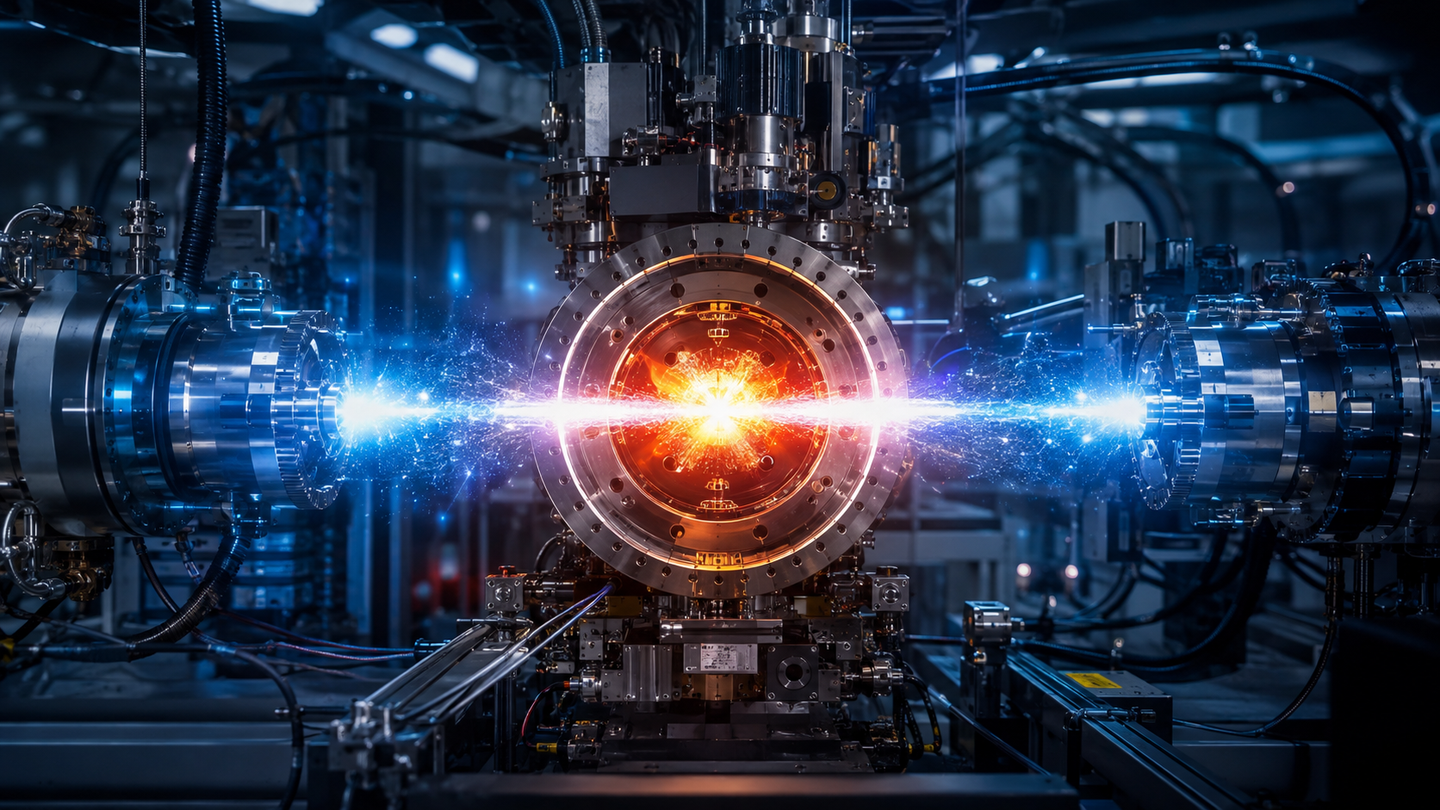
A proposed matter-antimatter experiment could test whether information has measurable energy and mass within elementary particles. (CREDIT: Shutterstock)
- A University of Portsmouth physicist has proposed an experiment to test whether elementary particles contain measurable information with an associated mass and energy.
- The experiment would collide electrons with positrons and search for two unexpected infrared photons appearing alongside the standard gamma rays produced by annihilation.
- Detecting those photons at the predicted wavelengths, including a temperature-dependent shift, would support a controversial hypothesis that information is a physical component of matter.
Information fills hard drives, crosses computer networks and describes the properties of physical systems. One physicist argues it may also have something far more surprising: measurable mass.
Dr. Melvin Vopson of the University of Portsmouth has proposed an experiment designed to test that idea using collisions between matter and antimatter.
If the predicted signal appears, Vopson argues it would support two related hypotheses. One says information has a mass-energy equivalent. The other says elementary particles contain a fixed amount of information about themselves.
Together, those ideas lead him to describe information as a fifth form of matter alongside solids, liquids, gases and plasma.
The proposed experiment, published in AIP Advances, has not yet demonstrated that information possesses mass. Instead, it lays out a way to put that claim to an experimental test.
“This would be a eureka moment because it would change physics as we know it and expand our understanding of the universe. But it wouldn't conflict with any of the existing laws of physics,” Vopson said.
“It doesn't contradict quantum mechanics, electrodynamics, thermodynamics or classical mechanics. All it does is complement physics with something new and incredibly exciting.”
From bits to physical information
The idea begins with a well-established connection between information and thermodynamics.
In 1961, physicist Rolf Landauer proposed that erasing information has a physical cost. An irreversible erasure of one bit must dissipate a minimum amount of energy into its surroundings.
Vopson has extended that connection much further.
His mass-energy-information equivalence principle proposes that information not only requires energy when erased but also possesses a tiny equivalent mass while stored.
Previous calculations led him to estimate that an elementary particle contains about 1.509 bits describing its distinguishable states. He has compared this intrinsic information to a kind of “particle DNA.”
Vopson has even suggested that information mass could contribute to the mystery of dark matter, although the experimental proposal does not test that possibility directly.
“If we assume that information is physical and has mass, and that elementary particles have a DNA of information about themselves, how can we prove it?” he said. “My latest paper is about putting these theories to the test so they can be taken seriously by the scientific community.”
Measuring something extraordinarily small
Directly weighing the proposed information mass would be extremely difficult.
For an electron, Vopson calculates that the information contribution would be about 22 million times smaller than the particle's ordinary rest mass.
An earlier proposed test involved measuring a digital storage device before and after erasing its information. The expected change for a one-terabyte device was around 10^-25 kilograms, far beyond practical measurement.
Another calculation considered changing the temperature of one kilogram of copper by 100 kelvins. The proposed information-mass change would reach about 3.33 × 10^-11 kilograms, still extremely difficult to measure accurately.
The new proposal takes another route. Instead of trying to weigh information directly, it attempts to detect the energy released when that information disappears.
Matter meets antimatter
The experiment centers on electrons and positrons.
A positron is the electron's antimatter counterpart. When an electron and positron collide under appropriate conditions, they annihilate, converting their mass into radiation.
In the standard two-photon annihilation process, the collision produces two gamma-ray photons carrying about 511 kiloelectronvolts each. Momentum conservation sends the photons traveling in opposite directions.
Vopson proposes looking for something extra.
If both particles also contain information, he argues that annihilating the particles would erase it. Under the mass-energy-information hypothesis, that information should still satisfy conservation requirements.
His proposed mechanism predicts two additional low-energy photons produced by information erasure.
“The information in an electron is 22 million times smaller than the mass of it, but we can measure the information content by erasing it,” Vopson said.
“We know that when you collide a particle of matter with a particle of antimatter, they annihilate each other. And the information from the particle has to go somewhere when it's annihilated.”
A distinctive infrared signal
The predicted photons would differ dramatically from the gamma rays produced by ordinary annihilation.
Using an estimated information content of 1.509 bits per particle, Vopson calculates that an electron-positron collision at room temperature should produce two additional infrared photons with wavelengths of about 50 micrometers.
More broadly, the predicted wavelength ranges from roughly 3 to 180 micrometers depending on temperature.
That temperature dependence provides an important proposed test.
The experiment would vary the temperature of the electrons and positrons. Under the hypothesis, the wavelength of the infrared signal should change with it. Detecting both the photons and the predicted wavelength shift would provide two related measurements.
Vopson proposes using sodium-22 as a positron source, a thin tungsten layer to slow the emitted positrons and an extremely thin aluminum target where annihilation could occur.
Gamma-ray and infrared detectors would then search simultaneously for the expected radiation.
A demanding test for an unusual hypothesis
The proposal contains an important limitation.
It assumes that information associated with the annihilating particles would emerge specifically as additional infrared photons. Vopson acknowledges that other possibilities could exist. The excess information energy, for example, might instead be carried by the gamma photons.
That means a failure to detect the predicted infrared radiation would not necessarily disprove every version of the underlying information hypothesis.
A positive result would be much harder to dismiss if the additional photons appeared simultaneously with annihilation and shifted wavelength with temperature exactly as predicted.
For now, information as a fifth form of matter remains a hypothesis rather than an established state of nature. The experiment provides a concrete way to challenge it.
Its importance lies precisely there. A claim about the fundamental makeup of the universe can ultimately gain scientific weight only if nature is given a chance to prove it wrong.
Dig deeper into information physics, Landauer’s principle and the physical limits of information
These resources explore the established links between information and thermodynamics, experimental tests of information erasure and the theoretical ideas that led to the proposed mass-energy-information experiment.
Experimentally probing Landauer’s principle in the quantum many-body regime: Researchers used an ultracold Bose-gas quantum field simulator to experimentally investigate Landauer’s principle in a quantum many-body system, extending tests of the connection between information and thermodynamics into a more complex quantum regime. (Nature Physics, 2025)
Landauer Bound in the Context of Minimal Physical Principles: Meaning, Experimental Verification, Controversies and Perspectives: This review examines the physical meaning, experimental evidence and continuing debates surrounding Landauer’s principle, including its relationship to other fundamental limits in physics and computation. (Entropy, 2024)
Estimation of the information contained in the visible matter of the universe: Vopson used Shannon information theory to estimate that each elementary particle could encode about 1.509 bits and calculated an information content of roughly 6 × 10^80 bits for visible matter in the universe. That prediction provides the numerical basis for the later annihilation experiment. (AIP Advances, 2021)
The mass-energy-information equivalence principle: This earlier paper proposed that a stored information bit possesses a finite mass equivalent and suggested that erasing information converts that contribution back into energy. It established the central hypothesis that the later particle-annihilation experiment is designed to test. (AIP Advances, 2019)
Experimental verification of Landauer’s principle linking information and thermodynamics: This landmark experiment measured heat released while erasing a one-bit memory and found that the dissipation approached the minimum predicted by Landauer’s principle, providing direct experimental evidence that information processing has unavoidable physical consequences. (Nature, 2012)
Research findings are available online in the journal AIP Advances.
The original story "Could information be a fifth form of matter? Strange matter-antimatter experiment aims to find out" is published in The Brighter Side of News.
Related Stories
- Dark matter may be naturally tuned to a hidden fifth dimension
- Scientists discover new state of matter inside Uranus and Neptune
- Scientists create Bose-Einstein condensate leading to a new fifth state of matter
Like these kind of feel good stories? Get The Brighter Side of News' newsletter.
Joseph Shavit
Writer, Editor-At-Large and Publisher
Joseph Shavit, based in Los Angeles, is a seasoned science journalist, editor and co-founder of The Brighter Side of News, where he transforms complex discoveries into clear, engaging stories for general readers. With vast experience at major media companies like The Los Angeles Times, Times Mirror and Tribune Publishing, he writes with both authority and curiosity. His writing focuses on space science, planetary science, quantum mechanics, geology. Known for linking breakthroughs to real-world markets, he highlights how research transitions into products and industries that shape daily life.