‘Dancing jets’ from black hole reveal their immense power
Cygnus X-1’s bent jets gave astronomers a rare direct measurement of black hole jet power and speed.

 Edited By: Joshua Shavit

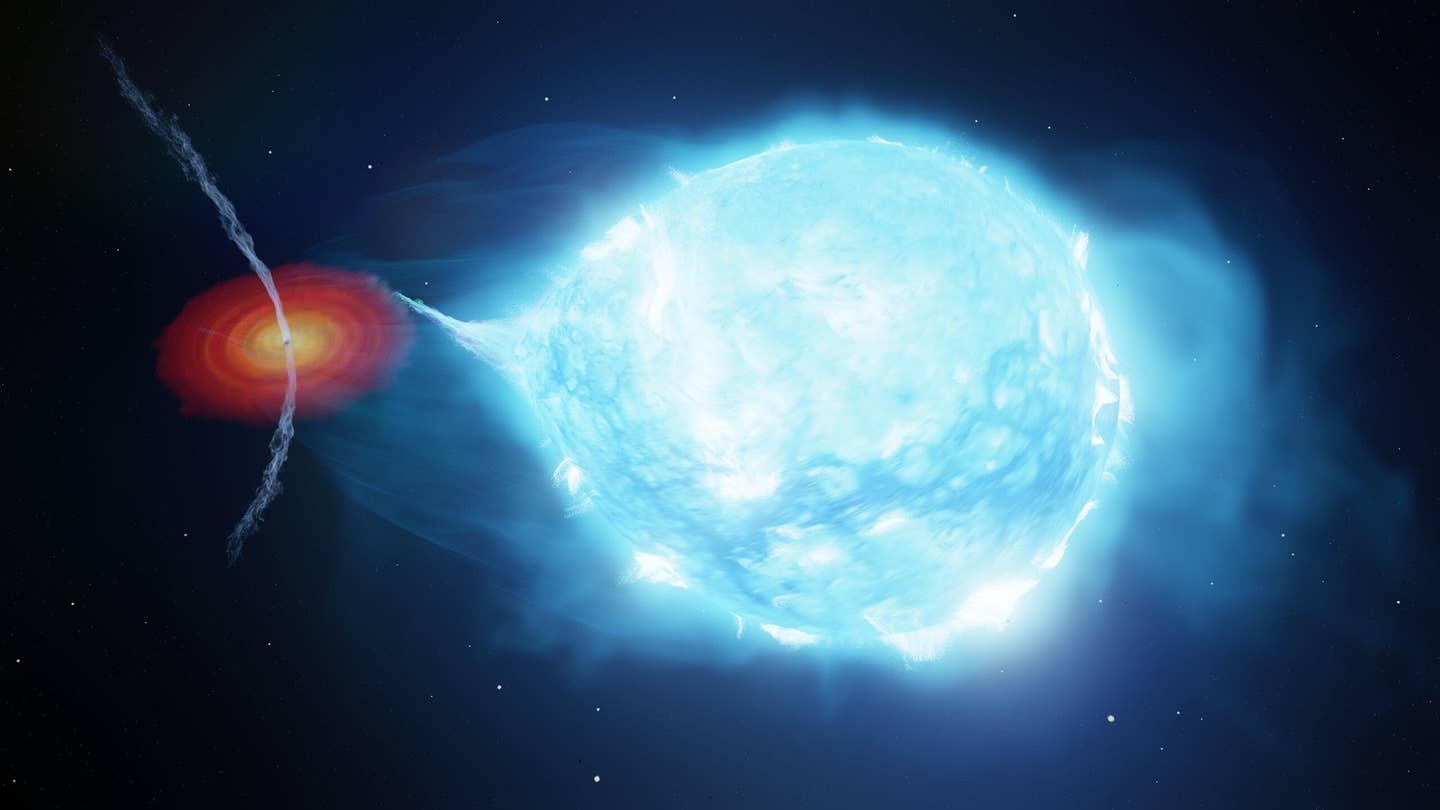
The strong stellar wind from the supergiant star pushes the jets launched by the black hole away from the star. This causes the jet direction to vary as the black hole and the supergiant star move around their orbit. (CREDIT: ICRAR)
The jets do not move in a straight, obedient line.
Around Cygnus X-1, a black hole and a massive supergiant star circle each other every 5.6 days. The black hole’s jets get shoved sideways by the star’s powerful wind. Over time, that pressure makes the outflow twist and bend. This creates what one researcher called “dancing jets.” Now, by tracking those bends in fine detail, astronomers have pulled off something that has long been out of reach. They have made a direct, instantaneous measurement of how much power the jets carry away from a feeding black hole.
That matters well beyond one binary system. Black hole jets are thought to help shape galaxies and larger cosmic structures by stirring gas, driving shocks, and dumping energy into their surroundings. Scientists have built that idea into large simulations of the Universe for years. However, confirming the key assumptions by observation has been difficult.
Cygnus X-1 offered a rare opening.
It was the first black hole ever confirmed, and it sits about 2.22 kiloparsecs from Earth. The system includes a black hole about 21.2 times the mass of the Sun and a massive O-type supergiant companion. As the black hole feeds on the star’s wind, it launches jets outward. Those jets then have to push through the same stellar wind that is feeding the black hole in the first place.
That struggle leaves a visible mark.
Reading the bends
To capture it, the research team used very long baseline interferometry. This method links radio telescopes separated by vast distances so they could act like a planet-sized instrument. They reanalyzed a 2016 campaign that followed Cygnus X-1 across a full orbit. In that research, they combined six 8.4-GHz observations from the Very Long Baseline Array and three 5-GHz observations from the European VLBI Network.
Those images showed both the approaching jet and the receding jet at each observing epoch. More importantly, the position angles of the jets shifted with orbital phase. Archival observations stretching across 18 years showed that this pattern was reproducible.
The team found that the approaching and receding jets bent in different directions, each being pushed away from the donor star. That ruled out a simple precession model, which would have kept the two jet sides aligned in a more symmetrical way. Instead, the data fit a wind-bending picture. The dense stellar wind deflects the outflow near the base, and the orbital motion of the black hole helps wind that deflection into a helical structure.
That geometry gave the researchers a way to turn shape into physics. If the wind’s momentum is known, and the amount of jet bending can be measured, the jet’s own momentum and power can be worked out.
The result was striking. The team determined that the instantaneous jet power in Cygnus X-1 is about 3.6 × 10^37 ergs per second, roughly equivalent to the output of 10,000 Suns. They also measured the jet speed at launch to be about 0.52 times the speed of light, around 150,000 kilometers per second.
Both numbers have been hard to pin down reliably.
A long-standing assumption put to the test
Lead author Dr. Steve Prabu said the new measurement helps answer a central question in black hole physics: how much of the energy released as matter falls inward gets redirected into jets.
“A key finding from this research is that about 10 per cent of the energy released as matter falls in towards the black hole is carried away by the jets,” Dr. Prabu said.
“This is what scientists usually assume in large-scale simulated models of the Universe, but it has been hard to confirm by observation until now.”
That gap has been a serious one. Earlier methods relied on calorimetry, estimating jet power from the large bubbles or cavities jets inflate over thousands or millions of years. Those methods are useful, but they average over timescales far longer than the quick changes happening near the black hole itself. That made it hard to compare jet power directly with the X-ray output from infalling matter at the same moment.
The new work bridges that mismatch. In Cygnus X-1, the instantaneous jet power turned out to agree well with the long-term, time-averaged power inferred from the surrounding radio nebula. That agreement suggests the jets in this hard X-ray state are relatively stable over long periods.
It also supports the use of those older calorimetric methods in other systems.
Co-author Professor James Miller-Jones said that gives astronomers a badly needed reference point.
“And because our theories suggest that the physics around black holes is very similar, we can now use this measurement to anchor our understanding of jets, whether they are from black holes 10 or 10 million times the mass of the Sun,” Professor Miller-Jones said.
Sorting out the black hole’s orientation
The study also addressed another unresolved issue: whether the jet axis is strongly tilted relative to the binary orbit.
Some earlier work had suggested a substantial misalignment. But when the researchers modeled how a misaligned jet should behave in the dense stellar wind, the predicted outcome was more dramatic and more uneven than what the radio images actually showed. A strongly tilted jet should have produced pronounced asymmetries between the approaching and receding sides as they passed through different wind conditions at different orbital phases.
That is not what appeared in the data.
After testing models that allowed for misalignment, the team adopted a conservative upper limit of 8.2 degrees between the jet and the binary orbit. In other words, the system appears much more aligned than some previous interpretations had implied.
That finding fits with other clues. Cygnus X-1 has a low orbital eccentricity and a low peculiar velocity, both consistent with the idea that the black hole formed with only a small kick. It also matches the long-term stability of the jet’s mean position angle across nearly two decades of radio observations.
The researchers noted that this low misalignment means other explanations are likely needed for previously reported high X-ray polarization, including the possibility of a relativistic outflow in the corona.
Practical implications of the research
This work gives astronomers something they have wanted for a long time: a direct way to measure the kinetic power of a black hole jet in real time. That helps ground the assumptions used in simulations of galaxy growth and large-scale cosmic structure, where black hole feedback is often treated as a major driver of how gas heats, cools, and moves.
It also strengthens confidence in using longer-term jet power estimates in other black hole systems, including the supermassive ones found in distant galaxies. As new instruments such as the Square Kilometre Array Observatory begin detecting black hole jets across millions of galaxies, measurements like this one can help calibrate what those jets are doing to their environments.
For Cygnus X-1 itself, the message is clear. The black hole is not just swallowing matter. A significant share of that energy is being hurled back out into space, fast enough and forceful enough to matter on much larger scales.
Research findings are available online in the journal Nature Astronomy.
The original story "Giant dark matter 'sheet' may shape galactic motion in the Milky Way" is published in The Brighter Side of News.
Related Stories
- Astronomers discover three distinct groups of merging black holes
- Scientists are close to proving that primordial black holes exist
- Astrophysicists are close to proving the existence of primordial black holes
Like these kind of feel good stories? Get The Brighter Side of News' newsletter.
Joseph Shavit
Writer, Editor-At-Large and Publisher
Joseph Shavit, based in Los Angeles, is a seasoned science journalist, editor and co-founder of The Brighter Side of News, where he transforms complex discoveries into clear, engaging stories for general readers. With vast experience at major media companies like The Los Angeles Times, Times Mirror and Tribune Publishing, he writes with both authority and curiosity. His writing focuses on space science, planetary science, quantum mechanics, geology. Known for linking breakthroughs to real-world markets, he highlights how research transitions into products and industries that shape daily life.