Decade-long muon calculation shrinks hope for a fifth force of nature
A decade-long calculation suggests the muon g-2 anomaly was a flaw in theory estimates, not a sign of new physics.

 Edited By: Joseph Shavit

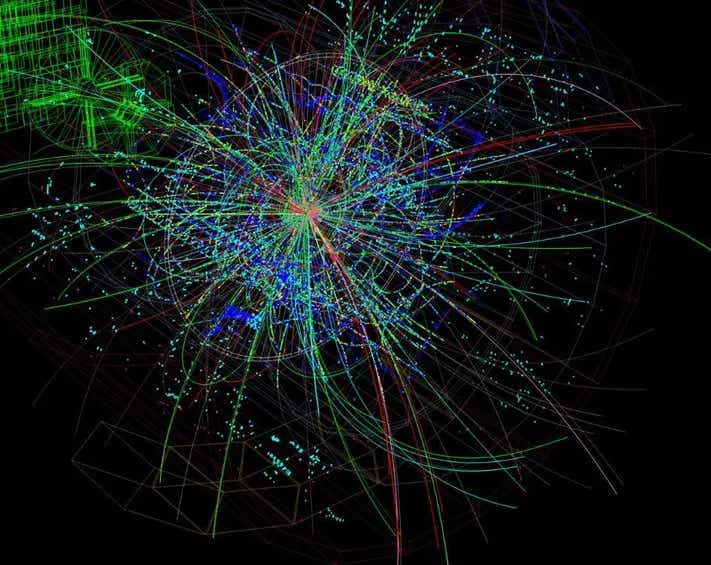
New muon g-2 calculation brings theory and experiment into agreement, shrinking hopes for a fifth force of nature. (CREDIT: Wikimedia / CC BY-SA 4.0)
For years, one tiny mismatch in particle physics carried outsized hopes.
The muon, a heavier and short-lived cousin of the electron, seemed to wobble in a magnetic field just a little differently than the Standard Model said it should. That gap, known through the particle’s anomalous magnetic moment or muon g−2, looked to many physicists like a possible opening to something deeper, perhaps even a fifth force of nature.
Now that opening looks much narrower.
An international team led by Penn State physicist Zoltan Fodor has published what it describes as the most precise calculation yet of the key strong-force contribution behind the muon’s magnetic behavior. Their result, published in Nature, brings theory and experiment into agreement within half a standard deviation, suggesting the long-running discrepancy was not a sign of new physics after all.
New calculation method
“There were many calculations in the last 60 years or so, and as they got more and more precise they all pointed toward a discrepancy and a new interaction that would upend known laws of physics,” Fodor, a distinguished professor of physics at Penn State and lead author of the study, said. “We applied a new method to calculate this discrepancy quantity, and we showed that it’s not there. This new interaction we hoped for simply is not there. The old interactions can explain the value completely.”
That conclusion lands with both force and disappointment. The muon g−2 puzzle had become one of the most closely watched clues in fundamental physics because it seemed to hint that the Standard Model, the theory describing the known building blocks of matter, might finally be showing a crack.
Instead, this work strengthens confidence in it to 11 decimal places.
A particle that became a test case
The muon is about 207 times heavier than the electron and carries spin 1/2. Like the electron, it acts like a tiny magnet. In simple relativistic quantum mechanics, its magnetic factor should be exactly 2. But quantum field theory complicates that picture. Fleeting particles and interactions tug at the muon and shift its magnetic strength by a very small amount, producing what physicists call the anomalous magnetic moment, written as aμ = (gμ − 2)/2.
Because the muon is so much heavier than the electron, those quantum corrections from heavy particles tend to be much larger. That made it an especially sensitive place to look for signs of unknown particles or forces.
Experiments at CERN in the 1960s and 1970s, then at Brookhaven National Laboratory in the early 2000s, and later at Fermilab in Illinois, measured the muon’s magnetic moment with remarkable precision. Those efforts recently received the Breakthrough Prize in Fundamental Physics. Yet the experimental value appeared to remain at odds with the Standard Model prediction, feeding excitement that something new might be lurking in the math.
The trouble was never the easy parts of the math.
The biggest uncertainty came from the strong interaction, or quantum chromodynamics, the force that binds quarks into protons, neutrons and other hadrons. It is the most powerful of nature’s four fundamental forces and, unlike gravity or electromagnetism, it becomes harder to handle as distance increases. Pull it apart, and the energy can create new particles. That makes the theory extraordinarily hard to calculate with precision.
A decade on supercomputers
To attack that problem, the team used lattice quantum chromodynamics, a method that breaks space and time into a fine grid and solves the equations numerically on massive supercomputers.
“The old methodology involved collecting thousands of experimental results and reinterpreting them to get the single number, the magnetic moment of the muon,” Fodor said. “Our approach was completely different. We divided space time into very small cells, a lattice, then we solved the equations of the Standard Model on that. There was an awful lot of theory, mathematics, programming, computational knowledge and computer architecture behind this calculation.”
The work took more than 10 years.
Hadronic vacuum polarization
The researchers focused on the leading-order hadronic vacuum polarization contribution, the dominant source of uncertainty in calculating aμ. They say they reached unprecedented accuracy by improving two of the biggest weak spots in earlier lattice studies: corrections related to the finite size of the lattice and the extrapolation to the continuum limit, where the grid spacing is taken toward zero.
They added a finer lattice spacing than before, shrinking it from 0.064 femtometers in their 2020 work to 0.048 femtometers in the new calculation. Since the leading discretization effects scale with the square of the lattice spacing, that step sharply reduced cutoff effects.
They also used a hybrid strategy. At short and intermediate distances, they relied on lattice calculations. At long distances, beyond 2.8 femtometers in Euclidean time, they replaced the lattice tail with a data-driven determination based on measurements from electron-positron annihilation and tau-decay experiments. Before combining the two, they checked that both approaches agreed within errors for part of that long-distance tail.
That tail contributed less than 5 percent of their final lattice-dominated result, but it helped cut uncertainties more effectively than either method alone.
What disappeared, and what did not
When the team folded its new result into the full Standard Model prediction, the old mismatch with experiment nearly vanished.
Their value for the hadronic vacuum polarization term, combined with the other Standard Model contributions summarized in a 2025 theory compilation, yielded aμ = 11,659,205.2(3.6) × 10−10. Compared with the world average from direct measurements, the difference was −0.5 standard deviations.
That is a long way from a crisis.
It is also much tighter than before. The authors say their uncertainty is a factor of 1.8 smaller than the latest 2025 Theory Initiative combination and that their new result reduces uncertainty by a factor of 5.5 compared with their 2017 determination and by 1.6 relative to their 2020 result.
Data-driven results
Still, the story is not quite finished. The researchers note that some data-driven results remain in serious tension with lattice-based estimates, especially around measurements of the two-pion spectrum near the ρ-meson peak. In one intermediate-distance window, their new lattice result differs from an earlier data-driven determination by 4.3 standard deviations. Other comparisons vary depending on the dataset, with differences of 6.2σ for KLOE, 3.5σ for BaBar, 1.3σ for CMD-3, and 2.7σ for τ-decay data, with an alternative τ evaluation bringing that gap down further.
They also spell out the main sources of uncertainty still requiring control: statistical errors, finite lattice size, continuum extrapolation, fixing the parameters of four-flavor QCD, and isospin-symmetry breaking.
So the result does not rule out new physics everywhere. It closes off one of the most promising paths toward it.
“People ask me how it feels to make this discovery and, to be honest, I feel somewhat sad,” Fodor said. “When we started to calculate this quantity, we thought we were going to have a good and trustworthy calculation for a new fifth force. Instead, we found there is no fifth force. We did find a very precise proof of not just the Standard Model, but also of quantum field theory, which is the foundation on which the Standard Model was built.”
Practical implications of the research
The immediate impact is scientific rather than technological. This work strengthens the case that the Standard Model, and the broader framework of renormalized quantum field theory, can still account for nature at extremely high precision. It also shifts where physicists may look next for signs of unknown particles or forces.
At the same time, the paper points to unfinished work. Fresh electron–positron to pion cross-section data is on the way. The MUonE Collaboration is pursuing a new method to directly probe hadronic vacuum polarization in the space-like region.
Meanwhile, a separate muon g−2/EDM experiment is taking shape at J-PARC, using a completely independent approach. Even if one major anomaly has faded, the search for cracks in the Standard Model is not over.
Research findings are available online in the journal Nature.
The original story "Decade-long muon calculation shrinks hope for a fifth force of nature" is published in The Brighter Side of News.
Related Stories
- Physicists achieve most accurate measurement yet of the W boson
- Inside the quantum loop: New tool cracks a long-standing physics mystery
- Fermilab experiment finds no evidence for a fourth neutrino, ending a long-debated theory
Like these kind of feel good stories? Get The Brighter Side of News' newsletter.
Shy Cohen
Writer