Digital ‘super-brain’ with a physics education speeds up technology development
Physics-aware AI helped Chalmers researchers design optical materials faster, with less data and fewer errors.

 Edited By: Joseph Shavit

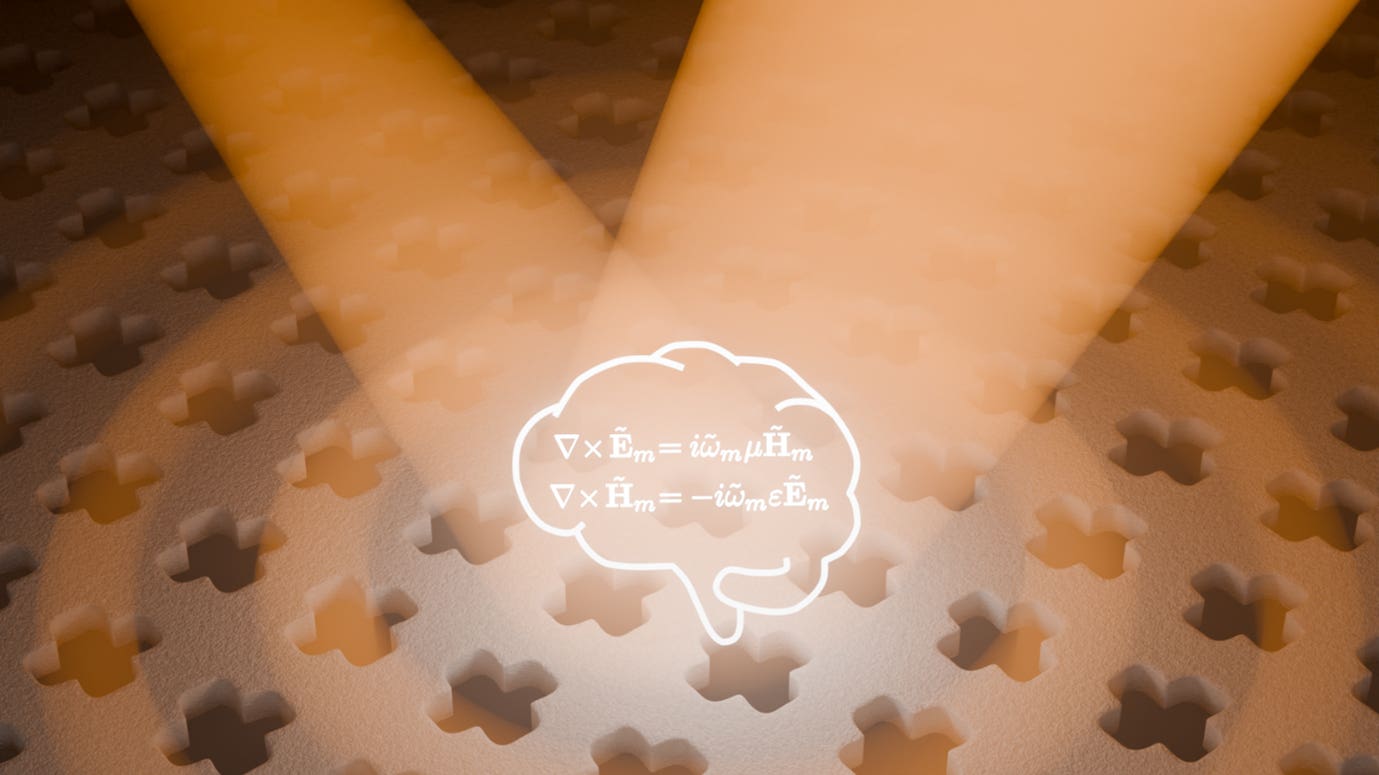
A Chalmers team built physics into AI, cutting optical material design time from 30 days to 3. (CREDIT: Chalmers University of Technology | Viktor Lilja)
Designing materials that steer light is a slow kind of trial and error. Each candidate structure must be tested in computer simulations, and every new data point can take anywhere from ten minutes to an hour to produce. That bottleneck has made one thing clear. Smarter machine learning is useful only if it can learn faster, too.
At Chalmers University of Technology in Sweden, researchers say they found a way to do that by giving a neural network something like a physics education before training begins. Instead of forcing the system to discover the laws of electromagnetism on its own from vast amounts of data, they built those laws directly into the model.
The payoff was immediate. “When we fed the super-brain information about the laws of physics, it immediately got much smarter. Our calculations now take one tenth of the time previously required,” said Philippe Tassin, professor in the Department of Physics and Astronomy at Chalmers.
That cut a month-long training-data effort down to about three days, according to the team.
Where light gets tricky
The work comes from nanophotonics, a field that deals with controlling light on scales smaller than its wavelength. At that size, light does not behave the way it does in everyday lenses or mirrors. That opens new design possibilities, but it also creates severe computational challenges.
Tassin’s group studies artificial optical materials that can do things natural materials cannot. Those materials could help make camera and eyeglass lenses thinner, lighter and more effective. The same design tools could also matter for quantum technologies.
Together with researchers at Chalmers’ Department of Microtechnology and Nanoscience, where Sweden’s first larger quantum computer is being built, the team is studying whether nanostructured materials can better control the movement of light. One idea is to transmit information between quantum computers, or across longer distances, at optical frequencies. They seek to do this using mechanically compliant photonic crystals, tiny engineered crystals with an extremely high capacity to reflect light.
The group’s work is done entirely in simulations on supercomputers. Neural networks serve as the main shortcut, helping predict how a structure will scatter, reflect, transmit or absorb light. This is done without having to run full electromagnetic calculations every time.
But those shortcuts have had a catch.
Teaching the model before training it
Ordinary neural networks are often treated as black boxes. They can become very good at prediction, but they usually need huge training sets first. Also, their internal reasoning is hard to interpret. In this case, the cost of producing the training data was a serious limit.
“It might take us a whole month to generate enough data to train the neural network. Then if you realise that you need to add more things, it can take another month,” said Viktor Lilja, a doctoral student in the Department of Physics and Astronomy at Chalmers.
The team’s answer was to stop making the network rediscover basic physics from scratch. Optical components must obey the laws of electromagnetism, so the researchers embedded those constraints into the architecture itself. In effect, they built an analytical physics model into the final stage of the neural network.
That changed the task. Instead of learning only from raw simulated outcomes, the network learned physics-based parameters tied to the resonant behavior of electromagnetic systems. The researchers based the method on quasinormal modes. This is a framework that connects scattering behavior to the natural resonances of an optical device.
Their model, which they call QNM-Net, was described in Laser & Photonics Reviews.
The gain was not only speed. The team reports that the physics-informed network needed much less training data than standard neural networks to reach similar accuracy. Moreover, it did so with fewer trainable parameters.
Better predictions, fewer obvious errors
The researchers tested the method on two kinds of systems. One was a photonic crystal slab, a patterned dielectric sheet whose scattering response was dominated by a single resonance. The other was a much harder case. This was a free-form dielectric metasurface with a far larger design space, multiple overlapping resonances, polarization-dependent behavior and less symmetry.
In the photonic crystal case, the QNM-Net achieved a low prediction error using only a fraction of the dataset, about 160 training samples. In contrast, conventional neural networks needed roughly an order of magnitude more data and more trainable parameters to reach similar performance.
The model also did more than match spectra. Its learned resonance frequencies lined up closely with eigenfrequencies obtained from full-wave eigenmode simulations. This suggests that the internal physics it learned was not just numerically useful, but physically meaningful.
That matters because the system is not only supposed to predict what a design will do. It is also meant to help create new ones.
Speeding up design development
Using the learned resonance parameters as design targets, the researchers inverse-designed five photonic crystal slabs with linearly increasing eigenfrequency and loss rate. Starting from a neutral initial design, the optimization reached the desired eigenfrequency after a few hundred steps in less than one second. Full-wave simulations of the final designs matched the model’s predictions closely.
For the more difficult metasurface case, the model did not capture every weak resonance. The team says the design space is so large that even tens of thousands of training samples may still be too few to learn every detail. Even so, the QNM-Net reached the performance of the best reference models with about one third as much data.
“Once we’d trained the network, we could ask it to examine any structure at all and get the optical properties in a millisecond. With these new networks, we get better estimates and avoid obvious errors,” Lilja said.
Tassin put the benefit more simply: “Now that we can work so much faster, we can speed up design development for optical components.”
Why the physics itself matters
The study also points to a broader shift in how machine learning may be used in physics. Rather than treating neural networks as pattern-matching machines that need enormous datasets, researchers are increasingly trying to bake scientific structure into them from the start.
In this case, that approach made the model more data-efficient, easier to interpret and more closely tied to real electromagnetic behavior. The authors say the method could be useful across a wide range of systems. Specifically, those where scattering spectra are shaped by resonances.
They also note that stronger data efficiency could make it more practical to train models on experimental data for simpler designs. In supporting tests, the team found the QNM-Net was more robust to simulated noise than standard neural networks. This could help when real-world measurements are messy.
The framework may also help researchers learn something new from the models themselves. Because the network predicts interpretable physical parameters, it can highlight which resonances matter most. It can also show which modes contribute little to the observable scattering response.
Practical implications of the research
This work could shorten the path from concept to usable optical component. Faster, more data-efficient design tools could help engineers develop better photonic crystals, metasurfaces and other nanostructured materials. This would mean not waiting weeks for enough simulation data to pile up.
That matters for lighter lenses, more compact optical systems and future quantum technologies that depend on precise control of light.
Just as important, the method suggests that machine learning can become more practical in physics when it is built around the rules nature already follows. This works better than trying to infer those rules from scratch.
Research findings are available online in the journal Laser & Photonics Reviews.
The original story "Digital ‘super-brain’ with a physics education speeds up technology development" is published in The Brighter Side of News.
Related Stories
- DNA nanomachines could revolutionize medicine and technology
- Evolvable AI could push technology into a new phase of evolution
- Scientists create the world's first neuromorphic supercomputer to simulate the human brain
Like these kind of feel good stories? Get The Brighter Side of News' newsletter.
Shy Cohen
Writer