Distance in space is an illusion
Distance feels obvious, but relativity and quantum theory suggest it may be an emergent feature, not a fundamental one.

 Edited By: Joshua Shavit

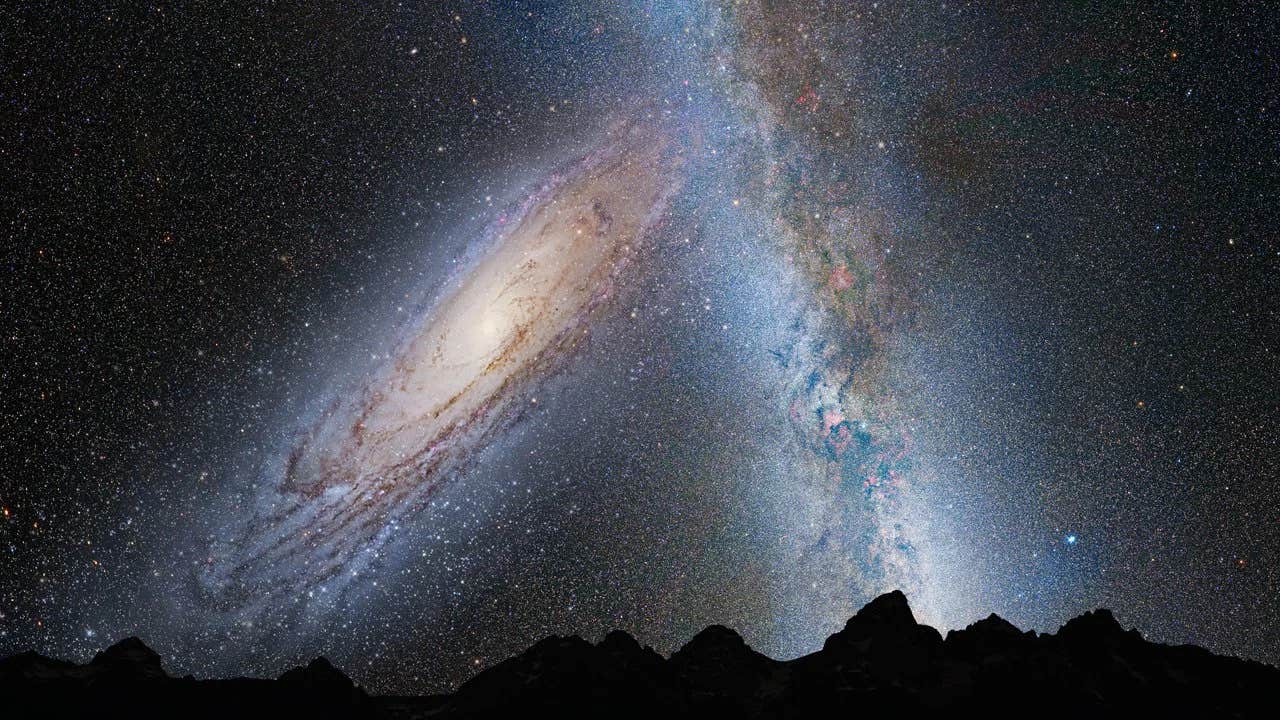
Modern physics suggests distance may emerge from motion, gravity and quantum entanglement, not exist as a basic fact. (CREDIT: NASA, ESA, Z. Levay and R. van der Marel/STScI, T. Hallas, and A. Mellinger)
Andromeda sounds far away because 2.5 million light-years sounds far away. It lands with authority. It feels exact. It gives you the comfort of a labeled universe, one where galaxies, stars and planets sit at fixed intervals inside a giant cosmic grid.
Might be time to ease up on that confidence.
Einstein, Juan Maldacena, Mark Van Raamsdonk, Brian Swingle and other physicists have pushed modern physics into a place where distance stops looking like a simple fact and starts looking more like a useful habit of thought. The old picture still works for everyday life, and for plenty of astronomy. But at deeper levels, distance gets slippery. It depends on motion. It depends on gravity. It depends on how you define the measurement. And in some of the boldest theoretical work, it may emerge from quantum entanglement rather than existing as a basic ingredient of reality.
That is a startling claim, but it does not come out of nowhere. It grows out of a series of cracks in common sense, and once you follow those cracks, the floor starts to shift.
Andromeda is how far away?
Take the familiar line that the Andromeda galaxy is about 2.5 million light-years away. That sounds like a clean statement about space. In practice, it is already tangled up with time.
A light-year is not some separate cosmic unit floating above the others. It is the distance light travels in one year. So when you say Andromeda is 2.5 million light-years away, you are also saying the light reaching you took 2.5 million years to arrive.
That detail matters more than it first appears to.
The light in your telescope left Andromeda millions of years ago. By the time it got here, Andromeda had not been politely standing still, waiting to be measured. It had been moving. So the number attached to the galaxy is not really telling you where it is “right now” in any easy everyday sense.
Things get even messier once cosmic expansion enters the discussion. The distance the light traveled is not identical to the current distance between Earth and the galaxy that emitted it. Those are different ideas. So are the distance at the moment the light was emitted, the distance implied by travel time, and the current distance after expansion.
Which one is the real distance?
That is exactly where the trouble begins. There is no single answer that arrives wearing a crown.
Einstein made distance personal
If cosmology unsettles the story, special relativity takes a hammer to it. Einstein’s 1905 work did not merely tweak how people think about motion. It changed how space and time themselves behave.
One of the best-known results is length contraction. An object moving at high speed relative to you measures shorter in the direction of motion than the same object at rest. Not squashed in the usual sense. Not squeezed by pressure. Shorter because spacetime geometry works that way.
The figures are not subtle once speed gets extreme. At 10 percent of light speed, the contraction is tiny. At 90 percent, an object drops to about 44 percent of its rest length. At 99 percent, it shrinks to roughly 14 percent.
That is the kind of result that sounds like a trick until you sit with it for a minute. Then it stops sounding like a trick and starts sounding rude.
The galaxy did not move. The ruler did not change. Yet the measured length did.
Apply that logic to Andromeda and the problem becomes impossible to ignore. Someone on Earth and someone hurtling toward the galaxy at 99 percent of light speed would not assign the same distance to it. The person on the fast-moving ship could calculate a far smaller separation, around 350,000 light-years rather than 2.5 million.
Neither observer gets to claim ownership of the “real” number in some absolute cosmic sense. The measurements differ because the frames differ.
That is not fuzzy philosophy. It is relativity.
Gravity bends more than light
General relativity makes the situation less tidy, not more. Special relativity already tells you that distance depends on motion. General relativity adds another problem: the geometry of space is not fixed.
Matter and energy curve spacetime. So the distance between two points is not written on a permanent background waiting for you to check it. It depends on the physical conditions in the region you are trying to describe.
This is where black holes enter the conversation like they usually do, which is dramatically.
Near a black hole, spacetime curvature gets extreme. In the picture laid out by general relativity, the usual instincts about near and far, inside and outside, start to wobble badly. A black hole can look finite from the outside while hiding a much stranger internal geometry. The point is not just that black holes are exotic. The point is that they expose how fragile your ordinary ideas about space really are.
Even the shortest path between two points is no longer the plain straight line your brain wants to draw. In curved spacetime, the shortest paths are geodesics, routes shaped by geometry itself. Add mass, shift energy, change curvature, and those routes change too.
Distance is not the rigid stage on which physics happens. It is part of the play.
Coordinates can make fools of you
There is another awkward detail that rarely gets star billing outside physics circles. The coordinates used to label spacetime are not sacred. They are choices.
This does not mean anything goes. Physics is not a free-for-all. But it does mean that what looks enormous in one coordinate system can look much smaller in another, and what seems close in one description can appear more remote in the next.
That is a hard point for nonphysicists to love, mostly because it sounds like bookkeeping. But it matters. It means the map you draw is not the territory itself. The labels are not the world. They are ways of organizing it.
People tend to speak about distance as though it were simply sitting there in nature, polished and objective, waiting to be read off like a highway sign. Modern physics is a lot less sentimental about that.
Entanglement wrecks the old idea of closeness
Then quantum mechanics arrives and turns the problem sideways.
Entanglement is the phenomenon Einstein famously disliked enough to call “spooky action at a distance.” Two particles interact, become entangled, and then behave as parts of a single quantum system even after being moved apart. Measure one, and the result tells you something definite about the other.
The strange part is not just that this happens. The strange part is what it does to the word “near.”
Two particles can be separated by immense physical distance and still share a quantum relationship stronger, in some sense, than two nearby particles that are not entangled. So spatial separation and quantum connection are not the same thing. They are not even close to the same thing.
That cuts right into the old intuition that distance is the master measure of separation. Sometimes it is. Sometimes it is not. At the quantum level, “far apart” may fail to describe the most important relationship in the room.
That does not let anyone cheat causality. Entanglement does not offer faster-than-light messaging, matter transport or a secret tunnel for your weekend travel plans. The limits remain. Still, it forces a distinction between being spatially apart and being physically disconnected. Those are not identical ideas.
Maldacena’s boundary trick changed the conversation
Juan Maldacena pushed this even further in 1997 with AdS/CFT correspondence, one of the landmark results in theoretical physics. In broad terms, it describes an exact equivalence between a gravitational theory in a certain curved spacetime and a quantum field theory without gravity living on that spacetime’s boundary.
That sounds forbidding. The underlying idea is easier to grasp than the math.
A higher-dimensional world with gravity can be fully described by a lower-dimensional theory on its boundary. The “bulk” and the boundary are not rival stories. They are two mathematically equivalent descriptions of the same physical reality.
That alone is enough to make a person stare into middle distance for a bit.
But the sharper implication is this: the extra depth dimension in the bulk is not necessarily fundamental. In the boundary picture, what appears as radial distance in the bulk corresponds instead to energy scale. High-energy processes line up with one region of the geometry. Lower-energy processes line up with another.
So depth, and by extension some of what you call distance, may emerge from something more basic than geometry itself.
Not from empty space.
From structure.
Space may be stitched together, not laid out in advance
Mark Van Raamsdonk, Brian Swingle and other physicists helped sharpen that idea by tying spacetime geometry more directly to entanglement structure. The picture that emerges is hard to forget once you hear it.
Reduce entanglement between regions of a quantum system and the corresponding spacetime geometry weakens. Reduce it enough and those regions disconnect. Restore entanglement and the geometry reconnects.
It is hard to ask for a more vivid image. Space stops looking like an already-built container. It starts looking stitched together.
That is why these ideas attract so much attention. They suggest that the connectivity of spacetime, the fact that regions of space are joined by finite distances at all, may arise from entanglement. Pull out enough of that quantum stitching and the geometry comes apart.
Distance, in that picture, is not a primitive feature. It is an effect.
Wormholes join the party
Then comes ER equals EPR, the conjecture associated with Maldacena and Leonard Susskind. It proposes a link between Einstein-Rosen bridges, better known as wormholes, and EPR pairs, the entangled systems named after the 1935 Einstein-Podolsky-Rosen paper.
The claim is bold enough to sound like a dare. A wormhole connecting distant regions of spacetime and a quantum entanglement link between systems may be two descriptions of the same deeper phenomenon.
No, this does not mean your entangled particles are offering you a comfortable commuter route to another galaxy. The idea is not that useful in the science fiction sense. The wormholes in these discussions are not open for traffic.
Still, the conceptual point lands. If geometry and entanglement can mirror one another this closely, then distance starts to look less like a bedrock fact and more like a large-scale description of hidden quantum relations.
Space may even come in chunks
Loop quantum gravity pushes in a different direction but lands near the same destination. In that approach, spacetime is not smooth all the way down. At very small scales, it is built from discrete quantum units, often described as spin networks.
In that framework, distance is not infinitely divisible. The source transcript ties the smallest meaningful scale to the Planck length, around 10^-35 meters. Below that, the classical notion of distance is not just hard to use. It may lose meaning entirely.
That idea has a rough elegance to it. Space looks smooth at human scales for the same reason a beach looks smooth from far away. Get close enough and the granularity appears.
If that picture is right, then ordinary distance is doing what temperature does. It works. It measures something real enough to matter. But it is not the deepest description available.
So what are you looking at when you look up?
That may be the nicest part of the whole story. It does not ruin the night sky. It complicates it.
When you look at the Milky Way and think about stars spread across hundreds or thousands of light-years, the distances still matter. They remain useful. They still govern travel times, observations and the ordinary business of astronomy.
But they may not be the universe’s first language.
At the deepest level, the cosmos may be less like a vast warehouse with objects scattered through it and more like a quantum structure whose large-scale appearance we experience as space. Distance, on that view, is not fake in the cheap sense. It is real the way a shadow is real. It tells you something true, but not everything true.
The original story "Distance in space is an illusion" is published in The Brighter Side of News.
Related Stories
- Breakthrough theory links Einstein’s relativity and quantum mechanics
- Interstellar travel is impossible and aliens haven't visited Earth, physicists say
- Death is not the end: What physics says about dying
Like these kind of feel good stories? Get The Brighter Side of News' newsletter.
Joseph Shavit
Writer, Editor-At-Large and Publisher
Joseph Shavit, based in Los Angeles, is a seasoned science journalist, editor and co-founder of The Brighter Side of News, where he transforms complex discoveries into clear, engaging stories for general readers. With vast experience at major media groups like Times Mirror and Tribune, he writes with both authority and curiosity. His writing focuses on space science, planetary science, quantum mechanics, geology. Known for linking breakthroughs to real-world markets, he highlights how research transitions into products and industries that shape daily life.