Emanuel Perathoner rebuilt his career after a knee replacement and won Paralympic gold
Emanuel Perathoner gave up skiing at eight for being too boring. At 39, after four surgeries and a knee replacement, he won Paralympic gold.

 Edited By: Joseph Shavit

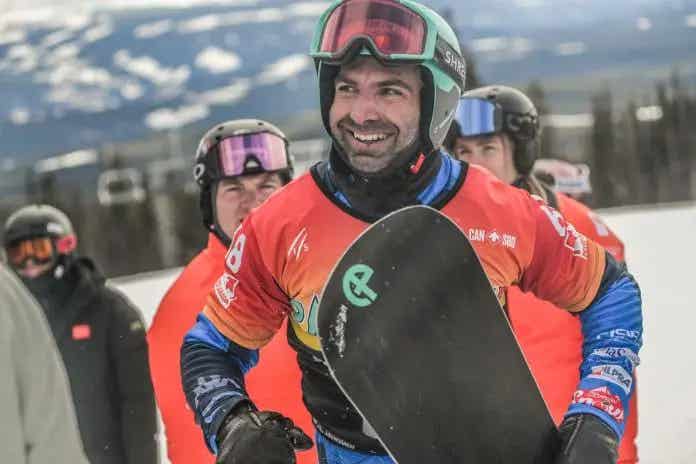
At 39, Italian snowboarder Emanuel Perathoner won Paralympic gold in his home Dolomites after a total knee replacement ended his Olympic career. (CREDIT: Julia Thrift)
He gave up skiing at eight years old. Too boring.
That detail tells you something about Emanuel Perathoner before anything else does. The Italian snowboarder who stood on top of a Paralympic podium in Cortina on March 8, gold medal around his neck, crowd roaring in his home Dolomites, has always needed more than just speed. He needs the chaos around it.
Snowboard cross gives him that. Six riders launching from the same gate, jostling through banked turns and jumps, everyone trying to survive and accelerate at the same time. It is not a lonely discipline. It suits him exactly.
What it took to get him there, however, was a different kind of test entirely.
The Knee That Changed Everything
In 2021, Perathoner attempted a jump called a double, clearing two rollers in sequence. He landed short. His tibial plateau, the flat surface at the top of the shinbone that forms the base of the knee joint, fractured severely. Four surgeries followed. The final one resulted in a total knee replacement, locking his left joint at a fixed angle of 35 to 40 degrees.
His shot at a third Winter Olympics, Beijing 2022, was gone.
"For a while, my only goal was to learn to walk again," he said.
His more immediate motivation was personal. Four months after that final surgery, he walked up the aisle at his wedding to Amelia in the Spanish Pyrenees. Getting there on his own two feet mattered more to him at that point than any race.
Paralympic competition wasn't even on his radar. Perathoner didn't consider himself eligible. He still had, as he put it, "all the pieces of my body." A knee prosthesis didn't feel like a qualification for a different kind of Games; it felt like an ending.
Then he visited old teammates at a training camp in Stelvio. Italy's Para-snowboard team happened to be there at the same time.
Learning What He Didn't Know
"I knew something about the Paralympic world," Perathoner told Italian outlet La Gazzetta, "but until you're in it, you don't realize how competitive it is. How ignorant I was."
An ex-teammate connected him with the Italian Paralympic Committee. By late 2022, he was competing again.
His left knee's limited mobility forces him to compensate through his back and hip, adjustments that affect both his riding and his daily movement. Despite that, the results came quickly. Since entering Para snowboarding, Perathoner has accumulated 31 World Cup medals across disciplines and three World Championship golds. Coming into the Milano Cortina 2026 Paralympic Winter Games, he had lost just three races since 2024.
He is 39. His final competitors in Cortina were roughly a decade younger.
None of it seemed to register as pressure, partly because pressure wasn't new. Perathoner first competed on the FIS World Cup circuit at 16, grinding through years of consistent but unspectacular results, taking construction jobs between training camps, sometimes sleeping in his van. Sustained success at the Olympic level only arrived after he turned 30. Two appearances at the Winter Olympics, Sochi 2014 and PyeongChang 2018, produced little.
What they produced, though, was experience.
At the Gate
"If you go first time to the Games, everything is huge, it's new," he said. "You enjoy it a lot but it's also a lot to absorb. Having that experience already, it's easier to just focus on the Games."
In the semifinals and final at Cortina, that composure was visible from the start. Perathoner exploded out of the gate both times, building enough of a lead early to avoid the scrambles and contact that routinely end races in snowboard cross. He finished the final more than three seconds ahead of Australia's Ben Tudhope, who took silver. South Korea's Lee Jehyuk earned bronze.
"In the final I had a pretty good start so I could do my race and my lines," he said. "That was the most important thing in my race today, the start."
The crowd packed into the final section of the course helped close it out. Perathoner lives in Val Gardena, two hours from Cortina. These were his mountains, his spectators, and his family in the stands.
"Especially going into the last chicane, there were a lot of people cheering, so hearing all the people yelling and cheering for me gave me an extra push for the last few metres," he said.
Italy had never won a Paralympic gold in Para snowboarding before. Perathoner is the first, arriving at his first Paralympic Games, in front of his home crowd, at 39 years old.
"I thought: the last four years have been totally worth it. All the work I was putting in, all the travelling, all the time away from home, it was totally worth it."
Two Careers, One Athlete
Only around 20 athletes in history have competed at both the Olympic and Paralympic Games. Perathoner is now the second to have done so at the Winter Games specifically. He is careful, though, about what comparisons he draws between those two versions of his career.
"At the beginning I was comparing my first career with my second career," he said. "But then I learnt it was a totally different thing. Having now a new career, it's a second chance. I'm trying to do my best and not compare a Paralympic career with an Olympic career."
What he does say, clearly, is that Paralympic sport carries something the other world doesn't always offer. "The Paralympic athletes have way more stories behind them than maybe an able-bodied athlete," he said.
He's already talking about French Alps 2030. And Utah 2034. The banked slalom on March 13 gives him the chance to match the two-gold performance of Federica Brignone, the Italian alpine ski star whose knee injury was similar to his, and who claimed two golds at the Olympic Games running concurrently in Milano Cortina.
The adrenaline, it seems, hasn't run out yet.
Lessons Learned
Perathoner's path carries a message that extends beyond sport. Total knee replacement is among the most common major orthopedic procedures worldwide, often associated in the public mind with reduced activity and permanent limitation. His competitive success at an elite level, adapting technique to accommodate a fixed joint angle, offers a visible example of what post-surgical athletic life can look like when the classification system makes room for it.
For the Paralympic movement, his crossover profile also draws a wider audience into contact with Para sport, bringing Olympic-familiar viewers to watch disciplines and athletes they might not otherwise encounter.
His vocal appreciation for the depth of Paralympic athletes' stories reflects a broader case the movement continues to make: that the competition is not a lesser version of something else, but a distinct thing worth watching on its own terms.
The original story "Emanuel Perathoner rebuilt his career after a knee replacement and won Paralympic gold" is published in The Brighter Side of News.
Related Stories
- Inside Tokyo’s growing movement toward inclusive Para sports
- Alysa Liu’s Gold Ignites a Sweet Homecoming in Oakland
- Laila Edwards’ family watches her win Olympic gold live with help from Kelce brothers and GoFundMe
Like these kind of feel good stories? Get The Brighter Side of News' newsletter.