Europe’s catastrophic ‘flood of the millennium’ in 1342 wasn’t a single event
Medieval records reveal a relentless sequence of floods that killed thousands and repeatedly battered Europe from 1341 to 1343.
 TU Wien Writer: Florian Aigner

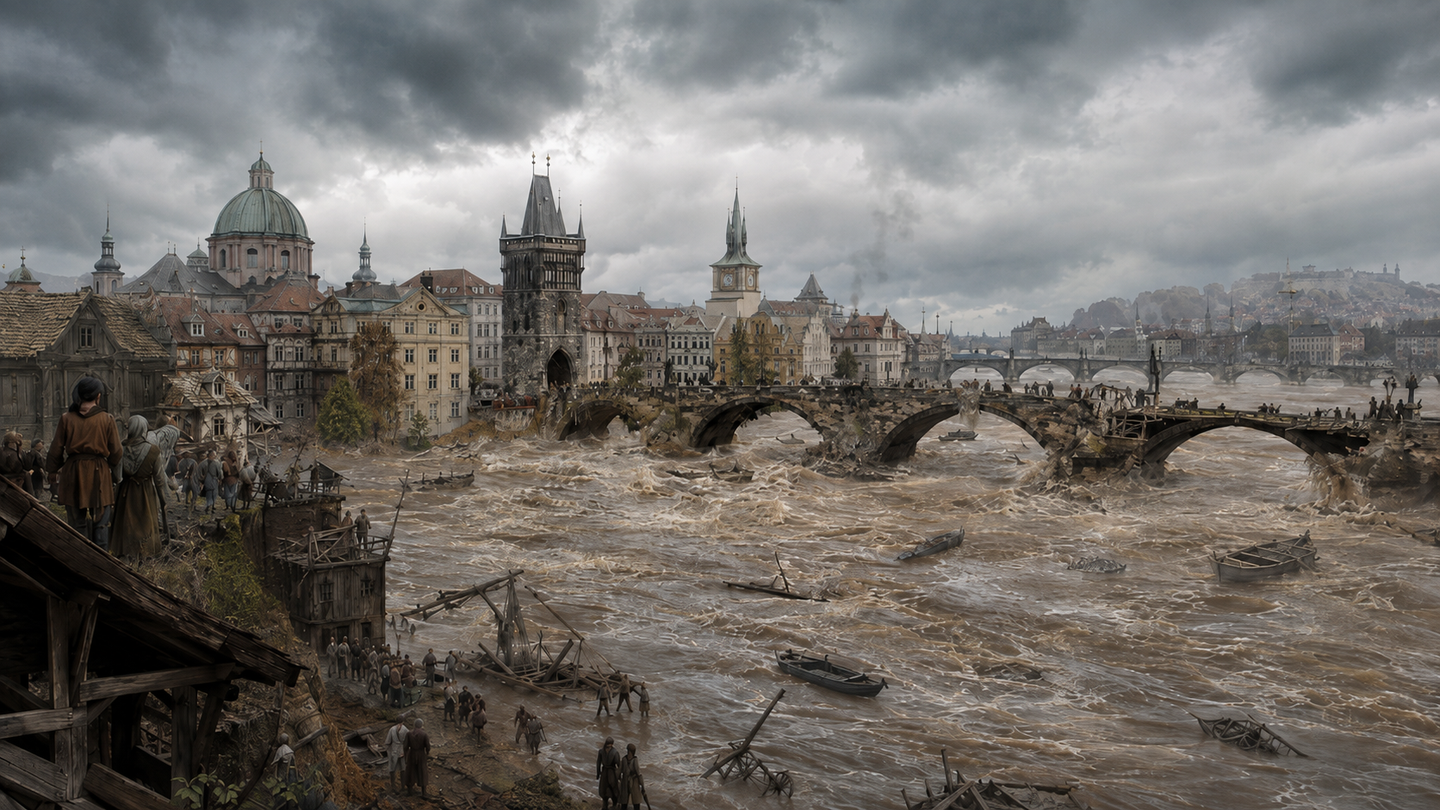
The St. Mary Magdalene Flood 1342 was part of 16 major European floods that struck within less than two years. (CREDIT: Shutterstock)
- Europe’s famous 1342 St. Mary Magdalene’s Flood was part of a much larger disaster, with 16 major floods striking the continent from 1341 through 1343.
- Volcanic eruptions, shrinking Arctic sea ice and shifts in atmospheric circulation may have helped create the unusual run of destructive weather, though no single cause has been proven.
- The disaster shows why modern flood planning must prepare for several extreme floods arriving within months, not just one exceptionally rare event.
Europe’s infamous St. Mary Magdalene’s Flood of 1342 was not one isolated catastrophe. It was the most destructive part of a nearly two-year chain of floods that repeatedly struck the continent from 1341 through 1343.
A reconstruction led by TU Wien identified 16 major flood events during that period. Four had estimated return periods of 500 to 1,000 years, while the late July 1342 Magdalena Flood reached an estimated 1,000 to 10,000 years in some areas.
The scale of the disaster becomes clearer when viewed as a sequence rather than a single summer flood. Rivers rose repeatedly across Central, Western, Southern and Southeast Europe, often before communities had recovered from earlier inundations.
The analysis drew on more than 1,000 contemporary entries, along with archaeological and sedimentary evidence. The team also compared the medieval floods with modern events that developed under similar conditions.
A continent hit again and again
The sequence began with a wet autumn in 1341, followed by major November and December floods in East Central and Southeast Europe. A cold, snowy winter then gave way to sudden thawing, producing the February 1342 Candlemas Flood across Western and Central Europe.
Three spring floods followed. In late July, the Magdalena Flood struck Southern Germany, particularly the Main River catchment. Flooding along the Rhine and Main reached estimated return periods of 100 to 1,000 years, while settlements, bridges, roads and mills were destroyed along major waterways.
Northern Italy flooded in late summer, followed by autumn events elsewhere. Wet conditions returned in early 1343, bringing more floods across parts of Europe.
Late July brought the Jacob Flood across the northern and central Alps and the Carpathians. A still larger Bartholomew Flood followed in late August. Flooding continued around Lake Constance and in the Carpathians into autumn.
Thousands died as transport and harvests collapsed
“Many thousands of people died in the floods, from hunger and disease,” said Andrea Kiss, a historian, medievalist and geographer at TU Wien who led the study.
One contemporary account reported roughly 6,000 deaths during the Candlemas Flood along the Danube. Across Europe, floodwaters destroyed or damaged bridges over major rivers and disrupted roads on a continental scale.
Prague lost the stone bridge that had crossed the Vltava since 1172. Its replacement, the Charles Bridge, was later built with broader and higher arches, pointed ice-breaking piers and elevated riverbanks.
Lost harvests and transportation problems contributed to dearth and famine from 1342 through 1344. Food prices rose across Western and Central Europe.
Flooding also disrupted salt production in Italy, forcing imports from places as distant as Cyprus.
In some areas, water remained long after individual floods passed. Records describe unhealthy standing water and outbreaks of a deadly “bleeding illness,” probably dysentery or another form of bloody diarrhea, in flood- and famine-affected regions.
Why 1342 became the flood year without equal
Compared with a 700-year European flood record, 1342 had the greatest number of great and extraordinary floods. The year 1343 ranked third.
Several major rivers flooded repeatedly during both years.
“Historical data show that it wasn't just a single flood event, but a whole series of events,” said Günter Blöschl, a hydrologist and team leader at TU Wien.
The researchers described the sequence as a “string of pearls.” “We can reconstruct month by month when which regions of Europe were affected,” Kiss said. “This clearly shows that a series of flood events stretches like a string of pearls through the years 1341 to 1343. Not all equally devastating, not all in the same place, but all clearly connected”.
Comparisons with recent floods underline how unusual the medieval sequence was. The team said the period resembled a situation in which the major European floods of 1999, 2002, 2005, 2006 and 2013, plus about a dozen other 10- to 100-year floods, all occurred within less than two years.
Volcanoes, sea ice and an unstable atmosphere
No single cause can yet explain the flood cluster. The authors instead identified several conditions that may have worked together.
At least five tropical volcanoes erupted around 1340, although their dates remain uncertain. Eight extratropical eruptions occurred in 1340 and 1341, including five in Iceland. Hekla erupted in May and June 1341.
Volcanic aerosols can cool the lower atmosphere and alter circulation. Reconstructions also indicate declining Arctic sea ice from the mid-1330s, while solar activity remained relatively low.
The team found evidence consistent with shifts in atmospheric circulation, including a southward movement of the North Atlantic jet stream, a weaker polar vortex and changes in large-scale climate patterns. These conditions could have favored intense cyclones and prolonged rainfall.
“The interplay of these factors could have contributed to intense low-pressure systems, prolonged rainfall, and thus the unusual series of floods.” Kiss said.
A direct causal explanation is not yet possible with available climate models and simulations. Volcanic forcing, sea-ice decline and internal climate variability remain plausible contributors rather than a proven single mechanism.
Practical implications of the research
The reconstruction challenges the way extreme flood risk is often framed. Modern planning commonly relies on recent observations and sometimes treats exceptional historical floods as isolated cases.
The 1342–1343 sequence shows that very large floods can cluster closely in time. That matters because societies may still be repairing bridges, roads, levees and other infrastructure when another major event arrives.
Flood disasters are therefore not necessarily independent events. The study argues that risk planning should consider cumulative damage and the possibility of repeated extremes across the same regions within months.
“This is extremely interesting for us today: We can draw important lessons about the interplay of climate and precipitation from events that occurred almost seven centuries ago,” Blöschl said.
The authors call for faster implementation of flood protection and more adaptive planning. Their findings support approaches that account for repeated events, flexible response capacity and local flood-proofing rather than preparing only for one catastrophic flood at a time.
Dig deeper into extreme European floods and climate drivers
These resources explore how atmospheric circulation, compound hazards, modern European flooding and adaptation strategies shape flood risk beyond individual extreme events.
Past hydroclimate extremes in Europe driven by Atlantic jet stream dynamics
This research links recurring European flood conditions to shifts in the North Atlantic jet stream and shows how persistent circulation patterns can influence flood-rich seasons, with volcanic eruptions also affecting jet behavior. (Nature Geoscience, 2025)
Compounding hazards increase flood economic losses across Europe
This Europe-wide analysis found that floods accompanied by other hazards can produce disproportionately large economic losses, highlighting why disaster planning needs to account for interacting and closely connected extremes. (Nature Communications, 2026)
Incorporating compound flood events in the weather warning system
Using a decade of Danish meteorological warnings and five case studies, this research examines the difficulties of forecasting compound floods and shows why warning systems need to consider interacting flood drivers rather than individual hazards alone. (npj Natural Hazards, 2025)
European State of the Climate 2024: Flooding
This authoritative assessment documents Europe’s most widespread flooding since 2013, with 30% of the river network exceeding the high-flood threshold during 2024, and examines major events including Storm Boris and the Valencia floods. (Copernicus Climate Change Service and World Meteorological Organization, 2025)
Comprehensive portfolio of adaptation measures to reduce flood risk
This research evaluates a broad range of flood-adaptation approaches, including structural defenses, nature-based measures, institutional responses and behavioral strategies, providing useful context for how societies can prepare for increasingly complex flood risks. (Communications Earth & Environment, 2025)
Research findings are available online in the journal Nature.
The original story "Europe's catastrophic 'flood of the millennium' in 1342 wasn't a single event" is published in The Brighter Side of News.
Related Stories
- The Red Sea was completely dry before a massive Indian Ocean flood revived it
- The Sikkim flood in India can help others prepare for similar disasters
- Earth's largest flood refilled the Mediterranean Sea five million years ago
Like these kind of feel good stories? Get The Brighter Side of News' newsletter.
Joshua Shavit
Writer and Editor
Joshua Shavit is a NorCal-based science and technology writer with a passion for exploring the breakthroughs shaping the future. As a co-founder of The Brighter Side of News, he focuses on positive and transformative advancements in technology, physics, engineering, robotics, and astronomy. Having published articles on AOL.com, MSN, Yahoo News, and Ground News, Joshua's work highlights the innovators behind the ideas, bringing readers closer to the people driving progress.