Ancient mammal ancestors gave birth to live young, 236-million-year-old fossil finds
A growth mark inside a Triassic cynodont bone could rewrite when live birth first appeared along the mammalian lineage.

 Edited By: Joshua Shavit

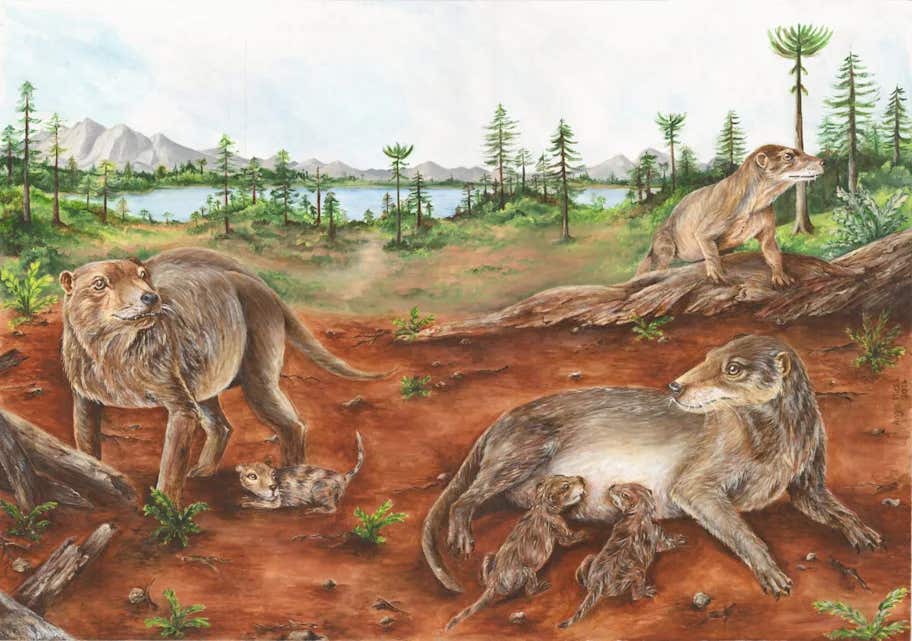
“Triassic Mothers,” a life reconstruction of a group of Chiniquodon theotonicus individuals, a pregnant female (left) as well as a female (right) breastfeeding few, relatively large neonates. (CREDIT: María de los Ángeles Miceli Baro
- A 236-million-year-old cynodont fossil from Argentina contains evidence that the animal may have given birth to live young rather than laying eggs.
- Bone growth patterns and estimated newborn size made the animal look far more like a placental mammal than a reptile or bird.
- The finding could push live birth deep into mammal ancestry, although researchers say more fossils are needed to determine when and how often it evolved.
A fossil bone from northwestern Argentina may have preserved a moment that happened roughly 236 million years ago: the biological shift surrounding birth. If the mark means what paleontologists think, one mammal ancestor was giving birth to live young far earlier than expected.
The animal, Chiniquodon theotonicus, was a cynodont, part of the lineage that eventually gave rise to mammals. A new study, published in Frontiers in Mammal Science, argues that one adult specimen carries the first compelling evidence of viviparity, or live birth, in a non-mammalian cynodont.
“We show for the first time that live birth was present in at least one mammalian ancestor, Chiniquodon theotonicus, which lived approximately 236 million years ago,” said lead author Dr Leandro Gaetano, a paleontologist at Argentina’s National Scientific and Technical Research Council, or CONICET.
If the interpretation is correct, live birth appeared in the mammalian lineage at least 95 million to 90 million years earlier than previously thought.
A growth mark preserved inside fossil bone
The clue came from specimen CRILAR-PV109, a partially articulated skeleton from the Chañares Formation. More than 50 specimens of C. theotonicus are known there, but this individual ranks among the largest.
Its skull measured about 160 millimeters at the base. The skull bones were strongly sutured, the teeth were fully erupted, and the postcranial skeleton was completely ossified. Those features led the team to interpret it as an adult.
Thin sections of its femur and ulna contained unusually well-preserved embryonic bone. The bones had very small medullary cavities and little secondary remodeling, helping preserve tissue normally lost as an animal grows.
Inside both bones, researchers found an abrupt transition in tissue structure. Vascular canals changed in size and arrangement, while the bone matrix also shifted. The pattern resembled a neonatal line, a growth mark associated with the change in bone deposition around birth.
“In cynodonts, embryonic tissues were never observed before, let alone a neonatal line,” said co-author María Miceli Baro, a graduate student at the University of Buenos Aires.
Bone structure alone could not distinguish a hatching line from a neonatal line. To test between those possibilities, the team turned to body size.
A newborn far larger than typical hatchlings
Researchers estimated body mass from the femur’s circumference. Their calculations placed the animal at about 11.99 kilograms when it died and about 1.68 kilograms when the birth-related line formed.
That means the young C. theotonicus was about 14.04% of its later body mass.
The team compared that ratio with 1,869 mammals, 2,619 non-avian reptiles, and 782 birds living today.
Reptiles weighing roughly 8 to 14.5 kilograms can produce hatchlings of only nine to 53 grams. Birds of similar or greater size can produce hatchlings weighing about 110 to 357 grams.
Placental mammals can produce much larger newborns. Among mammals weighing about 8 to 15 kilograms, newborn mass can range from 35.5 grams to 1.87 kilograms.
“We were amazed to find that C. theotonicus grouped with extant placental mammals, being clearly distinct from other amniotes like reptiles or birds,” Gaetano said.
Statistical tests reinforced that comparison. In every analysis described by the team, C. theotonicus grouped with placental mammals with high probability.
Researchers also estimated that its skull at birth measured about 40 to 50 millimeters. That matches the smallest known skulls of the species, which the team proposes may represent animals near birth.
Live birth moves deeper into mammal ancestry
The result challenges the traditional view that non-therian cynodonts laid eggs and viviparity appeared much later near the origin of therian mammals.
“If mammalian ancestors were egg-laying or viviparous has been considered an inscrutable mystery,” Gaetano said. “We came up with a somewhat ingenious set of methods to get at something very difficult to analyze in the fossil record.”
Evidence from other early synapsids remains mixed. An embryo found in an egg position supports egg-laying in Lystrosaurus. Kayentatherium wellesi produced very small young, but its reproductive mode cannot yet be determined from available information.
For C. theotonicus, the apparent neonatal line and unusually large estimated newborn favor live birth.
The authors caution that their body-mass equations were developed from living mammals, not Triassic cynodonts. Differences in body proportions could affect the estimates, especially for very small individuals. The pelvic anatomy of C. theotonicus also remains too poorly known for another comparison.
Two evolutionary histories remain possible
If C. theotonicus was viviparous, the finding leaves two equally parsimonious scenarios.
Under the traditional model, egg-laying remained ancestral for mammals. Live birth therefore evolved independently in C. theotonicus and later in therians.
An alternative places viviparity much earlier among Triassic probainognathian cynodonts. Under that scenario, monotremes would represent a later return to egg-laying.
The study cannot determine which scenario is more likely.
“It is very well possible that C. theotonicus does not represent an isolated case of viviparity among cynodonts. It could be evidence of the general switch from laying eggs to giving birth to live young early on in the mammalian lineage. But we need more evidence to test this hypothesis,” concluded Gaetano.
Practical implications of the research
The work gives paleontologists another way to investigate reproduction in animals whose eggs, embryos, and newborns rarely survive in the fossil record.
Bone microstructure, combined with estimates of newborn and adult size, could help researchers test other fossil synapsids for evidence of live birth or egg-laying.
The finding also shifts attention toward traits that may have emerged before true mammals appeared. If additional cynodonts preserve similar evidence, researchers could narrow down when reproductive changes associated with mammals first developed.
For now, C. theotonicus offers one unusually preserved data point, not a complete rewrite of mammalian reproductive history. Its bones suggest live birth reached deep into the Triassic, but resolving how often it evolved will require more fossils with equally rare biological clues.
Dig deeper into live birth and mammal evolution
These resources explore how early synapsids reproduced, how cynodont bodies changed on the road to mammals, and what fossils can reveal about the origins of mammalian reproductive traits.
The first non-mammalian synapsid embryo from the Triassic of South Africa
A fossilized Lystrosaurus embryo preserved in an egg provides direct evidence that an early synapsid reproduced by laying eggs, offering an important comparison for claims of live birth in later cynodonts. (PLOS ONE, 2026)
Weighing in on miniaturization: New body mass estimates for Triassic eucynodonts and analyses of body size evolution during the cynodont-mammal transition
This analysis reconstructs body masses across Triassic eucynodonts and examines how changing body size accompanied the transition toward mammals, providing useful context for fossil mass estimates used to infer reproductive biology. (The Anatomical Record, 2024)
The origin and evolution of Cynodontia (Synapsida, Therapsida): Reassessment of the phylogeny and systematics of the earliest members of this clade using 3D-imaging technologies
This reassessment uses modern anatomical and phylogenetic evidence to clarify early cynodont relationships, helping place animals such as Chiniquodon within the broader evolutionary lineage that eventually produced mammals. (The Anatomical Record, 2024)
Craniodental anatomy in Permian–Jurassic Cynodontia and Mammaliaformes (Synapsida, Therapsida) as a gateway to defining mammalian soft tissue and behavioural traits
The authors examine skull and dental evidence across cynodont evolution to reconstruct when mammal-like soft tissues and behaviors emerged, showing that several characteristic mammalian traits developed before true mammals appeared. (Philosophical Transactions of the Royal Society B, 2023)
Jurassic stem-mammal perinates and the origin of mammalian reproduction and growth
A remarkable fossil of Kayentatherium wellesi associated with at least 38 young revealed a reproductive pattern unlike that of living mammals, providing a crucial comparison for how litter size, development and maternal investment changed during mammalian evolution. (Nature, 2018)
Research findings are available online in the journal Frontiers in Mammal Science.
The original story "Ancient mammal ancestors gave birth to live young, 236-million-year-old fossil finds" is published in The Brighter Side of News.
Related Stories
- 250-million-year-old fossil proves that mammal ancestors laid eggs
- The rise and fall of Paraceratherium: Earth’s largest-ever land mammal
- This ancient species has existed for 10 million years without sexual reproduction
Like these kind of feel good stories? Get The Brighter Side of News' newsletter.
Joseph Shavit
Writer, Editor-At-Large and Publisher
Joseph Shavit, based in Los Angeles, is a seasoned science journalist, editor and co-founder of The Brighter Side of News, where he transforms complex discoveries into clear, engaging stories for general readers. With vast experience at major media companies like The Los Angeles Times, Times Mirror and Tribune Publishing, he writes with both authority and curiosity. His writing focuses on space science, planetary science, quantum mechanics, geology. Known for linking breakthroughs to real-world markets, he highlights how research transitions into products and industries that shape daily life.