Extreme X-rays from a magnetar exposes that empty space may not be empty
Exceptionally polarized X-rays from 1E 1547.0−5408 could provide a rare test of a 90-year-old quantum prediction.

 Edited By: Joseph Shavit

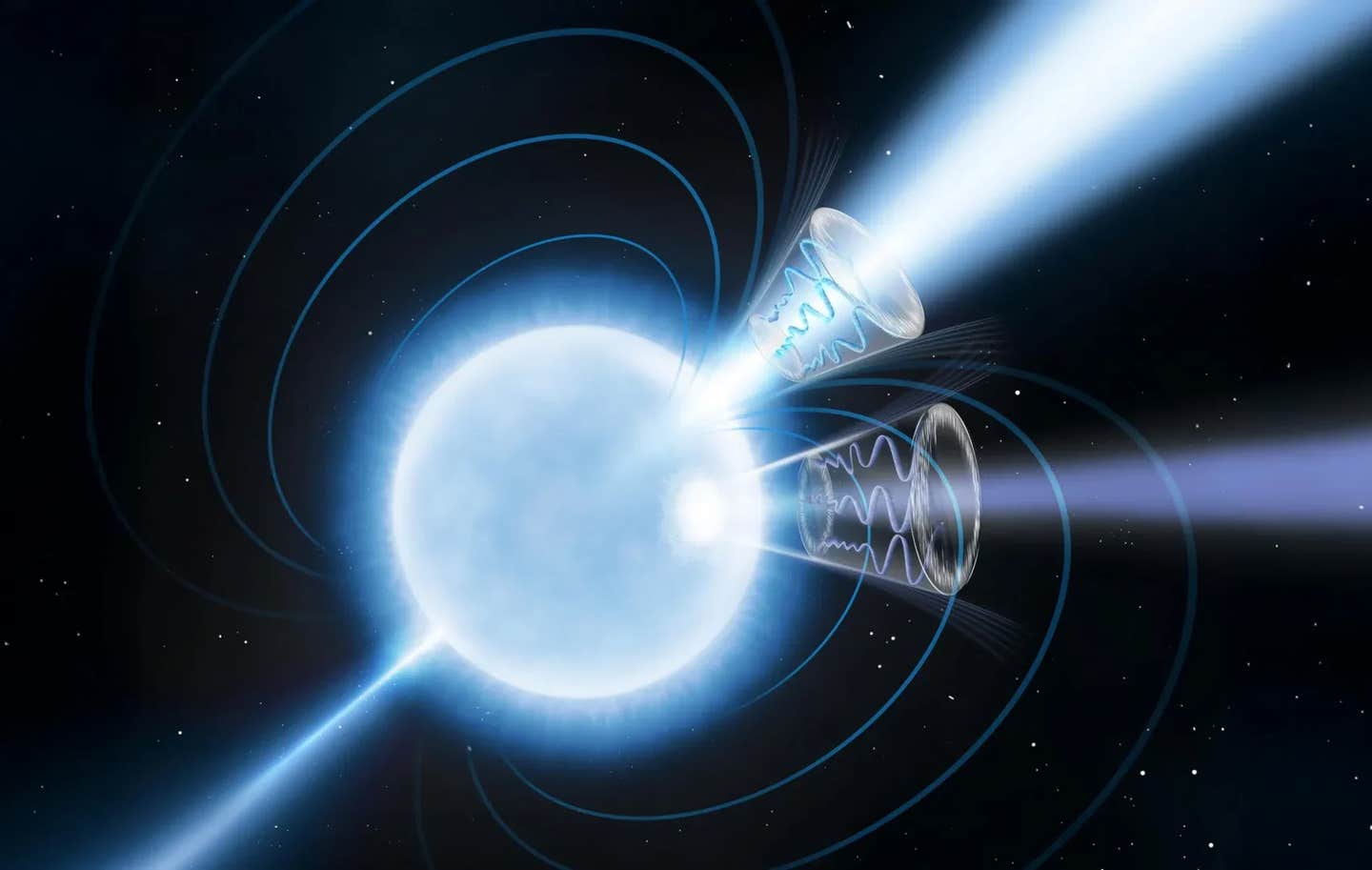
A Swinburne astronomer may have just confirmed one of the quirkiest aspects of quantum mechanics: that seemingly empty space can alter the behaviour of light. (CREDIT: NASA)
- A highly magnetized neutron star produced unusually polarized X-rays, offering some of the strongest evidence yet that empty space can change how light travels.
- The star’s extreme magnetic field may be affecting short-lived particle pairs in the quantum vacuum, keeping the X-rays strongly aligned with the magnetic field.
- The signal is not yet a definitive detection. More X-ray observations and improved simulations will be needed to confirm whether vacuum birefringence is responsible.
A magnetar with a magnetic field trillions of times stronger than Earth’s has produced an unusually polarized X-ray signal, giving astronomers some of their strongest evidence yet that empty space can alter how light travels.
The effect, called vacuum birefringence, comes from quantum electrodynamics, or QED. The theory predicts that a vacuum is not truly empty. Virtual electron-positron pairs can briefly appear, and an intense magnetic field can affect how different orientations of light move through that quantum vacuum.
The new observations focus on 1E 1547.0−5408, a magnetar with a 2.09-second spin period and a surface equatorial magnetic field of about 2.2 × 10^14 gauss. The work combined X-ray measurements from NASA’s Imaging X-ray Polarimetry Explorer, or IXPE, with NICER observations and radio data from Murriyang, CSIRO’s Parkes radio telescope.
X-rays arrive with unusually strong polarization
IXPE measured an average X-ray polarization degree of about 46% across the 2 to 8 kiloelectronvolt energy range. In the softest 2 to 3 keV band, that figure reached 59 ± 5%.
At certain rotational phases, the polarization became even stronger. In the 2 to 4 keV range, it peaked at 74 ± 11%. In the narrower 2 to 3 keV band, it reached 82 ± 15%.
Those values stand out among magnetars already observed by IXPE. The 2 to 3 keV polarization degree was at least 2.5 times larger than corresponding measurements in the rest of the observed magnetar population.
The polarization angle also changed in a smooth, roughly sinusoidal pattern as the star rotated. That behavior resembled the pattern seen in radio observations, although the X-ray and radio signals were offset in rotational phase.
A joint IXPE and NICER analysis also found that the soft X-ray emission was dominated by a thermal component with a temperature of 0.72 ± 0.01 keV. Assuming a distance of 4.5 kiloparsecs, the emitting region had a radius of about 1.07 kilometers, consistent with a relatively small surface hotspot.
The high polarization is difficult to reproduce with standard surface and atmospheric models alone. A pure magnetized atmosphere may produce phase-averaged polarization approaching about 40%, but values near 65% are harder to explain. The phase-resolved levels of roughly 70% to 80% create an even stronger challenge.
Radio pulses reveal an unusually favorable geometry
The radio observations provided another important piece of the puzzle. The polarization position angle traced an S-shaped sweep that matched the rotating vector model for a dipolar magnetic field.
That fit indicates that the magnetar is a nearly aligned rotator. Its magnetic and rotational axes sit close together, while Earth’s line of sight lies near the spin axis.
This geometry gives astronomers an unusually favorable view of the magnetic field. The broad radio pulse spans about 25% of the star’s rotation, and the inferred radio emission height is less than 1% of the light-cylinder radius.
Dr. Marcus Lower of Swinburne University of Technology said magnetars provide conditions that laboratories cannot reproduce.
“Detecting vacuum birefringence requires a magnetic field that is over 100 million times stronger than any we've ever made on Earth. Thankfully, nature has provided us with magnetars, which are the perfect cosmic laboratories to go looking for this effect,” Dr. Lower said.
The geometry matters because vacuum birefringence should keep the polarization direction of X-rays closely tied to the large-scale magnetic field as the radiation moves outward. In the team’s interpretation, the exceptionally high polarization and relatively modest angle changes fit that expectation.
“Because of the magnetic field's strength, Heisenberg's virtual particles become aligned with the direction the field is pointing,” Dr. Lower said.
“By carefully tracking the direction the radio waves and X-rays oscillate as the magnetar rotates, the team found that the alignment of 1E1547's magnetic and rotational poles were ideal for detecting vacuum birefringence.”
A polarization drop may point to another QED effect
The X-ray polarization did not remain constant with energy. It fell from 59 ± 5% in the 2 to 3 keV band to 37 ± 5% between 3 and 4 keV.
The researchers argue that this decrease is most naturally explained by polarization mode conversion near a QED vacuum resonance. In a magnetized hydrogen atmosphere, vacuum and plasma effects can cause photons to switch between two polarization modes.
For 1E 1547.0−5408, that conversion is expected to become efficient at energies above about 2 keV. The process can reduce the net polarization escaping the surface.
At higher energies, the interpretation becomes less certain. IXPE measured a 40 ± 11% polarization degree between 4 and 8 keV, but the signal had a lower signal-to-noise ratio and only a 3.5-sigma detection significance.
The team also modeled the X-ray intensity and polarization with the MAGTHOMSCATT radiative transfer code. Configurations that included magnetospheric vacuum birefringence better matched the phase-resolved polarization data than models that neglected the effect.
Those simulations remain model-dependent. The researchers also note that deeper IXPE observations are needed, especially at higher energies where the current measurements are less precise.
Practical implications of the research
Vacuum birefringence has been predicted since the 1930s, but a definitive direct detection has remained out of reach. The new magnetar observations offer a way to test the prediction under magnetic fields far stronger than any produced on Earth.
If future observations confirm the interpretation, magnetars could become powerful laboratories for studying non-linear QED in extreme conditions. Lower-energy X-ray polarization measurements may be especially useful because even higher polarization degrees are expected there.
Future IXPE observations, possible soft X-ray polarimetry missions such as GoSOX, and complementary laboratory and collider experiments could make the test more stringent.
“With these future data on hand and our updated simulations, we may finally be able to complete the quest started by Heisenberg nearly 90 years ago.”
Dig deeper into magnetars and polarized X-rays
These resources explore how extreme magnetic fields affect light, how X-ray polarization reveals magnetar physics, and how astronomers are testing quantum electrodynamics under conditions impossible to reproduce on Earth.
Pulsed, Polarized X-Ray Emission from Neutron Star Surfaces: The Effects of Vacuum Birefringence in the Magnetosphere
This modeling study examines how vacuum birefringence alters polarized X-rays as they propagate through neutron-star magnetospheres, showing how the effect can substantially increase the observed linear polarization. (The Astrophysical Journal, 2026)
IXPE Detection of Highly Polarized X-Rays from the Magnetar 1E 1841-045
IXPE observations of another magnetar revealed strongly energy-dependent X-ray polarization reaching roughly 55% at higher energies, helping establish the range of polarization signatures produced by ultra-magnetized neutron stars. (The Astrophysical Journal Letters, 2025)
X-ray Polarization from Magnetar Sources
This review summarizes the first years of IXPE magnetar observations and explains how X-ray polarization can probe magnetic-field structure, neutron-star surfaces and possible vacuum-birefringence effects. (Galaxies, 2024)
X-ray polarization in magnetar atmospheres – effects of mode conversion
The authors model how photons can switch polarization modes near the QED vacuum resonance, demonstrating how this process can reduce polarization and create energy-dependent signatures important for interpreting magnetar observations. (Monthly Notices of the Royal Astronomical Society, 2024)
Polarized x-rays from a magnetar
One of IXPE’s foundational magnetar studies measured polarized X-rays from 4U 0142+61 and showed how polarization can distinguish competing models of a magnetar’s surface, atmosphere and magnetosphere while testing strong-field quantum physics. (Science, 2022)
Research findings are available online in the journal Nature.
The original story "Extreme X-rays from a magnetar exposes that empty space may not be empty" is published in The Brighter Side of News.
Related Stories
- Newborn magnetar offers rare evidence of Einstein’s relativity in a stellar explosion
- Astronomers discovered the most primitive star ever
- Pristine star reveals the dawn of stars and galaxies in the universe
Like these kind of feel good stories? Get The Brighter Side of News' newsletter.
Joshua Shavit
Writer and Editor
Joshua Shavit is a NorCal-based science and technology writer with a passion for exploring the breakthroughs shaping the future. As a co-founder of The Brighter Side of News, he focuses on positive and transformative advancements in technology, physics, engineering, robotics, and astronomy. Having published articles on AOL.com, MSN, Yahoo News, and Ground News, Joshua's work highlights the innovators behind the ideas, bringing readers closer to the people driving progress.