Atomic clocks may be powerful enough to detect the quantum fabric of time
Scientists say advanced atomic clocks may soon detect quantum superpositions of time, bridging relativity and quantum physics.

 Edited By: Joseph Shavit

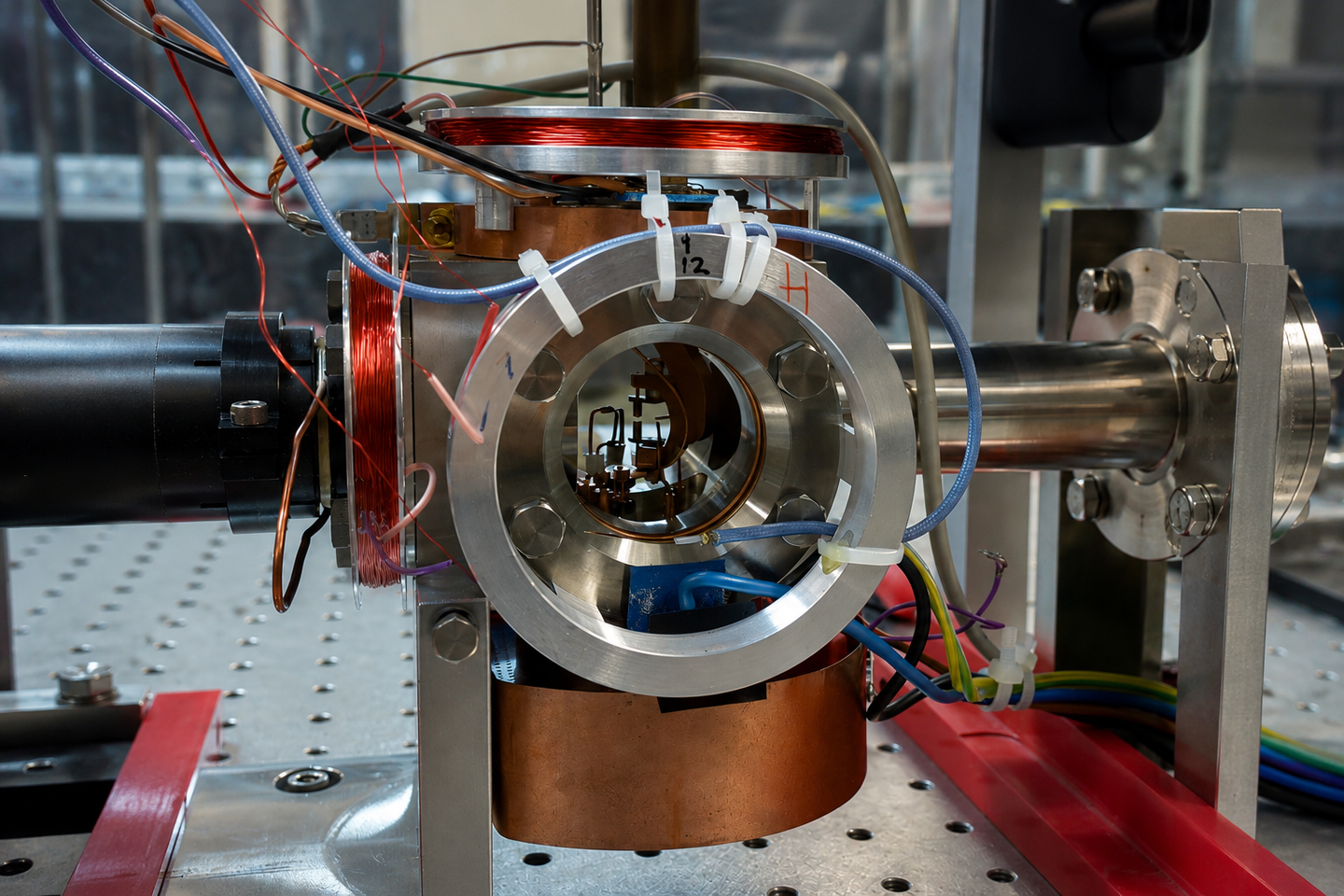
A new study suggests trapped-ion atomic clocks could detect quantum superpositions of time, opening a path toward uniting quantum mechanics and relativity. (CREDIT: Kyushu University)
Time feels familiar. It marks every moment of daily life, from the ticking of a wall clock to the changing numbers on a smartphone screen. Yet despite its constant presence, time remains one of the deepest mysteries in science.
For more than a century, physicists have known that time is not fixed. Albert Einstein’s theory of relativity showed that time can speed up or slow down depending on motion and gravity. The faster an object moves, or the closer it is to a massive object, the more differently it experiences time.
But another revolution in physics, quantum mechanics, introduced an even stranger possibility. At the quantum level, particles can exist in multiple states at once through a phenomenon called superposition. If motion can exist in a superposition, then time itself may also flow in multiple ways simultaneously.
Scientists have long wondered whether this bizarre idea is real. Until now, no experiment has been capable of testing it.
A new study suggests that answer may finally be within reach. Researchers from Kyushu University, working with collaborators from the Stevens Institute of Technology and more, have developed a theoretical framework showing that today’s most advanced trapped-ion atomic clocks could detect what they describe as a quantum superposition of time.
When Two Great Theories Collide
Modern physics rests on two remarkably successful theories. Relativity explains gravity, motion and the structure of the universe on large scales. Quantum mechanics governs the behavior of atoms and particles on the smallest scales.
Both theories work extraordinarily well. Yet they describe reality in very different ways.
In quantum mechanics, time is usually treated as a steady background parameter. It simply moves forward while quantum systems evolve. In relativity, however, time is dynamic. It changes according to motion and gravity.
This difference has created one of the biggest unresolved problems in science.
“What happens when a clock itself behaves according to quantum mechanics?” researchers have asked for decades.
Atomic clocks offer a rare opportunity to investigate that question.
The Most Precise Clocks Ever Built
Atomic clocks measure time using the natural vibrations of atoms. Their accuracy is so extraordinary that some modern versions would lose less than a second over billions of years.
These devices have become essential to technologies such as GPS navigation, telecommunications and scientific research.
They are also sensitive enough to detect tiny relativistic effects. Modern atomic clocks can measure differences in time caused by a change in height of only a few millimeters.
That incredible precision inspired the new research.
“It’s the precision that led us to develop our theoretical model. We found that the atomic clock’s motion becomes “entangled” with its internal energy. The signature of this entanglement is that the clock itself loses some of its quantum properties, which can be detected using modern techniques,” explains Associate Professor Joshua Foo of Kyushu University’s Institute for Advanced Studies and one of the lead authors of the paper.
The team also developed a new method for controlling the clock’s motion.
“We introduced a new technique for controlling the atomic clock’s motion, improving its sensitivity to this effect by 100 to 1000 times.”
A Clock Experiencing Multiple Times At Once
The researchers focused on trapped-ion atomic clocks, devices that hold individual ions in electromagnetic traps and monitor their quantum behavior.
Normally, a clock follows a single path through space and time. In that situation, relativity predicts a single amount of time dilation.
Quantum mechanics allows something far stranger.
The trapped ion’s motion can be placed into a quantum superposition, meaning it occupies multiple motion states simultaneously. Since time depends on motion, each motion state experiences a slightly different flow of time.
Instead of following one timeline, the clock effectively experiences several versions of time at once.
The researchers found that this situation creates a subtle link between the clock’s motion and its internal ticking process. Physicists call this relationship quantum entanglement.
As the entanglement grows, measurable changes appear in the clock’s behavior. Specifically, some of its quantum coherence begins to fade. This loss becomes an observable signature that scientists can measure directly.
Tiny Effects With Enormous Meaning
Detecting these effects is challenging because they are extraordinarily small.
The researchers modeled trapped aluminum-ion clocks, among the most precise clocks currently available. They examined several relativistic effects, including well-known phenomena such as the second-order Doppler shift, which causes moving clocks to tick more slowly.
They also studied more subtle quantum effects.
Even when an ion is cooled to its lowest possible energy state, quantum mechanics prevents it from becoming completely motionless. Tiny fluctuations remain. These fluctuations create a small shift in timekeeping known as the vacuum-induced second-order Doppler shift.
While interesting, that effect can still be explained without fully treating time as a quantum quantity.
The most important prediction emerged when the ion’s motion was placed into specially prepared quantum states known as squeezed states.
Under those conditions, the interaction between motion and time becomes much stronger. The researchers calculated that current trapped-ion clocks could experience a measurable reduction in signal visibility of about 7%.
That may sound small, but in precision physics it is enormous.
Such a signal would provide direct evidence that time dilation can become entangled with quantum motion.
Opening A New Window Into Reality
The study does not claim that quantum time has already been observed. Instead, it provides a roadmap for experiments that could test the idea using existing technology.
That possibility excites physicists because it pushes science toward one of its biggest goals: unifying quantum mechanics and relativity.
For decades, researchers have searched for ways to observe situations where both theories must operate simultaneously. Atomic clocks may now provide one of the first practical opportunities.
The work also highlights how rapidly clock technology has advanced. Instruments originally developed to measure time now serve as laboratories for exploring the foundations of reality itself.
The findings suggest that future clocks may do far more than keep accurate time. They could help reveal how time behaves at the deepest levels of nature.
The Next Challenge
The researchers emphasize that their work remains theoretical. The next step is turning the framework into a real experiment.
“Naturally, bringing our theoretical model to reality is the big next step, and developing a detailed experiment that accounts for real-world unpredictability will give us further insight into our model,” concludes Foo.
The implications could extend even further.
“We are also interested in exploring whether atomic clocks could eventually be used to probe the quantum realm of gravity, the other fundamental question in physics.”
If successful, those experiments could help scientists investigate one of the most elusive goals in modern science: understanding how gravity behaves in the quantum world.
A Mystery That Continues To Deepen
The history of physics often involves familiar concepts becoming stranger the closer scientists examine them. Time may be the ultimate example.
What appears to be a steady, universal flow has already been revealed as flexible by relativity. Now, quantum mechanics hints that time itself may exist in multiple possibilities at once.
For generations, this idea remained beyond experimental reach. Advances in atomic clock technology may finally change that.
What began as a tool for measuring seconds could soon become one of humanity’s most powerful instruments for exploring the nature of reality.
Practical Implications of the Research
This research could transform atomic clocks from precision timekeeping devices into tools for testing the foundations of physics. If experiments confirm the predicted effects, scientists would gain one of the first opportunities to directly study how quantum mechanics and relativity interact in a single system.
The work may also contribute to the development of next-generation atomic clocks. Understanding how quantum motion influences timekeeping could lead to even greater accuracy in technologies that depend on precise timing, including navigation systems, telecommunications networks and scientific instruments.
In the longer term, the research may help address one of the biggest unanswered questions in physics: how gravity operates at the quantum level. By using atomic clocks to investigate the quantum nature of time, researchers could move closer to a unified understanding of the laws that govern the universe.
Such advances would deepen humanity’s understanding of reality and potentially inspire entirely new technologies built on principles that remain undiscovered today.
Research findings are available online in the journal Physical Review Letters.
The original story "Atomic clocks may be powerful enough to detect the quantum fabric of time" is published in The Brighter Side of News.
Related Stories
- New optical atomic clock is 1,000x more accurate than today's standard
- Groundbreaking new atomic clock detects dark matter and gravity’s effect on time
- University of Chicago team proposes flexible new platform to produce entangled quantum states
Like these kind of feel good stories? Get The Brighter Side of News' newsletter.
Shy Cohen
Writer