Fusion’s biggest challenge may no longer be the physics, MIT study finds
Fusion may work in the lab, but MIT researchers say plant economics will hinge on power density, maintenance and financing.
 MIT Writer: Sarah McDonnell

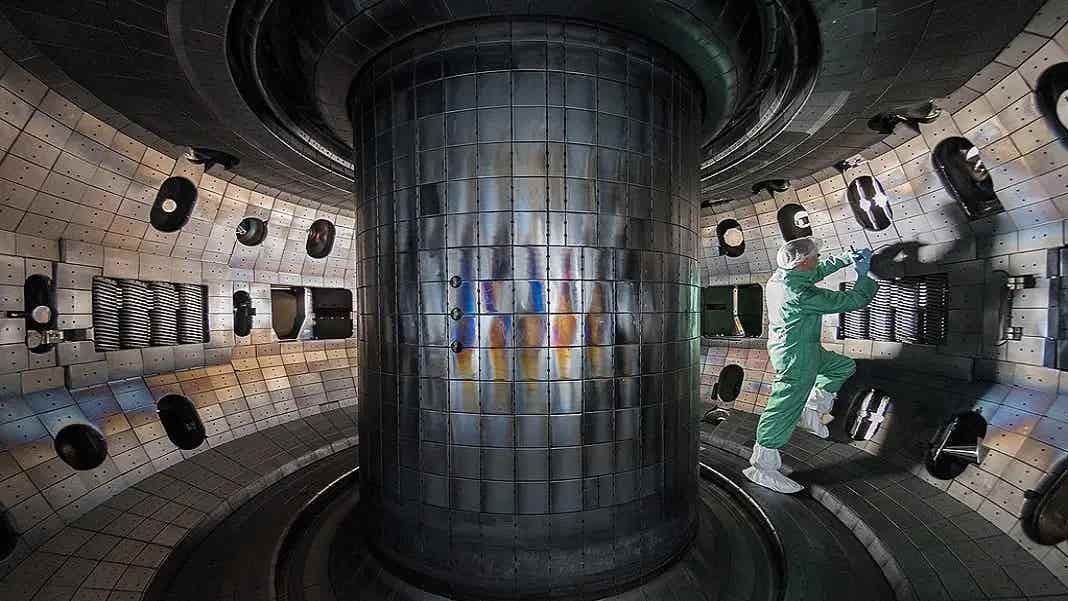
MIT’s fusion economics framework identifies the power, cost and financing thresholds commercial fusion plants may need to clear. (CREDIT: Wikimedia / CC BY-SA 4.0)
- Fusion has proved it can produce net energy, but an MIT-led analysis says commercial plants must also generate more economic value than they cost.
- The framework identifies power density, fast component replacement, construction costs, efficiency, energy prices, and financing as key factors that can determine whether a plant survives financially.
- The model is meant as a screening tool, not a full investment forecast, but it suggests low-cost financing and cheap, rapid maintenance may matter as much as major advances in fusion physics.
Fusion power has crossed an important scientific line, but its next test may be harder: making enough money to justify building the plants. A new MIT-led framework argues that commercial success will depend on more than producing net energy.
The work, published in the Journal of Fusion Energy, was co-authored by MIT professors Dennis Whyte and Andrew W. Lo with researchers from Rutherford Energy Ventures and MIT’s Plasma Science and Fusion Center. Their goal is to give fusion developers a common way to judge whether a power plant can generate an economic return.
“It’s all the things that come along with finding, allocating, and spending money at this scale,” Whyte said. “This is critical to what we do. We should look at the economics. If we want this technology to actually be meaningful in the world economy, we have to start getting straight with ourselves about these topics.”
Fusion harnesses the reaction that powers stars by combining light nuclei. The fuel exists as plasma, which can be confined with magnets or driven by powerful lasers. In 2022, researchers at the National Ignition Facility in California achieved a fusion reaction with positive energy gain.
From plasma gain to economic gain
Fusion science has long relied on the Lawson Criterion, developed in the 1950s. It describes combinations of temperature, plasma density, and energy confinement time that can produce net energy from fusion.
The criterion also produces a measure known as plasma Q, the ratio of fusion power generated to the external power needed to sustain the plasma. Whyte and Lo adapted that logic to economics.
“The Lawson Criterion describes the scientific success of energy gain from fusion plasmas, while our framework generally describes economic Q, which is the ratio of capital gained to that expended,” Whyte said.
Their model uses 10 controlling parameters spanning physics, engineering, construction, operations, financing, and energy markets. The key requirement is an economic Q greater than 1. That means the economic value produced must exceed the costs included in the model. The authors stress that this is necessary, but not sufficient, for real commercial viability.
Power density becomes a hard constraint
One of the model’s most striking results concerns fusion power density, or how much fusion power moves through a given surface area around the reaction.
Low power density might seem attractive because components would wear out more slowly. The model reaches the opposite economic conclusion. If power density falls too far, the plant cannot produce enough revenue to recover construction and financing costs.
Across broad sensitivity tests, the researchers repeatedly found a threshold power density for basic economic viability. Existing commercial fusion plant studies independently fall in a similar range, even though those designs were developed from specific engineering concepts.
Increasing power density improves economic gain when the plant is already selling energy profitably. But the model also shows diminishing returns at very high levels because the energy-extracting surface wears out faster and requires more downtime.
That creates a tension between power production and plant availability. More output can mean more revenue, but it may also consume component lifetime faster.
Cheap, fast replacement may beat extreme durability
The analysis places unusual emphasis on the surface surrounding the fusion region, which the authors call S. All fusion energy must ultimately pass through this boundary before becoming a commercial product.
That surface and related components can face damage from energetic particles, neutrons, plasma exhaust, photons, and helium accumulation, depending on the design. The model treats durability as an energy-fluence limit, meaning the total fusion energy that can pass through before replacement becomes necessary.
But the researchers found that extreme durability is not necessarily the best economic target.
Their sensitivity analysis indicates that replacing these components quickly and cheaply can matter more than making them last as long as possible. The authors note that replacing ITER’s 740 blanket shield modules is expected to take two years using remote handling. Future commercial plants would need much shorter maintenance periods under the framework’s assumptions.
“This pattern of learning by doing exists in all deep technology sectors,” Lo said, noting that sequencing a human genome is now a million times cheaper than about 25 years ago. “We’re going to see the same thing, but maybe not to the same degree, in fusion energy.”
Financing can change the engineering target
The framework also shows how strongly financing conditions can affect technical design.
Higher interest rates force a plant toward higher power density to preserve economic returns. Yet higher power density can increase technical difficulty and risk. That risk could then raise borrowing costs further.
The authors therefore conclude that low-cost financing will be important, especially for early fusion plants. They discuss public loan guarantees, contracts-for-difference, capacity payments, and other mechanisms that could lower financing costs or stabilize revenue.
The model is aimed most directly at mature, nth-of-a-kind fusion plants rather than the first commercial facilities. It assumes steady operations and economic conditions over a plant’s life. It does not fully capture net present value, internal rate of return, tax treatment, depreciation, market volatility, or every upfront development and regulatory cost.
Those exclusions matter. Economic Q above 1 is a basic threshold, not proof that a project will attract investors or succeed in a real market.
Practical implications of the research
The framework gives fusion developers a way to compare different plant concepts using the same economic language. Teams can examine how power density, component life, replacement time, plant cost, financing, efficiency, and energy prices interact.
It also gives engineers a clearer way to judge tradeoffs. Spending heavily to extend component life may make little sense if cheaper materials can be replaced quickly. Raising power density may improve returns, but only until maintenance and physical limits begin eroding the advantage.
“When you’ve got a framework to evaluate it in a quantitative way, it tells you about the literal worth of making a particular design decision,” Whyte said. “That seems to me at this moment of fusion development absolutely critical, and what we’ve been missing.”
Dig deeper into the subject
Here are five expert resources to help you dig deeper into fusion energy and recent progress in the field.
- NIF Pushes Fusion Target Gain Above 4
Lawrence Livermore National Laboratory reported that an April 2025 experiment produced 8.6 megajoules of fusion energy from 2.08 megajoules delivered to the target, for a target gain of 4.13. That substantially extends the original 2022 ignition milestone and gives readers a much more current picture of inertial fusion performance. - SPARC Fusion Facility Reaches About 75% Completion
Commonwealth Fusion Systems reported in April 2026 that its SPARC facility was roughly 75% complete. SPARC is especially relevant to this story because it is intended to demonstrate commercially relevant net fusion energy using high-field superconducting magnets. CFS currently targets operation in 2027. - First Commercial Fusion Plant Moves Toward Construction in Virginia
In December 2024, The Brighter Side of News reported that Commonwealth Fusion Systems expects to begin construction in 2027 on a planned 400-megawatt ARC fusion plant in Virginia, with power generation targeted for the early 2030s. This is one of the clearest examples of the economic questions in your story moving from theory toward an actual proposed power project. - CFS Details the Engineering Behind Its ARC Power Plant
Nature reported in 2026 on a new collection of technical papers describing the proposed ARC commercial fusion plant, including how CFS intends to convert fusion output into grid electricity. The coverage is useful because it focuses specifically on the gap between producing fusion reactions and operating a practical power station, while emphasizing that major uncertainties remain. - A 2025 Proposal for Lower-Cost, High-Gain Inertial Fusion
A 2025 research paper introduced the AMPS high-yield fusion concept, using pulsed-power technology and magnetized liner inertial fusion. Its authors argue that scaling the system could achieve facility-level net energy gain while reducing capital costs compared with NIF-scale laser systems. It connects especially well with the MIT paper’s focus on the relationship between physical performance and plant economics.
Research findings are available online in the Journal of Fusion Energy.
The original story "Fusion’s biggest challenge may no longer be the physics, MIT study finds" is published in The Brighter Side of News.
Related Stories
- Thunderbird Reactor: New room-temperature fusion reactor that fits on a tabletop
- Homemade fusion reactor built by a 12-year-old draws national attention
- Fusion reactors may be the key to uncovering dark matter particles
Like these kind of feel good stories? Get The Brighter Side of News' newsletter.
Joseph Shavit
Writer, Editor-At-Large and Publisher
Joseph Shavit, based in Los Angeles, is a seasoned science journalist, editor and co-founder of The Brighter Side of News, where he transforms complex discoveries into clear, engaging stories for general readers. With vast experience at major media companies like The Los Angeles Times, Times Mirror and Tribune Publishing, he writes with both authority and curiosity. His writing focuses on space science, planetary science, quantum mechanics, geology. Known for linking breakthroughs to real-world markets, he highlights how research transitions into products and industries that shape daily life.