Introducing Biomni: Stanford’s AI co-scientist built to accelerate biomedical research
Stanford unveils Biomni, an AI co scientist that automates research workflows and speeds biomedical discovery.

 Edited By: Joseph Shavit

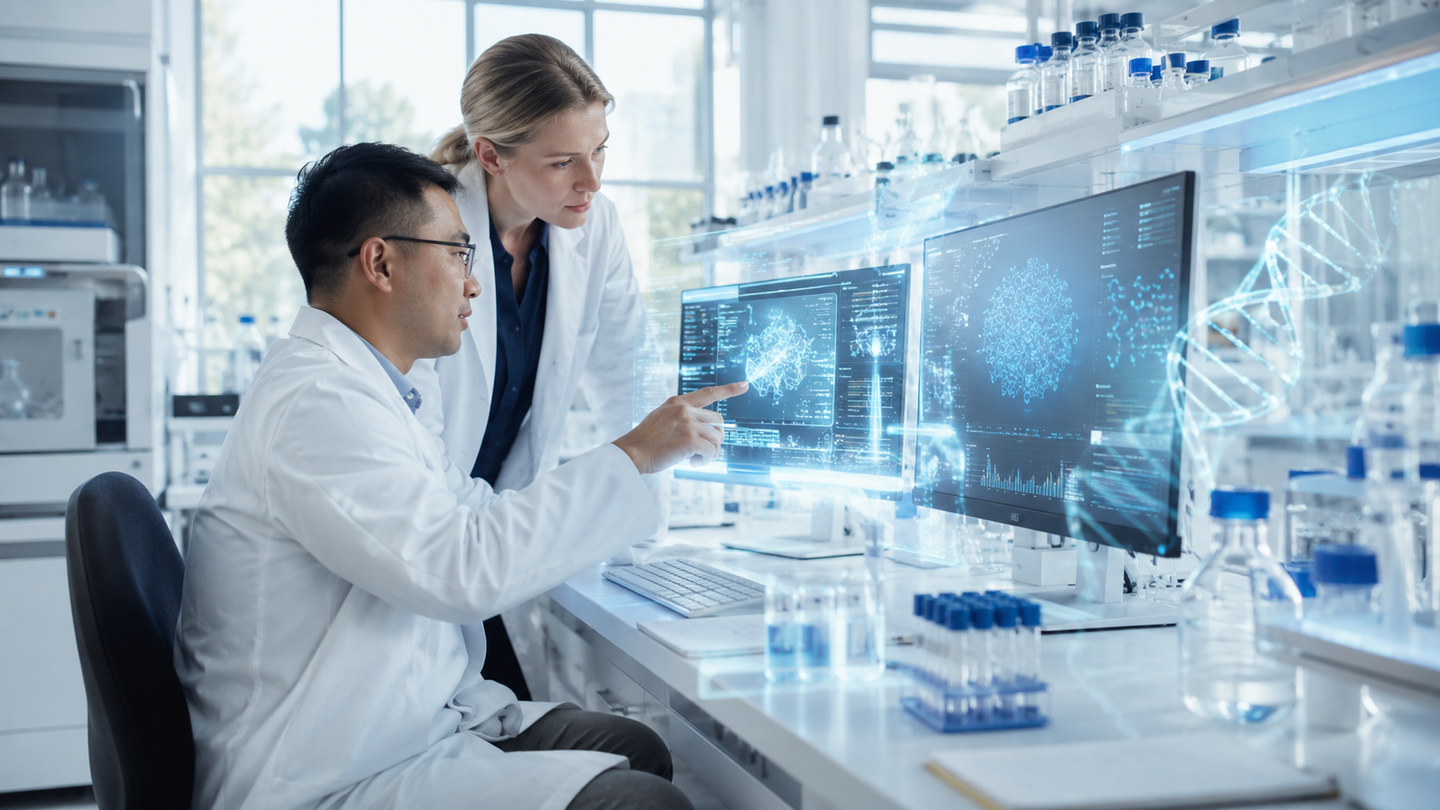
A new AI system called Biomni can design experiments, analyze data, and accelerate biomedical research in minutes. (CREDIT: Shutterstock)
- Stanford University researchers developed Biomni, an AI “co-scientist” that can read scientific papers, analyze datasets, write and execute code, form hypotheses, and design experiments in minutes.
- Biomni uses 150 specialized tools, 105 software packages, and 59 databases across 25 areas of biology, allowing it to complete complex biomedical research tasks at speeds far beyond traditional human workflows.
- Researchers say Biomni is designed to augment rather than replace scientists, handling labor-intensive research tasks while leaving interpretation, creativity, and final decision-making to humans.
A new kind of scientific partner is beginning to take shape in research labs. It does not wear a lab coat or hold a pipette. Instead, it reads thousands of papers, writes code, analyzes data, and suggests new experiments in minutes. Researchers at Stanford University call it Biomni, an artificial intelligence system designed to act as a “co-scientist.”
The system, described in the journal Science, reflects a growing effort to rethink how research is done. As scientific knowledge expands, the challenge is no longer just having ideas. It is managing the enormous workload required to test them.
“If you think of an agent as a carpenter, a carpenter without tools is just a carpenter who can talk,” said Jure Leskovec, professor of computer science at Stanford. “With Biomni, we give the carpenter a set of tools, so it can build.”
A Growing Bottleneck In Discovery
Modern biomedical research moves at a fast pace. New studies appear daily, and datasets grow larger each year. Yet progress often slows under the weight of routine tasks.
Scientists must read literature, organize data, write code, and test ideas before reaching conclusions. Each step takes time. Together, they can delay discovery for weeks or months.
“The hurdle in biomedical science is not intelligence or ideas; it is mechanics,” Leskovec said. “It’s this laborious stuff that slows innovation. Biomni can do this work in minutes.”
This challenge has created a gap between what researchers know and what they can act on. Important patterns may remain hidden simply because there is not enough time to explore them.
Building A Digital Co-Scientist
Biomni was designed to close that gap. The idea is simple. A scientist should be able to ask a question in plain language and receive a complete research workflow in return.
The system reads scientific papers, forms hypotheses, selects datasets, and chooses the right tools. It writes and runs code, interprets results, and suggests next steps.
“Biomni is able to understand a simple question like, ‘Why are these patients responding differently to the drug?’” said Kexin Huang, who helped lead the project. “Then it digs in, doing a lot of the scientific legwork.”
This process turns a single question into a structured investigation. Instead of handling one task at a time, the system manages the entire pipeline from start to finish.
Powered By Data, Tools, And Knowledge
To achieve this, researchers built a large digital environment for the system. Biomni draws on full-text papers, code repositories, and datasets from across the biomedical field.
It includes 150 specialized tools, 105 software packages, and 59 databases. These resources span 25 areas of biology, from genetics to neuroscience.
The system identifies which tools are needed for a given task. It then combines them into a step-by-step plan. Each step is translated into code that can be executed automatically.
This design allows Biomni to adapt to many types of problems. It does not rely on a fixed workflow. Instead, it builds a new one for each question.
Speed That Changes The Pace Of Research
The system’s speed is one of its most striking features. In one real-world example, a researcher uploaded more than 450 files of health data. These included glucose levels, food intake, and physical activity.
The user asked a simple question. Analyze the data and find meaningful patterns.
Within 40 minutes, Biomni cleaned the data, combined it, created visualizations, and identified links between diet and body temperature. Leskovec said the same work could take a human more than 60 hours.
This difference is not just about efficiency. It changes how research can be done. Faster analysis allows scientists to test more ideas and explore more possibilities.
Matching Experts Across Tasks
To evaluate performance, researchers tested Biomni on hundreds of biomedical questions. These included tasks such as gene identification and disease analysis.
The system performed well across these areas. In many cases, it matched the accuracy of experienced researchers. It also completed tasks much faster.
In one test involving rare disease diagnosis, Biomni reached 60 percent accuracy. This was similar to experts, who scored between 60 and 70 percent. However, the system finished the task in three minutes, while humans took nearly two hours.
In another test focused on gene detection, it achieved 80 percent accuracy. It reduced analysis time from about 90 minutes to just four minutes.
These results suggest that the system can support experts by handling time-consuming work.
From Data Analysis To Real Experiments
Biomni does more than analyze data. It can also design experiments and guide laboratory work.
In one case, the system generated a complete protocol for DNA cloning. It included detailed steps, materials, and validation methods.
Researchers followed the instructions in the lab. The experiment worked as expected. Colonies grew, and DNA sequencing confirmed the results.
This ability to connect digital analysis with physical experiments is a key strength. It shows that the system can move from theory to practice.
Transparency And Reproducibility
Another advantage lies in how Biomni tracks its work. Every step is recorded and linked to sources.
The system provides full citations for the data and methods it uses. This allows researchers to verify results and reproduce findings.
In science, reproducibility is essential. By documenting its process, Biomni helps strengthen the reliability of research.
A Tool, Not A Replacement
Despite its capabilities, researchers stress that Biomni is not meant to replace scientists.
The system can process information quickly and find patterns. However, it does not make final decisions. Human judgment remains central to the scientific process.
“And it always will,” Huang said. “This is not about machines taking over science, but more about machines becoming a powerful new partner to augment human researchers.”
The goal is to free scientists from routine tasks. This allows them to focus on creativity, interpretation, and decision-making.
Challenges And Future Growth
The system still has limits. It does not cover every area of biology. Some tasks require more detailed input to ensure accuracy.
Researchers are working to expand its capabilities. Future versions may include more data sources and improved reasoning methods.
There are also questions about safety. Tools that can design experiments must be used responsibly. Developers emphasize the importance of transparency and ethical guidelines.
Even with these challenges, early adoption is strong. More than 10,000 labs have begun using the system in academic and industry settings.
A New Way To Do Science
The rise of systems like Biomni reflects a broader shift in research. As knowledge grows, collaboration between humans and machines becomes more important.
Instead of working alone, scientists may rely on digital partners that handle complex workflows. This could speed up discovery and open new paths for innovation.
For fields like medicine, the impact could be profound. Faster research may lead to quicker development of treatments and deeper understanding of disease.
Practical Implications Of The Research
This work could transform how biomedical research is conducted. By automating routine tasks, it allows scientists to focus on deeper questions and creative thinking. This may accelerate discoveries in areas such as drug development and disease prevention.
The system also lowers barriers to entry. Researchers with fewer resources can access advanced tools and perform complex analyses. This could expand participation in science and increase global collaboration.
In healthcare, faster data analysis may improve patient outcomes. Researchers can identify patterns more quickly and develop targeted treatments. Over time, this may lead to more personalized medicine.
For the scientific community, improved transparency and reproducibility strengthen trust in research. By documenting every step, the system helps ensure that findings can be verified and built upon.
Research findings are available online in the journal Science.
The original story "Introducing Biomni: Stanford’s AI co-scientist built to accelerate biomedical research" is published in The Brighter Side of News.
Related Stories
- Scientists reveal limits of AI - where it succeeds and where it fails
- Millions of gamers are advancing biomedical research through gameplay
- Speck of dust sized AAA voltage battery provides energy for biomedical applications
Like these kind of feel good stories? Get The Brighter Side of News' newsletter.
Shy Cohen
Writer