Gulf of California orcas use precision strikes to explode sunfish into thousands of pieces
One orca holds the carcass while another charges, scattering thousands of pieces through the water for younger whales to eat.

 Edited By: Joseph Shavit

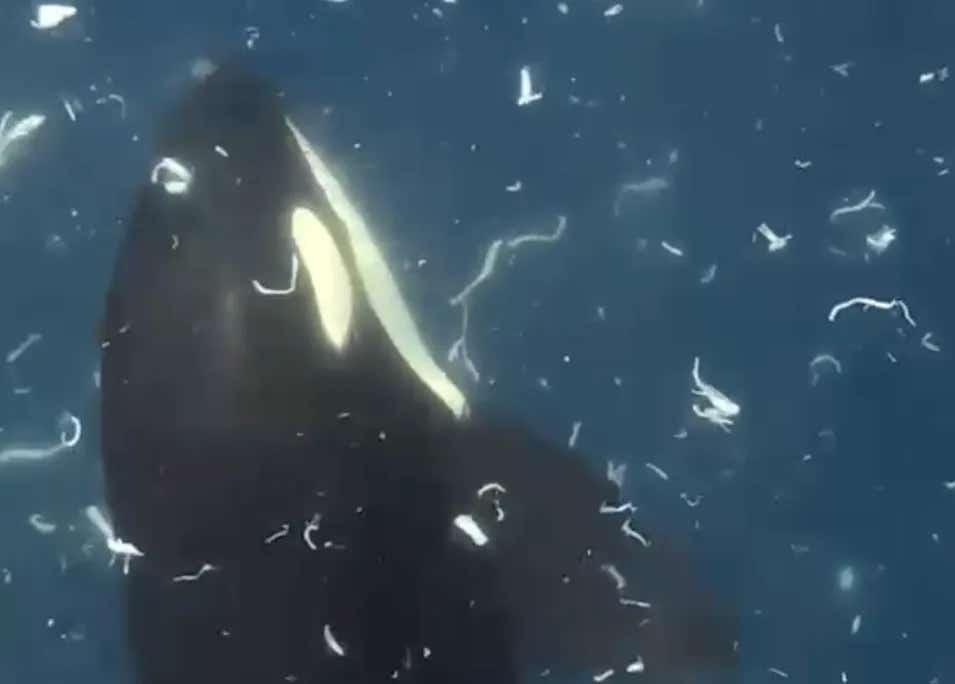
Orcas ramming sunfish in the Gulf of California may be processing prey into smaller pieces for calves or engaging in social play. (CREDIT: Héctor Franz)
- Orcas in the Gulf of California were recorded using a coordinated “ram-to-fragment” technique on dead sharp-tail sunfish.
- One orca held the carcass steady while another struck it at high speed, breaking the tissue into thousands of smaller pieces.
- Juvenile orcas fed on the fragments, suggesting the behavior may help younger animals eat, though it could also involve play or social learning.
- Two events, recorded in 2024 and 2025, suggest a newly documented prey-processing strategy that researchers now hope to study across more pods and sunfish species.
Orcas in the Gulf of California
Orcas in the Gulf of California have been seen using a brutal but precise way to process sharp-tail sunfish. One whale holds the carcass steady, another charges at speed, and the impact blasts the flesh into thousands of drifting pieces.
The behavior, described in Frontiers in Ethology, was recorded during two separate encounters more than a year apart. Both involved coordinated ramming after the sunfish had already been killed and opened.
“We document how one orca holds the sunfish and lets go just before another orca hits it at high speed, causing the tissue to break apart into thousands of pieces,” said first author Dr Kathryn Ayres, a scientist at Beneath The Waves. “We think this may help younger orcas feed more easily or it could also just be for fun. Orcas are known for playing with their food.”
Sharp-tail sunfish are enormous teleost fish that can exceed three meters in length and weigh up to 2,000 kilograms. They travel through several depth layers but often rise to the surface to rest, regulate their temperature, or seek parasite removal.
That makes them vulnerable to attack.
A coordinated strike after the kill
The first event occurred on July 29, 2024, near an offshore seamount off San José del Cabo, Mexico. The group included three adult females, one adult male, and a juvenile.
The orcas had already captured and eaten a spine-tail devil ray. They then interacted with a dead sharp-tail sunfish whose internal organs had been removed.
An adult female gripped the sunfish by its clavus, the broad tail structure that gives the species its sharp-ended shape. An adult male accelerated toward the carcass while swimming belly-up.
The female released the fish just before impact. The collision produced a loud sound and broke the sunfish’s tissue into fragments that spread through the water.
A juvenile entered the debris and began eating the smaller pieces. The adults fed from the split-open body but were not seen consuming the floating fragments.
A second encounter on September 7, 2025, near Isla Cerralvo followed the same sequence. One adult stabilized a sharp-tail sunfish while another rammed it at high speed. The impact again scattered tissue through the water.
Three adult females and a calf were present. The calf pulled tissue from the remaining carcass, while adults bit into larger sections. The same group had hunted a shortfin mako shark earlier that day.
Processing prey, not delivering the killing blow
Ramming has appeared in other orca hunts. Groups in the Gulf of California have used force while attacking whale sharks, and orcas elsewhere cooperate when hunting rays, whales, sharks, seals, and penguins.
The newly documented behavior differs because the sunfish were already dead. Their internal organs had also been removed before the impacts.
That suggests the collisions were not meant to kill. Instead, the researchers interpret the behavior as a method of processing the carcass.
The coordination required precision. One orca held the prey in place while another approached fast enough to break apart the tissue. The holder then released the carcass at the right moment.
The pronounced clavus may give orcas a useful grip. Researchers also noted that this degree of fragmentation has not been reported in other sunfish species.
Sharp-tail sunfish tissue may respond differently to high-energy impacts. Their bodies contain a thick, gelatinous collagen layer called the capsule, which is almost 90 percent water.
Smaller pieces for younger orcas
The juvenile’s feeding behavior offers one possible explanation. Breaking the carcass into small pieces may allow younger animals to eat more easily.
“Orcas often tear apart prey and share it with other members of the group, including calves and juveniles,” Ayres said.
That pattern could make the ramming a form of parental investment or feeding assistance. Adults handled the large remains while younger orcas consumed smaller pieces.
The behavior may also serve several purposes at once. It could distribute food, reinforce social interaction, provide hunting practice, or function as play.
Orcas often manipulate prey without immediately eating it. Such actions have been interpreted as social behavior, hunting practice, or play in populations around the world.
The observations cannot determine which explanation matters most. Two recorded encounters are not enough to show whether the technique is common, learned within a group, or limited to certain individuals.
A microbiome scattered through the sea
Fragmentation may also change what happens around the carcass. The capsule and skin of sunfish host distinct communities of microorganisms.
When the tissue breaks apart, those microbes spread into the water. That could redistribute nutrients and increase contact between the microbiomes of predator, prey, and the surrounding sea.
The researchers proposed that such contact could provide nutritional or functional benefits, including possible effects on immune regulation. They did not establish that those benefits occurred during either encounter.
The microbial explanation remains a possibility rather than a demonstrated outcome.
The observations also raise questions about the sunfish itself. So far, extreme fragmentation has only been documented in sharp-tail sunfish. Larger sunfish species may not break apart in the same way.
Two encounters leave many questions
It remains unclear whether the same orcas participated in both events. Researchers lacked matching high-resolution images of dorsal fins and eye patches, which are commonly used to identify individual killer whales.
That gap limits conclusions about whether one group repeated the technique.
“Collecting good identification photographs whenever possible is key: we are still seeing new techniques of how orcas hunt and process their prey,” Ayres said. “They're one of the most iconic marine predators in the world, yet they continue to surprise us.”
The research relied on opportunistic footage gathered by scientists and tourism operators. One event was recorded with a GoPro, while the other came from video filmed by Héctor Franz using an action camera.
Such footage can reveal rare behavior that researchers might otherwise miss. It also creates uncertainty because more sightings may reflect more cameras on the water rather than a true increase in the behavior.
Practical implications of the research
The observations expand the known range of orca prey-processing techniques and give researchers a clear behavior to watch for during future encounters.
Better identification photographs could show whether ram-to-fragment behavior belongs to one pod, several groups, or the wider Gulf of California population. Repeated footage could also reveal whether calves learn the technique by watching adults.
Further research may clarify whether the strategy is limited to sharp-tail sunfish or works on other prey. It could also help scientists distinguish among feeding assistance, social learning, play, and carcass processing as explanations for the same dramatic act.
Research findings are available online in the journal Frontiers in Ethology.
The original story "Gulf of California orcas use precision strikes to explode sunfish into thousands of pieces" is published in The Brighter Side of News.
Related Stories
- Filmed for the first time: Killer whales attack and kill great white sharks
- Wild killer whales spotted sharing their food with humans in multiple acts of kindness
- Killer whales might be getting smarter and that may not be good news
Like these kind of feel good stories? Get The Brighter Side of News' newsletter.
Hannah Shavit-Weiner
Medical & Health Writer
Hannah Shavit-Weiner is a Los Angeles–based medical and health journalist for The Brighter Side of News, an online publication focused on uplifting, transformative stories from around the globe. Having published articles on AOL.com, MSN and Yahoo News, Hannah covers a broad spectrum of topics—from medical breakthroughs and health information to animal science. With a talent for making complex science clear and compelling, she connects readers to the advancements shaping a brighter, more hopeful future.