New study challenges existing knowledge for why galaxies stop forming stars
Most simulated galaxy collisions did not stop star formation, pointing instead to gradual black hole feedback and internal evolution.

 Edited By: Joshua Shavit

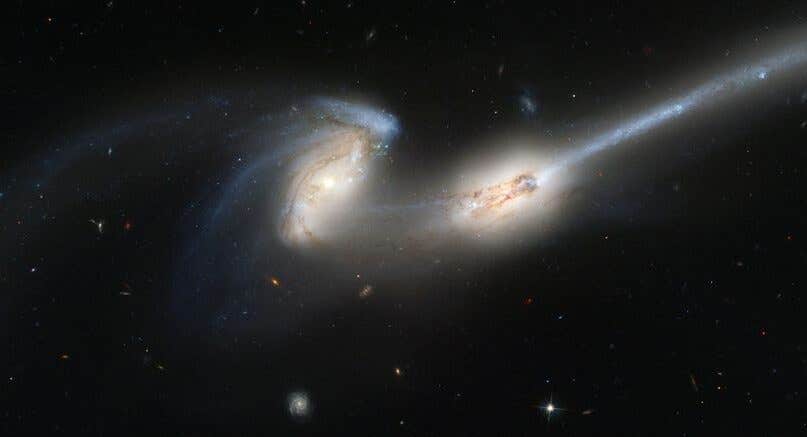
Interacting galaxies NGC 4676, known as “The Mice,” as captured by the Hubble Space Telescope. (CREDIT: NASA/H. Ford (JHU), G. Illingworth (UCSC/LO), M. Clampin (STScI), G. Hartig (STScI) and the ACS Science Team)
- Most galaxy collisions do not cause galaxies to stop making new stars.
- A galaxy’s central black hole and its slow, long-term growth appear more important than sudden cosmic crashes.
- The findings suggest galaxies usually fade gradually because they lose access to fresh gas, rather than shutting down after one violent event.
Galaxy mergers have carried a dramatic reputation for decades. Two enormous systems collide, gas rushes inward, a central black hole erupts and star formation ends. A sweeping simulation analysis now challenges nearly every step of that familiar story.
Researchers at Florida International University examined 11,724 simulated galaxies and found that mergers were neither necessary nor sufficient to stop star formation. The shutdown process, known as quenching, appeared far more closely tied to gradual internal evolution.
Only about 3 percent of major mergers were associated with quenching within a window beginning one billion years before the shutdown process. Extending that window to two billion years raised the figure to about 5 percent.
When the team included mergers of every size, the proportions rose to about 12 percent and 16 percent. Even then, most collisions were not followed by quenching.
“I’ve always been fascinated by galaxy evolution and the question of why some galaxies continue forming stars while others stop completely,” said lead author Camilo Casimiro, an FIU physics graduate student.
Testing astronomy’s dramatic explanation
The study, published in Monthly Notices of the Royal Astronomical Society, tested the merger-quasar-quench model. That influential theory connects galactic collisions, intense black hole activity and the end of star formation.
In the classic picture, gravitational disturbances during a merger drive large amounts of gas toward the galaxies’ centers. The inflowing material feeds supermassive black holes and may also ignite a burst of star formation.
As the black holes consume matter, they release radiation, winds or jets. That energy can heat or expel the cold gas needed to build stars, leaving the merged galaxy inactive.
The idea gained support from smaller simulations and observations of bright quasars, distorted galaxies and recent starbursts. Yet those dramatic events do not reveal whether mergers usually produce lasting shutdowns.
Casimiro and his colleagues tested the relationship with IllustrisTNG100, an advanced cosmological simulation that follows galaxies across billions of years. It models stars, gas, dark matter, black holes and feedback inside an evolving cosmic environment.
The team reconstructed each galaxy’s star formation and merger history. It also tracked when galaxies entered the transitional “green valley” between active, blue galaxies and inactive, red systems.
Most collisions leave galaxies active
If mergers commonly caused quenching, star formation should have declined near the time of those encounters. That pattern rarely appeared.
About 97 percent of major mergers were not associated with quenching in the one-billion-year window. Nearly 88 percent of all mergers, including smaller events, also occurred without an accompanying shutdown.
Many merging galaxies simply continued forming stars.
The researchers then reversed the question. Rather than asking how often mergers produced quenching, they asked how often quenched galaxies had recently experienced mergers.
Only about 11 percent of quenched galaxies had a major merger within the one-billion-year association window. Using two billion years raised the share to about 17 percent.
Minor mergers appeared more common, but they also occur frequently in galaxies that continue forming stars. Once the team compared galaxies of similar stellar mass and corrected for chance timing, the apparent excess disappeared.
The same result emerged for both rapid and gradual shutdowns. Mergers did not appear more closely connected to either pathway after stellar mass was controlled.
“Challenging a long-standing idea in galaxy evolution is something I never expected to be doing so early in my career,” Casimiro said.
“At the same time, I have a great deal of trust in my advisor and in the scientific process itself. One of the most important parts of science is being willing to test even widely accepted ideas against new data and better simulations.”
Black hole mass carries the strongest signal
The team also used random forest models, a machine-learning method, to identify which galaxy properties best predicted quenching.
The central black hole’s mass dominated the results. Stellar mass ranked next when black hole mass was removed, while dark matter halo mass became strongest when both were excluded.
Measures of merger history added little predictive value. These included the number of mergers, mass gained through collisions and time since the most recent encounter.
Together, merger-related properties contributed less than 6 percent of the predictive signal when the main internal properties were included.
Merger measurements could still classify galaxies reasonably well when used alone. The authors found that this reflected an indirect correlation. More massive galaxies tend to experience more mergers, and they also tend to contain larger black holes.
Once black hole and stellar mass entered the analysis, the merger signal largely vanished.
The researchers also separated stellar mass formed inside a galaxy from mass acquired through collisions. The internally produced portion proved far more useful for predicting both black hole mass and quenching.
A slower route to galactic shutdown
The findings point toward a less explosive process inside the simulation.
A quasar outburst may remove gas already inside a galaxy, but galaxies exist within a larger cosmic environment. Fresh material can continue flowing inward from surrounding gas, allowing star formation to resume.
Long-term quenching therefore requires more than a single purge. The surrounding halo must remain hot enough to prevent gas from cooling and falling back into the galaxy.
IllustrisTNG accomplishes this through a low-accretion form of black hole feedback. Instead of relying on one luminous quasar episode, the central black hole injects kinetic energy that stabilizes hot halo gas over extended periods.
The analysis suggests the black holes themselves mainly grow through gradual processes rather than mergers. Star formation, gas inflow and internal instabilities may build them until their feedback becomes strong enough to suppress future fuel supplies.
This conclusion applies to the IllustrisTNG model, not necessarily every real galaxy. Observations have linked some recent mergers to post-starburst galaxies and elevated black hole activity. However, many mergers remain active, while some rapidly quenched galaxies show no visible collision evidence.
Practical implications of the research
The results give astronomers a clearer test for competing explanations of galaxy evolution. Future surveys can compare merger frequency in quenching and star-forming galaxies after carefully matching their stellar and black hole properties.
Observations across earlier cosmic periods will be especially important because mergers and luminous quasars were more common then. Large spectroscopic surveys could determine whether nature follows the gradual pathway seen in IllustrisTNG or relies more heavily on merger-driven outbursts.
Either outcome would refine models of how galaxies leave the star-forming population. The key question may no longer be which catastrophic event killed a galaxy, but what prevented its gas supply from recovering over billions of years.
Research findings are available online in the journal Monthly Notices of the Royal Astronomical Society.
The original story "New study challenges existing knowledge for why galaxies stop forming stars" is published in The Brighter Side of News.
Related Stories
- JWST reveals why some distant galaxies suddenly stop forming stars
- Pristine star reveals the dawn of stars and galaxies in the universe
- New discovery about distant galaxies: Stars are heavier than we thought
Like these kind of feel good stories? Get The Brighter Side of News' newsletter.
Joseph Shavit
Writer, Editor-At-Large and Publisher
Joseph Shavit, based in Los Angeles, is a seasoned science journalist, editor and co-founder of The Brighter Side of News, where he transforms complex discoveries into clear, engaging stories for general readers. With vast experience at major media companies like The Los Angeles Times, Times Mirror and Tribune Publishing, he writes with both authority and curiosity. His writing focuses on space science, planetary science, quantum mechanics, geology. Known for linking breakthroughs to real-world markets, he highlights how research transitions into products and industries that shape daily life.