In 2010, Earth’s molten core suddenly reversed direction and scientists don’t know why
A deep flow of molten iron beneath the Pacific flipped direction in 2010, overturning a pattern scientists thought was stable.

 Edited By: Joshua Shavit

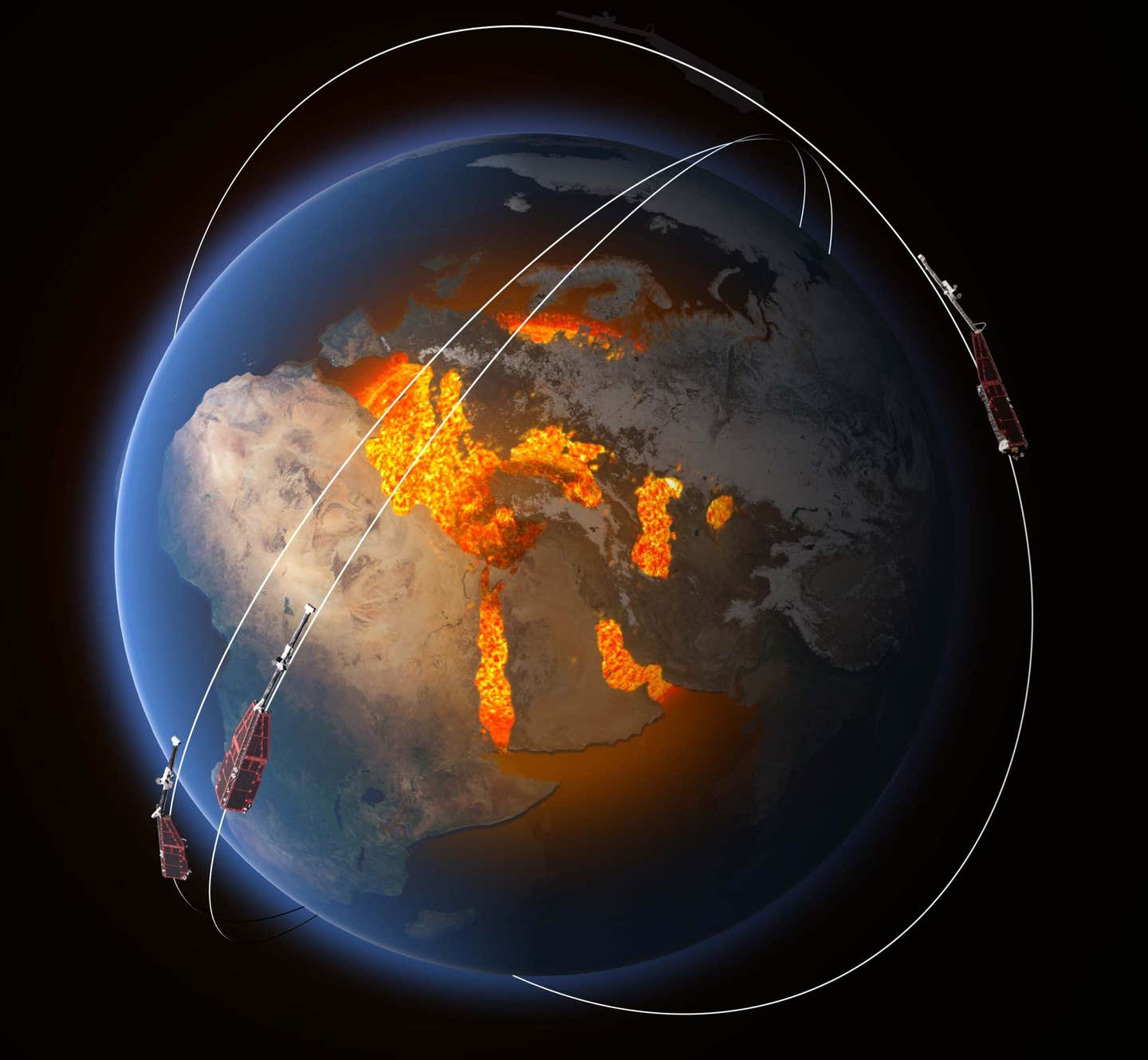
Swarm constellation satellites and ground data reveal a startling 2010 reversal in molten core flow beneath the Pacific and suggest it may now be weakening. (CREDIT: ESA)
A river of molten iron, more than 2,000 kilometers below the surface, appears to have pulled off something Earth scientists did not expect. Around 2010, a broad patch of fluid in the outer core beneath the equatorial Pacific stopped drifting west and began moving sharply east. This reversed a pattern long treated as one of the deep planet’s more stable habits.
That change did not happen where people can see it, or feel it, and it poses no direct danger. However, it matters because the churning outer core generates Earth’s magnetic field. The field is the shield that helps protect the atmosphere and modern technology from charged particles streaming from the Sun.
The new analysis, published in the Journal of Studies of Earth’s Deep Interior, draws on ground observatories and satellite measurements from 1997 to 2025. The team combined data from the Ørsted, CHAMP, CryoSat-2 and Swarm missions to reconstruct how flow at the top of the core evolved through the years. This includes the period around the reversal.
Frederik Dahl Madsen of the University of Edinburgh’s School of Geosciences, the study’s lead author, said the shift opens a new set of questions about how Earth behaves far below the crust.
“The large-scale flow reversal beneath the Pacific raises new questions about the behaviour of Earth’s deep interior,” he said. “Scientists now want to understand whether the reversal represents a short-lived fluctuation, part of a repeating oscillation, or a new stable equilibrium for core circulation. Continued monitoring will be essential to determine how the flow evolves over the coming years.”
A deep pattern breaks beneath the Pacific
For decades, scientists have inferred core flow from subtle changes in Earth’s magnetic field, known as secular variation. On long timescales, the large-scale pattern was often described as mostly westward. Researchers call this the eccentric planetary gyre.
That broad circulation did not vanish in the new work. In fact, it still dominated the system. The analysis found that the first principal component, representing that nearly steady gyre and its high-latitude jet, explained about 90% of the flow variance over the study period.
The surprise came from the second principal component. That feature isolated the Pacific overturn itself, a shift from weak westward flow before 2010 to strong eastward flow afterward. Together, the first two components explained more than 99% of the total flow variance in the models.
The paper describes the reversal as a large-scale event focused beneath the central equatorial Pacific, not a minor local wobble. By 2020, what had once been a weak westward drift had become a strong eastward current. The change was also linked to an emerging pattern of upwelling and downwelling in the same region.
Satellites filled in a critical picture
One reason the event has drawn so much attention is that it occurred during an awkward observational gap. Dedicated magnetic satellites did not provide continuous coverage from 2010 to 2013, exactly when the reversal took shape.
That forced the team to stitch together evidence from several sources. Long-running ground observatories helped bridge the gap, while CryoSat-2 platform magnetometer data added extra coverage. Later, ESA’s Swarm mission, launched in 2013, delivered the precision needed to track how the system behaved after the reversal.
Swarm’s three satellites carry sensitive magnetometers and fly in coordinated orbits that help separate magnetic signals from the core from those produced by the crust, oceans, ionosphere and magnetosphere. This made it possible to follow changes in the core with far greater clarity than ground measurements alone can provide.
According to ESA Swarm Mission Manager Anja Stromme, that long, consistent record has become one of the mission’s biggest strengths.
“Although Swarm was launched after the dramatic reversal event of 2010, it has provided high-precision data that tell us about Earth’s inner core in the period that followed,” she said.
“Importantly, Swarm provides continuous global coverage over many years, allowing scientists to track how core dynamics evolve over time rather than relying only on ground-based magnetic observatories. Long-duration satellite magnetic measurements allow researchers to follow changes in the geodynamo in near-realtime and improve models of Earth’s magnetic field evolution. Future observations from missions such as Swarm will play a crucial role.”
The satellite record also helped reveal smaller, faster features in the flow, including wave-like accelerations and structures linked to geomagnetic jerks, abrupt changes in the magnetic field’s rate of change.
Clues point deeper, but not to a single answer
The study does not claim to have solved what caused the Pacific reversal. Instead, it narrows the possibilities.
One idea is that the overturn was linked to other changes seen around the same time in Earth’s deep interior. The paper notes that the shift coincided with disruptions in periodic length-of-day signals. There were also changes in inner-core seismic signatures and the later rise of magnetic waves in the Pacific region.
Madsen said the timing is hard to ignore.
“The rise of the strong eastward flow in the Pacific is contemporary with a change in behaviour in the inner core, as inferred from geodesy and seismology, and we hypothesise that these changes in the deep interior are associated with the changes in flow beneath the Pacific,” he said.
Another possibility points upward rather than downward. The authors note that uneven heat flow across the core-mantle boundary could help drive eastward motion in the Pacific through thermal effects imposed from above. In that view, the flow change may reflect the influence of the mantle rather than a trigger from deeper inside the core.
The models also suggest the eastward surge has weakened since about 2020. That matters because it hints the event may not mark a permanent reorganization. Instead, it could be a temporary fluctuation, part of a longer oscillation, or a shift into a new state that is still settling down.
Earth’s magnetic shield is shaped by restless motion
The research also challenges a quieter assumption, that the outer core’s large-scale circulation changes only slowly and predictably. The dominant gyre still looks persistent. However, the Pacific event shows that major regional changes can appear within about a decade.
Elisabetta Iorfida, ESA’s Swarm Mission Scientist, said that makes the result especially important for deep-Earth physics.
“This study shows that regional changes can emerge rapidly within just a decade. The findings may also help scientists investigate possible interactions between Earth’s outer core, inner core, lower mantle and, therefore, give more insights into core-mantle boundary, which is a critical region for the deep Earth dynamics,” she said.
“This research raises intriguing questions about how Earth’s deepest layers are dynamically connected. As the magnetic field continues to evolve, satellite missions are providing an increasingly detailed view of the dynamic processes unfolding deep inside our planet, revealing that Earth’s core may be far more variable and complex than once believed.”
Practical implications of the research
The reversal beneath the Pacific does not threaten life at the surface, but it matters for understanding how Earth’s magnetic field changes over time. That field supports navigation, spacecraft operations and models of near-Earth space weather.
Better knowledge of core flow improves magnetic field forecasts, which are used in systems that depend on accurate positioning and radiation planning.
Just as important, the findings show that Earth’s deepest layers may be more tightly linked than once thought. This means future satellite monitoring could reveal how changes in the outer core, inner core and core-mantle boundary unfold together rather than as isolated events.
Research findings are available online in the Journal of Studies of Earth’s Deep Interior.
The original story "In 2010, Earth’s molten core suddenly reversed direction and scientists don't know why" is published in The Brighter Side of News.
Related Stories
- Antarctic seismic data points to an ancient structure circling Earth’s core
- Earth’s core may hold 45 oceans worth of hydrogen, study finds
- Scientists discover onion-like layering in Earth’s inner core
Like these kind of feel good stories? Get The Brighter Side of News' newsletter.
Joseph Shavit
Writer, Editor-At-Large and Publisher
Joseph Shavit, based in Los Angeles, is a seasoned science journalist, editor and co-founder of The Brighter Side of News, where he transforms complex discoveries into clear, engaging stories for general readers. With vast experience at major media companies like The Los Angeles Times, Times Mirror and Tribune Publishing, he writes with both authority and curiosity. His writing focuses on space science, planetary science, quantum mechanics, geology. Known for linking breakthroughs to real-world markets, he highlights how research transitions into products and industries that shape daily life.