Inside the quantum loop: New tool cracks a long-standing physics mystery
A new experimental technique called magnetoARPES has provided the first direct momentum-space evidence of time-reversal symmetry.

 Edited By: Joseph Shavit

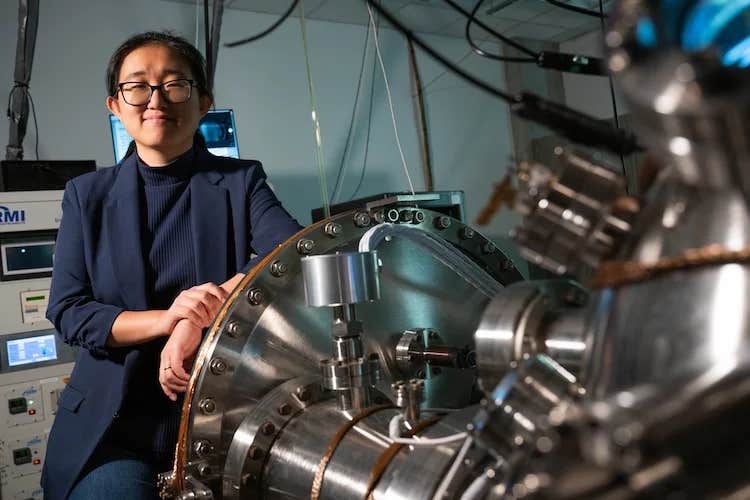
Rice University researchers developed magnetoARPES to directly observe time-reversal symmetry breaking in a kagome superconductor, offering new insight into unconventional superconductivity. (CREDIT: Rice University)
Superconductors are among the most puzzling materials in physics. They conduct electricity with zero resistance, but only under specific conditions that researchers have struggled for decades to fully explain.
In certain exotic versions, called unconventional superconductors, the usual explanations do not apply, and the microscopic behaviors responsible for their properties remain disputed. One such material, a kagome superconductor, has been at the center of a long-running debate about what its electrons are actually doing.
A team at Rice University has now built a new experimental tool that provided the first direct momentum-resolved evidence for one of the stranger things those electrons might do: circulate in tiny loops, flowing in opposite directions on different parts of the crystal, in a way that breaks a fundamental symmetry of time itself.
The tool is called magnetoARPES, developed by physicists Jianwei Huang and Ming Yi. It adds something that had long been considered incompatible with a standard technique for probing electrons in quantum materials, namely a tunable magnetic field, and applies it to one of the most contested problems in condensed matter physics.
A Technique Built Around Light and Electrons
To understand what magnetoARPES does, it helps to understand what ARPES does first. Angle-resolved photoemission spectroscopy works by shining light on a material and measuring the electrons that get knocked out of its surface. Because electrons carry momentum, their exit angles and energies encode detailed information about how they were moving inside the material.
The technique has become one of the most powerful tools for mapping the electronic structure of quantum materials, revealing how electrons organize themselves into bands, where those bands sit relative to the material's energy levels, and how they respond to temperature or other changes.
Magnetic fields are one of the most useful ways physicists have to probe and tune quantum materials. Applying a field can align electron spins, shift energy levels, reveal hidden symmetries, and distinguish competing phases of matter. But for ARPES, magnetic fields had always been a problem. Once an electron is ejected from a surface, any surrounding field deflects it before it reaches the detector, scrambling the momentum information that makes the measurement useful.
Yi's team, based at Rice's Department of Physics and Astronomy, spent several years working through simulations and experiments to find a solution. What they found was that a small magnetic field, generated by a coil and carefully controlled, could be applied to the sample itself during measurement without destroying the momentum information beyond recovery. The extrinsic deflection of ejected electrons turned out to be predictable and correctable at low field strengths.
"This project started as a small exploratory exercise," said Yi, associate professor of physics and astronomy and corresponding author on the study. "Then a series of simulations and tests gave increasingly promising results until we discovered that a small tunable magnetic field, generated by a coil, could allow momentum-resolved electronic spectral information to be largely retained."
The Kagome Problem
To test the new technique on something scientifically meaningful, the team turned to a material that had been generating controversy for years.
The kagome lattice takes its name from a traditional Japanese basket-weaving pattern, a repeating arrangement of triangles and hexagons that tiles a flat plane. In crystalline materials, atoms arranged in this geometry create unusual conditions for the electrons that travel between them.
The geometry produces flat energy bands, which tend to amplify electron-electron interactions, and special points in the electronic structure where electrons behave like massless particles moving at constant speed. These features make kagome materials fertile ground for exotic quantum states.
The compound the Rice team studied, a cesium-vanadium-antimony crystal, is a kagome superconductor that becomes superconducting below about 3 degrees above absolute zero. Before it reaches that state, it undergoes a transition into what is called a charge density wave phase, where electrons arrange themselves into a periodic pattern rather than distributing evenly through the material. This charge density wave has been studied extensively, but it has also been implicated in something more unusual.
Charge Density Wave Experiments
Several experiments had suggested that the charge density wave phase of this material breaks time-reversal symmetry, meaning the material behaves differently depending on whether you imagine running time forward or backward. In a time-reversible system, a movie of the electrons would look the same played in either direction. Time-reversal symmetry breaking implies that something directional is happening at the quantum level, something with a preferred orientation.


One theoretical explanation involves loop currents: electrons in the crystal lattice circulating in tiny closed loops, with neighboring loops running in opposite directions. A material harboring such currents would spontaneously develop a kind of internal magnetic texture, invisible to many conventional measurements but detectable if you know where and how to look.
Evidence for this had accumulated from several experimental directions, including muon spin measurements and scanning tunneling microscopy. But a direct observation in momentum space, the language in which electronic structure is most precisely described, had not been achieved.
What the Magnetic Field Revealed
When the Rice team applied magnetoARPES to their kagome superconductor, they found clear signatures of the symmetry breaking that loop current models predict.
In zero field, the electronic bands associated with the vanadium atoms in the crystal showed the full sixfold rotational symmetry expected from the kagome lattice geometry. When a small magnetic field was applied, that symmetry broke. Specific branches of the electronic structure became broader and dimmer while others stayed sharp and distinct, with the pattern reversing when the field direction was flipped. This reversal with field direction, what physicists call an odd-in-field response, is a hallmark of time-reversal symmetry breaking.
"Using magneto-ARPES allowed us to confirm that kagome's electrons work together to make the quantum state break time-reversal symmetry," said Huang, a former Rice postdoctoral researcher now at Sun Yat-Sen University and first author on the paper. "The data showed this breaking was connected with another electron state called a charge density wave, allowing insight into how charge density waves may help form superconductivity."
Electronic States From Antimony Atoms
The team also examined the electronic states coming from the antimony atoms, which sit at a different part of the crystal structure. Those bands responded differently to the field, becoming elliptical rather than circular, and the ellipticity persisted even above the temperature where the charge density wave disappears. That persistence suggests the two sets of electrons are governed by related but distinct physics, a distinction that had not previously been measurable in this way.
The temperature dependence of both effects tracked the charge density wave transition with striking clarity, confirming that the symmetry breaking is intrinsically linked to that ordered phase rather than being a separate, unrelated phenomenon.
Crucially, the team ruled out a simpler explanation. The fields they used were too weak, by five orders of magnitude, to produce the observed effects through a standard Zeeman interaction, the ordinary way a magnetic field shifts electron energy levels. The response must arise from an internal property of the material itself, one that a small external field can align and amplify but not create.
A New Dimension for Quantum Materials Research
The existence of time-reversal symmetry breaking in this kagome superconductor had been proposed and debated for years. What the Rice experiment provides is direct evidence in the precise quantum-mechanical language of momentum space, where the competing theoretical models make distinguishable predictions.
"Showing that useful information can be gained when performing ARPES in a field is an exciting starting point," Yi said. "We look forward to the discoveries to come from this capability as the collective creativity and momentum of an incredible research community continues to enhance and improve this technique."
The kagome system is not the only place where these questions arise. Unconventional superconductors more broadly remain poorly understood, and the connection between charge ordering, symmetry breaking, and superconductivity is a central unresolved problem. A tool that can track how electrons respond to a tunable magnetic field while preserving full momentum resolution opens a new dimension of investigation across that entire class of materials.
Practical Implications of the Research
Understanding the electronic mechanisms behind unconventional superconductivity is a prerequisite for designing materials that superconduct at higher temperatures, ideally closer to room temperature. The loop current states and symmetry-breaking behaviors that magnetoARPES can now probe directly are theoretically connected to the pairing mechanisms that make high-temperature superconductors work.
Beyond superconductivity, magnetoARPES offers a new handle on a broad range of quantum materials where magnetic response and electronic structure are intertwined. Topological materials, magnetic metals, and other systems where competing ordered phases produce unusual behavior could all benefit from the ability to resolve their electronic structure under controlled magnetic conditions.
The technique is already attracting independent development efforts, a sign that the community recognizes its potential reach across condensed matter physics and quantum materials science.
Research findings are available online in the journal Nature Physics.
The original story "Inside the quantum loop: New tool cracks a long-standing physics mystery" is published in The Brighter Side of News.
Related Stories
- MIT scientists built photonic 'ski jumps' that beam light off chips for faster quantum computing
- Quantum spin study reveals a previously unknown state of matter
- Physicists build a quantum Newton’s cradle where energy flows without resistance
Like these kind of feel good stories? Get The Brighter Side of News' newsletter.
Shy Cohen
Writer