JWST finds hidden structure in a hot exoplanet’s atmosphere 1,300 light-years away
Transmission strings reveal temperature differences around WASP-17b’s atmosphere, adding detail beyond an average planetary spectrum.
 University of Bristol Writer: Victoria Tagg

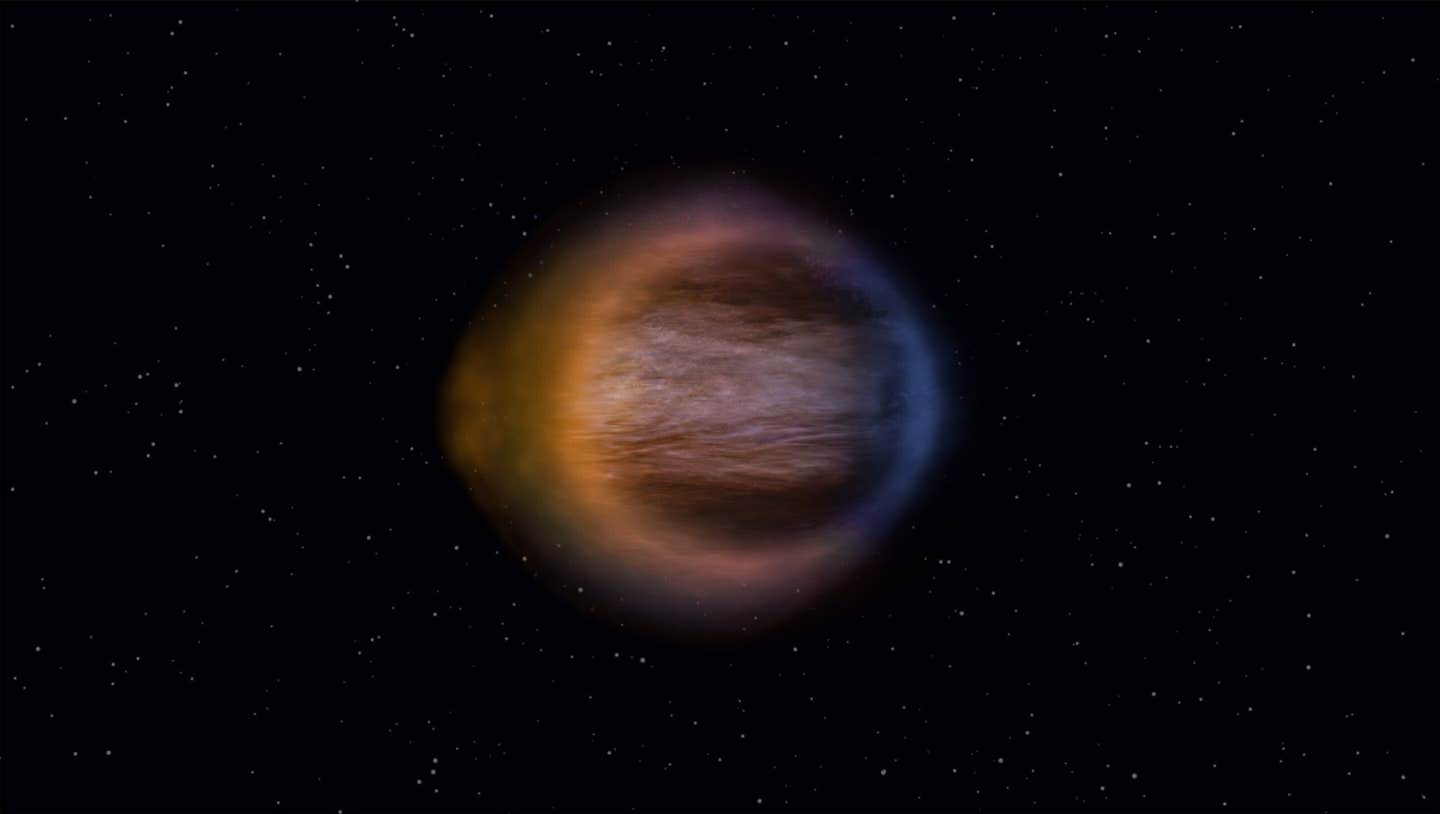
The shape of WASP-17b’s atmosphere mapped using transmission strings. The planet has a broad banded jet around the equator with vast wind speeds which transport material and heat from the permanently irradiated dayside to the permanently shadowed nightside. (CREDIT: Engine House and Hannah Wakeford)
- Webb observations reveal a hotter, more extended evening edge in the atmosphere of the giant exoplanet WASP-17b.
- A method called transmission strings maps atmospheric differences around the planet’s apparent outline during transit.
- The inferred temperature contrast is about 650 kelvin, while water and carbon dioxide abundances remain broadly consistent around the limb.
One edge of WASP-17b stretches farther into space than the other. Around this swollen gas giant, intense heating and atmospheric circulation produce differences that disappear when astronomers treat the entire atmosphere as one uniform ring. A new analysis has recovered some of that missing structure from starlight filtered through the planet’s atmosphere.
The findings, published in Nature Astronomy, concern a hot Jupiter roughly 1,300 light-years from Earth. A team co-led by Cornell University and the University of Bristol applied a method called transmission strings to James Webb Space Telescope observations. The approach traces atmospheric properties at different positions around the planet’s apparent edge.
Lead author Lili Alderson, a Klarman Postdoctoral Fellow at Cornell, began the investigation while completing her doctorate at Bristol. Bristol astrophysicists David Grant and Hannah Wakeford developed the mathematical technique. Its application reveals a hotter evening limb and a cooler morning limb, consistent with predictions of heat-carrying winds.
A giant planet with an atmosphere worth mapping
WASP-17b has about half Jupiter’s mass but approximately 1.9 times its radius. That combination gives it an unusually inflated atmosphere and makes atmospheric signals easier to detect. The study lists an equilibrium temperature of around 1,760 kelvin, a broad reference value rather than a temperature shared by every region.
The planet presents permanent day and night sides, creating a strong contrast in stellar heating. Atmospheric circulation redistributes some of that energy. Models predict an eastward equatorial jet that carries heat toward the evening boundary between day and night.
Such conditions mean that one atmospheric radius cannot describe everything astronomers measure. Hotter gas extends over a greater vertical distance, while different molecules absorb light at different wavelengths. The apparent outline therefore depends both on where around the limb an observation probes and which wavelength it measures.
The result concerns this transmitting atmosphere, rather than a photograph of a sharply bounded planetary surface. It also does not establish that every exoplanet has the same distorted outline. WASP-17b offers a particularly favorable test of a method intended to investigate atmospheric differences on other worlds.
Following the planet across its star
During a transit, a planet crosses in front of its host star and blocks some of its light. A small portion of starlight also passes through the atmosphere. The resulting wavelength-dependent changes carry information about the gases and atmospheric extent along the planet’s edge.
Conventional analysis often combines that information into a single spectrum averaged around the limb. Transmission strings instead allow the fitted radius to change continuously with angle. As different parts of the planet enter and leave the stellar disk, their contributions help constrain an uneven silhouette.
The team used open-source software called Harmonica to fit those changing shapes. It then extracted spectra corresponding to particular angles around the limb. Those spectra could be compared with atmospheric models to estimate temperature and composition at each position.
“Rather than assuming your atmosphere is a circle with the same radius all the way around, our technique allows you to pull out different distances from the centre to the edge of the planet,” Alderson said. Earlier asymmetry studies commonly compared two atmospheric halves. The new approach can also explore differences between equatorial and polar regions.
A hotter evening edge emerges
The analysis combined observations from Webb’s NIRISS, NIRSpec and MIRI instruments. Together, they covered wavelengths from 0.6 to 12 micrometers. The observations came from the TST DREAMS program, which studies selected exoplanet atmospheres using multiple instruments.
The team organized the spectra into 24 wavelength intervals and examined positions around the limb. Atmospheric models inferred temperatures of roughly 850 kelvin near the morning equator and 1,500 kelvin near the evening equator. That difference of approximately 650 kelvin corresponds to the same numerical difference in degrees Celsius.
The temperature estimates have uncertainties, with the cooler morning region less tightly constrained. Nevertheless, the overall progression is consistent with the predicted thermal pattern. The hotter evening atmosphere has a larger scale height, meaning its density falls off more gradually with altitude.
At the morning edge, the spectrum is relatively flat, with weaker absorption features. Toward the evening edge, those features become larger. This change supports the interpretation that heating and atmospheric circulation drive much of the observed variation, rather than a wholly different chemical mixture on each side.
Similar gases beneath different thermal conditions
Water vapor and carbon dioxide provide the clearest chemical information in the mapped spectra. Their inferred abundances are broadly consistent around the limb. Their absorption features can still differ in strength because temperature changes how far the atmosphere extends.
That distinction matters when interpreting a spectrum. A stronger molecular feature does not automatically mean that a region contains proportionally more of that molecule. The temperature and physical structure of the atmosphere also affect the signal reaching the telescope.
Other chemical patterns remain less certain. The analysis produced possible hints involving methane near polar regions and sulfur dioxide, but did not tightly constrain those abundances. It also could not reliably map changes in cloud or haze properties around the limb.
Those limitations prevent the findings from becoming a detailed weather chart. They leave open questions about regional cloud composition and less abundant gases. Better observations, particularly at longer infrared wavelengths, could help test those possibilities.
Building a fuller view from complementary measurements
Transmission mapping adds a different perspective to eclipse mapping. During an eclipse, a planet passes behind its star, progressively hiding and revealing regions of its emitting atmosphere. Changes in the planet’s own light can therefore provide information about its dayside brightness and temperature structure.
Earlier observations of WASP-17b found an eastward displacement of its dayside hot spot. The new limb temperatures agree broadly with that circulation picture and with nightside emission measurements. The techniques probe different atmospheric pressures, so matching patterns matter more than identical temperature values.
The new analysis also makes assumptions. It treats the northern and southern hemispheres as symmetric, guided by circulation models. Extracting spatial information requires broader wavelength bins and larger uncertainties than some methods that average over larger atmospheric regions.
Even with those trade-offs, the results move atmospheric studies beyond a single representative ring. They show that transit observations can test where heat is distributed around a distant planet’s edge. Applied to other suitable targets, the method could reveal which atmospheric patterns are shared and which depend on each world’s circumstances.
Dig deeper into mapping exoplanet atmospheres
These studies explain the mapping method and earlier observations that help interpret WASP-17b’s atmosphere.
Transmission strings: a technique for spatially mapping exoplanet atmospheres around their terminators: Introduces the mathematical framework used to reconstruct continuously varying atmospheric outlines. (Monthly Notices of the Royal Astronomical Society, 2023)
Inhomogeneous terminators on the exoplanet WASP-39 b: Demonstrates differences between a hot giant planet’s morning and evening atmospheric regions. (Nature, 2024)
JWST-TST DREAMS: Nonuniform Dayside Emission for WASP-17b from MIRI/LRS: Uses eclipse mapping to investigate dayside temperature structure and an eastward hot-spot offset. (The Astronomical Journal, 2024)
JWST-TST DREAMS: The Nightside Emission and Chemistry of WASP-17b: Provides complementary measurements of the planet’s dark hemisphere. (The Astrophysical Journal Letters, 2025)
JWST-TST DREAMS: Quartz Clouds in the Atmosphere of WASP-17b: Reports evidence for silica particles in the atmosphere using earlier Webb observations. (The Astrophysical Journal Letters, 2023)
Research findings are available online in the journal Nature Astronomy.
The original story "JWST finds hidden structure in a hot exoplanet's atmosphere 1,300 light-years away" is published in The Brighter Side of News.
Related Stories
- JWST catches mineral clouds forming and fading on 'hot Jupiter' exoplanet
- Scientists baffled by 'Hot Jupiter' exoplanet's irregular motion
- South Africa’s MeerKAT array detects the first radio signal directly from an exoplanet
Like these kind of feel good stories? Get The Brighter Side of News' newsletter.
Joseph Shavit
Writer, Editor-At-Large and Publisher
Joseph Shavit, based in Los Angeles, is a seasoned science journalist, editor and co-founder of The Brighter Side of News, where he transforms complex discoveries into clear, engaging stories for general readers. With vast experience at major media companies like The Los Angeles Times, Times Mirror and Tribune Publishing, he writes with both authority and curiosity. His writing focuses on space science, planetary science, quantum mechanics, geology. Known for linking breakthroughs to real-world markets, he highlights how research transitions into products and industries that shape daily life.