
Light-activated tattoo inks make skin a rewritable, animated canvas
Experimental tattoo inks stayed light-switchable for up to 2.2 years in one researcher’s skin. Broader safety testing is needed.

 Edited By: Joseph Shavit

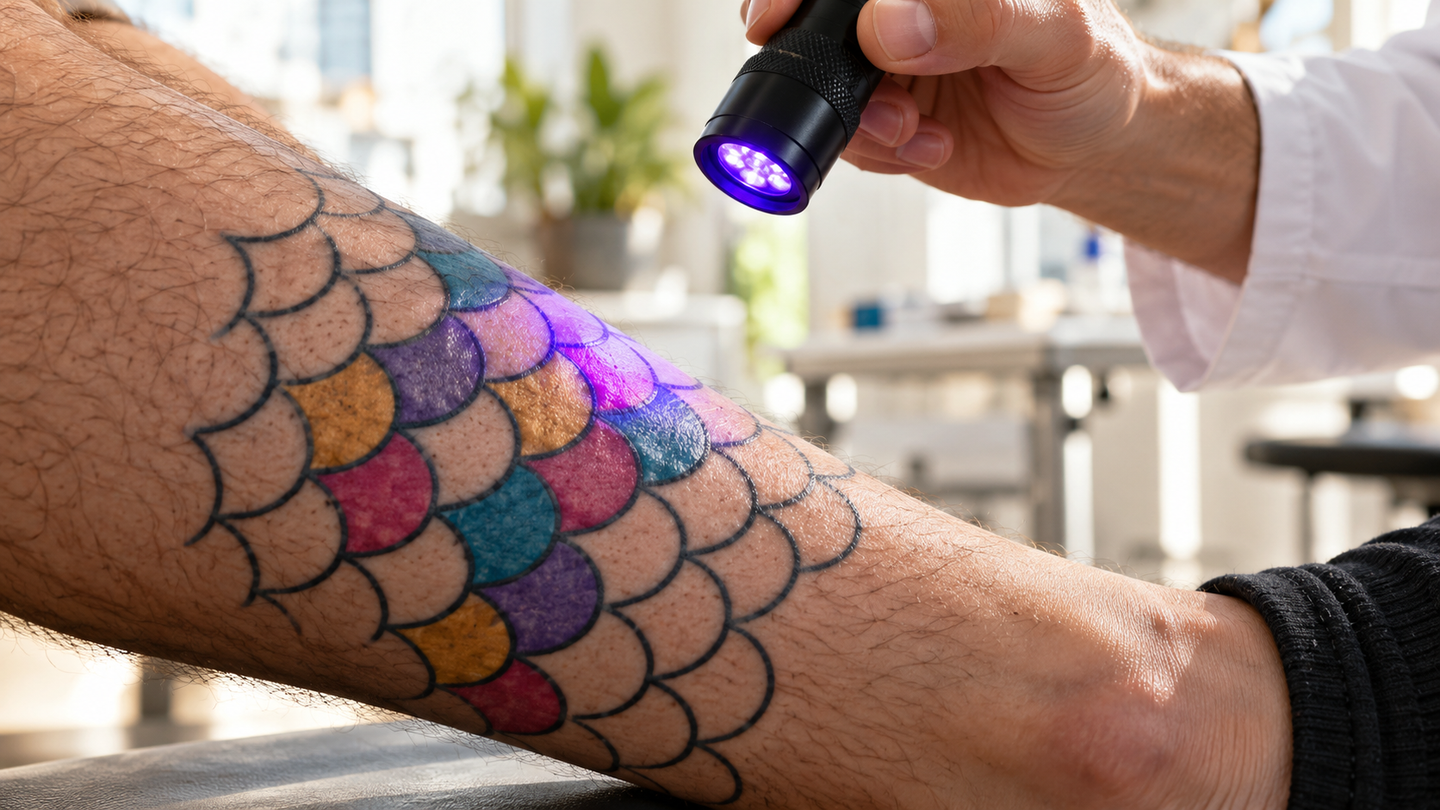
PhotoTat inks reveal and erase tattoo colors with light, but human safety and blue-dye durability remain unresolved. (CREDIT: The Brighter Side of News)
- PhotoTat inks become blue, magenta or yellow under ultraviolet light and fade under visible light.
- Skin-model tests demonstrated multicolor image rewriting, while one researcher’s tattoos remained switchable for up to 2.2 years.
- Human safety remains unproven, and repeated switching can leave the blue ink permanently purple.
A tattoo can disappear from view without its pigment leaving the skin. Experimental inks called PhotoTat become colorful under ultraviolet light, then return to a nearly invisible state under bright visible light.
The University of Colorado Boulder team behind the technology reported its experiments in Matter & Light. Led by Carson Bruns, the researchers demonstrated light-controlled designs in artificial skin and excised pig skin, alongside a limited experiment on Bruns himself.
The work could eventually give people more control over body art and medical tattoo markers. However, the inks are not available in tattoo parlors, and their safety in people has not been established. Several technical problems also separate the demonstrations from dependable everyday use.
Tiny polymer spheres carry the changing colors
PhotoTat uses three dyes that change color when exposed to different wavelengths of light. Each dye sits inside nanoparticles made from polymethyl methacrylate, or PMMA. This transparent polymer also appears in medical products such as certain dermal fillers and intraocular lenses.
Most particles measured between 100 and 500 nanometers across. Their size falls within the range found in conventional tattoo pigments. The team suspended them in water to create separate blue, magenta and yellow inks.
The polymer’s optical properties help make the particles difficult to see when the dyes are colorless. Ultraviolet light changes the dye molecules into forms that absorb visible light, producing color. Visible light drives the reverse reaction.
The pigment stays implanted while its appearance changes. The system therefore changes what a tattoo looks like rather than removing it. It requires external light, but no implanted electronics or batteries.
“I love body art because of how personal it is,” Bruns said. His own tattoos provided the setting for the study’s first demonstration in living human skin.
A few seconds of light can reveal a design
The researchers used conventional tattoo equipment to place the inks into silicone practice skins and freshly excised pig skin. The silicone models included several pigmentation levels corresponding to Fitzpatrick skin types II through V. These tests assessed performance without establishing results across human populations.
A 365-nanometer ultraviolet LED produced most of the available color within two to three seconds. Bright white light could erase the color within seconds as well. Under ordinary indoor lighting, however, the dyes faded much more slowly, allowing images to persist for hours or days.
Activated colors remained perceptible in every tested skin model. Contrast decreased as the models became darker, with yellow particularly less conspicuous. When deactivated, the inks were nearly indistinguishable from their backgrounds.
Sunlight complicates that control because it contains both ultraviolet and visible wavelengths. It can activate the ink even in shade, making complete outdoor concealment difficult without ultraviolet protection. Applying SPF 30 sunscreen restored the nearly invisible state within minutes in all six tested models.
That result suggests a possible ultraviolet-exposure indicator, but it was a skin-model experiment. It does not establish a validated sunscreen monitor for people.
Images emerge by switching different dyes off
The team mixed the three inks in different proportions to produce 16 test colors. Those mixtures covered a useful range, although substantially less than conventional color-printing inks. The present system lacks both a true cyan dye and a white channel.
Simple designs could be written by illuminating selected regions with ultraviolet light. The researchers used stencils, printed transparency masks and a narrow-beam ultraviolet stylus. White light then cleared the designs for rewriting.
The light writes only where PhotoTat pigment has already been implanted. It does not turn untreated skin into a drawing surface.
Multicolor photographic transfer worked differently. Ultraviolet light first activated a mixture of all three inks into a dark state. Patterned red, green and blue light then selectively erased different dye channels, leaving the desired colors behind.
A portable laser projector delivered the best color reproduction among the tested sources. In the models, it transferred multicolor images during five-minute exposures. Printed transparencies and a phone screen also worked, but produced slower changes and less distinct colors.
This was not yet complete photographic rewriting in living skin. The full multicolor images were demonstrated only in silicone and excised pig skin, which cannot reproduce all the optical effects of a living epidermis.
One researcher’s tattoos kept switching for years
Bruns received the experimental inks in his leg between January 2024 and January 2025. Some filled existing black fish-scale outlines, while others combined the primary colors. The conventional black ink remained visible when the PhotoTat colors disappeared.
All three color channels retained switching function after 1.4 to 2.2 years. The tattoos healed normally, with no reported adverse events in this single participant. That observation establishes feasibility, rather than generalizable evidence of safety.
On one magenta scale, the researchers successively wrote a smiley face, a heart and a musical note. Each design was erased before the next appeared. Writing and clearing these single-color images took only seconds.
The experiment also showed selective erasure of different channels through living skin. However, it did not use that mechanism to write a complete spatially patterned multicolor photograph. Bruns’s skin was Fitzpatrick type II, leaving performance across other human skin tones untested.
A permanent purple trace exposes an important flaw
Repeated switching damaged the blue dye during tests spanning 10 to 100 ultraviolet-visible cycles. A purple byproduct accumulated and remained visible even after prolonged white-light exposure. That residual color undermines the central promise of hiding the tattoo.
Magenta and yellow proved more durable over the same cycle range. Finding a more stable replacement for blue is therefore a priority. The lack of white also prevents the system from producing highlights lighter than the surrounding skin.
Safety assessment must address the specific formulations, not simply PMMA’s history in other implants. A separate 11-person study of monochromatic Magic Ink reported no adverse events and retained switching after at least a year. Those findings provide context but do not validate PhotoTat’s three inks.
Each channel still needs independent testing for cell toxicity, sterility and purity before broad human use. Ultraviolet activation adds an exposure that also requires consideration. Bruns has commercial interests in the technology, and the research received funding that included HYPRSKN.
Potential medical uses include radiotherapy alignment marks and biopsy-site identification. PhotoTat demonstrated those concepts in pig skin, rather than patient care. Whether light-controlled markers can provide reliable clinical guidance while remaining inconspicuous afterward awaits further testing.
Dig deeper into light-responsive inks and medical tattoos
These resources explore rewritable colors, implanted optical sensors and alternatives to visible medical tattoo marks.
Clinical evaluation of photochromic nanoparticle tattoo ink: safety, tolerability, and performance of rewritable intradermal implants: Reports a pilot study of monochromatic Magic Ink in 11 people, distinct from the three-color PhotoTat formulations. (Journal of Nanobiotechnology, 2026)
Solar Freckles: Long-Term Photochromic Tattoos for Intradermal Ultraviolet Radiometry: Investigates implanted color-changing pigments as indicators of ultraviolet exposure. (ACS Nano, 2020)
Photo-Chromeleon: Re-Programmable Multi-Color Textures Using Photochromic Dyes: Describes earlier light-controlled multicolor rewriting on object surfaces, providing a foundation for the tattoo approach. (Massachusetts Institute of Technology, 2019)
A randomized control trial evaluating fluorescent ink versus dark ink tattoos for breast radiotherapy: Compares treatment-positioning reliability and body-image outcomes using fluorescent and conventional medical tattoos. (British Journal of Radiology, 2016)
Photochromic Intradermal Smart Tattoo Based on Diarylethene-Doped Polystyrene Nanoparticles for Personal γ-Ray Dosimetry: Explores another experimental use of implanted photochromic pigments, detecting exposure to gamma radiation. (ACS Applied Nano Materials, 2022)
Research findings are available online in the journal Matter & Light.
The original story "Light-activated tattoo inks make skin a rewritable, animated canvas" is published in The Brighter Side of News.
Related Stories
- Chest e-tattoo revolutionizes heart monitoring
- Graphene ‘tattoo’ revolutionizes treatment of heart conditions
- New ‘smart tattoos’ revolutionize on-skin computing
Like these kind of feel good stories? Get The Brighter Side of News' newsletter.
Joshua Shavit
Writer and Editor
Joshua Shavit is a NorCal-based science and technology writer with a passion for exploring the breakthroughs shaping the future. As a co-founder of The Brighter Side of News, he focuses on positive and transformative advancements in technology, physics, engineering, robotics, and astronomy. Having published articles on AOL.com, MSN, Yahoo News, and Ground News, Joshua's work highlights the innovators behind the ideas, bringing readers closer to the people driving progress.