Little red dot galaxies may solve a cosmic neutrino mystery
New research suggests distant Little Red Dot galaxies may produce hidden high-energy neutrinos across the universe.

 Edited By: Joseph Shavit

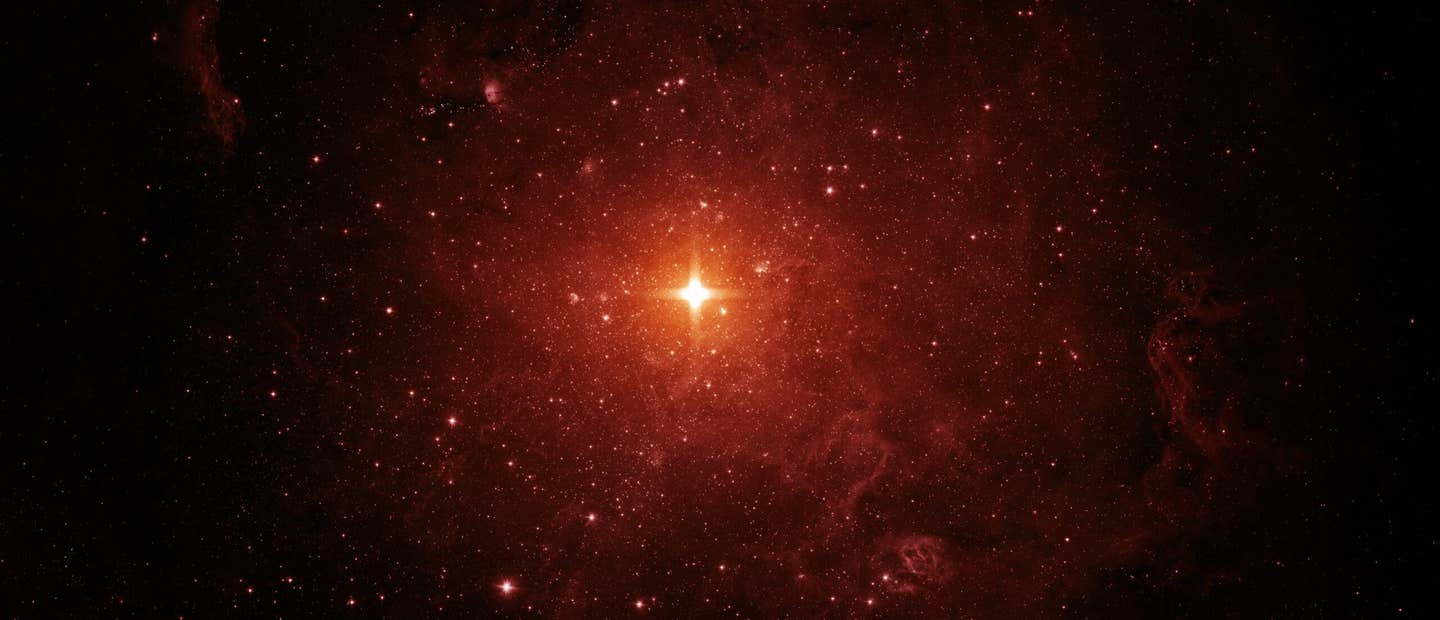
Scientists propose that distant Little Red Dot galaxies could be hidden sources of high-energy neutrinos detected on Earth. (CREDIT: Shutterstock)
Faint, distant galaxies spotted by the James Webb Space Telescope are beginning to reshape how scientists understand the high-energy universe. These compact objects, known as “Little Red Dots,” may hold clues to one of astronomy’s longest-standing mysteries, the origin of cosmic high-energy neutrinos.
A new study led by researchers at Kyoto University suggests that these early galaxies could act as hidden particle factories. Their extreme environments may generate powerful neutrinos while concealing other forms of radiation that astronomers typically rely on for detection.
A Strange Population In The Early Universe
Observations with the Webb telescope revealed these small, red galaxies at great distances. Their light has traveled billions of years to reach Earth. This means they formed when the universe was still young.
Despite their small size, they appear in large numbers. Their density rivals or exceeds that of bright quasars from the same era. This surprised astronomers, who expected fewer energetic objects so early in cosmic history.
Each of these galaxies likely contains a growing supermassive black hole. These black holes consume surrounding gas and release enormous energy. Estimates suggest their output can reach between 10⁴⁵ and 10⁴⁷ ergs per second.
Yet something does not add up. Objects this powerful usually emit strong radio and X-ray signals. These galaxies do not. Their quiet appearance hints that something is hiding their true nature.
Black Holes Hidden Inside Thick Gas
Researchers propose that these galaxies contain black holes buried within dense envelopes of gas. This thick material traps much of the energy produced near the center.
Instead of escaping as high-energy radiation, the energy is absorbed and re-emitted at lower energies. This gives the galaxies their reddish glow and masks their most violent processes.
“In the scenario we considered, abundant photons and dense gas are expected to exist around the central black hole in a Little Red Dot, which may allow such collisions to occur efficiently,” said Riku Kuze.
This environment creates a hidden powerhouse. It also provides the right conditions for producing one of the universe’s most elusive particles.
The Mystery Of High-Energy Neutrinos
Neutrinos are nearly massless particles that rarely interact with matter. They pass through stars, planets, and even human bodies without leaving a trace.
Detectors on Earth have observed a steady background of high-energy neutrinos arriving from across the sky. However, their origin remains unclear.
Producing these particles requires extreme conditions. High-energy protons must collide with light or matter, creating short-lived particles that decay into neutrinos.
Most sources that create neutrinos also emit gamma rays. Yet the observed gamma-ray background does not match what scientists would expect if all neutrino sources were visible.
This mismatch suggests that many neutrino sources are hidden. Their gamma rays must be blocked, while neutrinos escape.
A Perfect Hidden Source
Little Red Dots fit this requirement. Their dense gas envelopes trap high-energy radiation but allow neutrinos to pass through.
Inside these galaxies, conditions appear ideal for particle collisions. A black hole draws in matter, forming a rotating disk. Above and below this disk, narrow channels may form where jets of energy travel outward.
These jets accelerate particles to extreme speeds. As these particles move through intense radiation fields, they collide with photons and produce neutrinos.
Because the surrounding gas is so thick, gamma rays cannot escape. They are absorbed and transformed into lower-energy light. Neutrinos, however, travel freely into space.
Simulating A Hidden Engine
To test this idea, researchers combined analytical models with detailed numerical simulations. They estimated how efficiently these galaxies could produce neutrinos.
Their calculations included particle acceleration, cooling processes, and interactions within the dense environment. The results suggest that these galaxies can generate high-energy neutrinos while suppressing gamma-ray emission.
This makes them strong candidates for contributing to the diffuse neutrino background observed on Earth.
“Although it is difficult to observe the individual objects directly, we believe this study is significant because it is the first to demonstrate that, given their abundance, these little red galaxies could account for a part of the observed high-energy neutrinos,” Kuze said.
Strength In Numbers
One galaxy alone would not produce a strong signal. These objects are extremely distant, and their individual emissions are faint.
However, their large numbers may compensate for this. When combined, they could produce a measurable contribution to the overall neutrino background.
Researchers explored different models for how these galaxies are distributed across cosmic time. In some scenarios, they contribute only a small share. In others, they account for a significant fraction of the observed signal.
Even if they are not the only source, they may represent an important piece of the puzzle.
Why They Are Hard To Detect
Finding direct evidence remains challenging. Each galaxy lies billions of light-years away. The neutrino signal from any single source is weak.
In addition, many of these galaxies cluster together. This makes it difficult to link a detected neutrino to a specific origin.
Scientists must rely on indirect evidence. They study patterns in the neutrino background and compare them with theoretical predictions.
Future detectors with greater sensitivity may help narrow down these sources.
Searching For Distinct Signatures
Researchers are now looking for ways to distinguish these galaxies from other potential sources. One clue may lie in the types of neutrinos produced.
Neutrinos come in different forms, known as flavors. The ratio of these flavors can reveal how they were created.
In these galaxies, dense radiation fields may alter this ratio. Detecting such patterns could provide evidence for their role in neutrino production.
Another clue is the absence of gamma rays. A source that produces neutrinos without strong gamma-ray emission is likely hidden within dense material.
A New Window Into The Early Universe
The discovery of these galaxies highlights how much remains unknown about the early universe. They show that powerful black holes formed quickly and operated in unusual environments.
These conditions may have played a key role in shaping cosmic evolution. They also reveal how energy moves through dense systems.
By studying these objects, scientists gain insight into both galaxy formation and high-energy physics.
Practical Implications Of The Research
This research could reshape how scientists study cosmic particle sources. Identifying hidden neutrino factories may help solve a long-standing mystery in astrophysics.
It also improves understanding of how black holes grow and interact with their surroundings. These insights may inform models of galaxy formation across cosmic history.
In the future, improved neutrino detectors may confirm the role of these galaxies. This could lead to new ways of mapping the universe using neutrinos instead of light.
The work also highlights the importance of combining observations and theory. By linking telescope data with simulations, researchers can uncover processes that are otherwise invisible.
Ultimately, this research brings scientists closer to understanding how the most extreme environments in the universe operate and how they shape the cosmos.
Research findings are available online in the journal Physical Review D.
The original story "Little red dot galaxies may solve a cosmic neutrino mystery" is published in The Brighter Side of News.
Related Stories
- Mirror universe where time runs backwards could help explain dark matter, antimatter and neutrinos
- Shadow Blaster points to starburst galaxies as hidden sources of cosmic neutrinos
- The explosive fate of a collapsing star depends on neutrinos
Like these kind of feel good stories? Get The Brighter Side of News' newsletter.
Joshua Shavit
Writer and Editor
Joshua Shavit is a NorCal-based science and technology writer with a passion for exploring the breakthroughs shaping the future. As a co-founder of The Brighter Side of News, he focuses on positive and transformative advancements in technology, physics, engineering, robotics, and astronomy. Having published articles on AOL.com, MSN, Yahoo News, and Ground News, Joshua's work highlights the innovators behind the ideas, bringing readers closer to the people driving progress.