XMM-Newton gamma-ray detection shows the Milky Way is bigger than previously thought
X-ray echoes from distant gamma-ray bursts helped redraw parts of the Milky Way, pushing two outer arms farther out.

 Edited By: Joseph Shavit

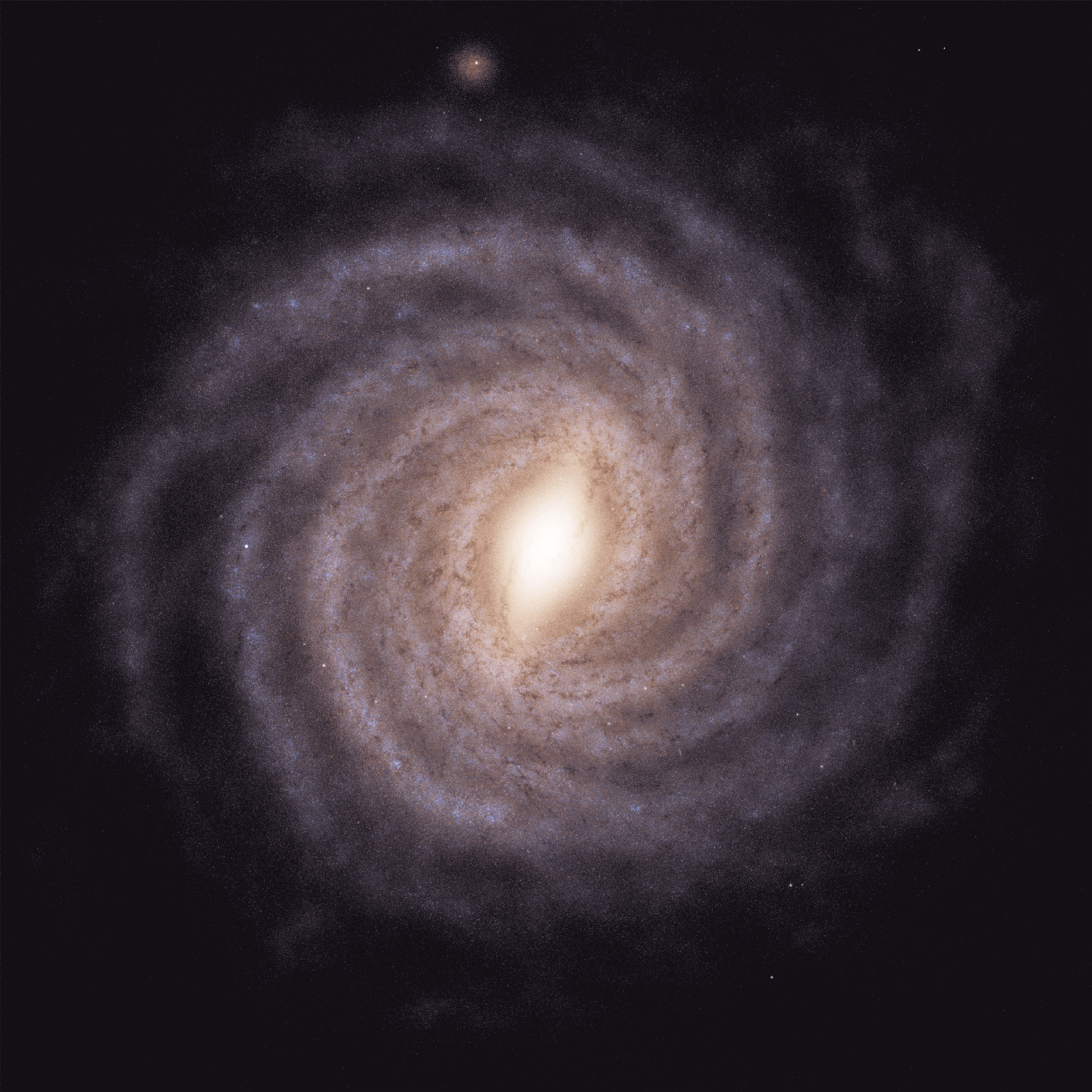
This artist’s impression depicts the structure of our galaxy, the Milky Way, based on data from ESA’s Gaia and illustrates how scientists have revised the position of its outer arms thanks to observations from ESA’s XMM-Newton and NASA’s Chandra. (CREDIT: ESA/Gaia/DPAC, Stefan Payne-Wardenaar, ESA/XMM-Newton and NASA/Chandra)
The Milky Way’s farthest spiral arms have long been sketched more from motion than measurement. Now three violent explosions far beyond our galaxy have helped redraw that map, showing that parts of the outer Milky Way sit farther away than astronomers thought.
The work used the fading X-ray afterglow of three gamma-ray bursts, brief but extraordinarily bright blasts that erupted in distant galaxies. As that X-ray light crossed the Milky Way, some of it scattered off dust in the galaxy’s spiral arms, creating expanding rings that space telescopes could track. Those rings, the team found, offer a rare direct way to measure remote stretches of the galactic disk.
That matters because getting your bearings inside the Milky Way is hard. Earth sits buried in the galaxy’s disk, not above it, and thick dust clouds block many lines of sight. Astronomers have built galactic maps using tracers such as hydrogen gas, carbon monoxide, giant molecular clouds, H II regions, and methanol masers, but distances in the outer galaxy often depend on models of how the Milky Way rotates.
Those models are useful, but they can drift, especially far from the galactic center.
When exploding galaxies light up our own
Beatrice Vaia of the Istituto Nazionale di Astrofisica in Italy led the research, which focused on three low-latitude gamma-ray bursts: GRB 221009A, GRB 160623A, and GRB 031203. Two X-ray observatories, the European Space Agency’s XMM-Newton and NASA’s Chandra, captured the dust-scattering rings around those bursts.
The method hinges on geometry. For a burst in another galaxy and a dust cloud inside the Milky Way, the scattered X-rays arrive later than the direct ones and appear at an angular offset. As time passes, the ring expands. By measuring that expansion, the team could calculate the distance to the dust cloud that produced it.
Because those dust clouds sit inside spiral arms, the ring distances also locate the arms themselves.
The researchers concentrated on clouds more than 5 kiloparsecs away, using the ring data to probe the Perseus Arm, the Outer Arm, and the Outer Scutum-Centaurus arm. In several cases, they also measured the width of the peaks in the data, which helped estimate how thick the dust structures were along the line of sight.
A sharper look at the galaxy’s edge
One of the clearest results came from GRB 221009A, the record-setting burst detected in October 2022. Its X-ray echoes revealed multiple dust structures deep in the Milky Way. Measurements from both XMM-Newton and Chandra agreed well, giving confidence that the distances were real and not artifacts of one instrument or one observing run.
In that direction, the team placed the Perseus Arm at 9.6 ± 0.1 kiloparsecs, the Outer Arm at 13.9 ± 0.1 kiloparsecs, and the Outer Scutum-Centaurus arm at 19.0 ± 0.2 kiloparsecs from the Sun along that line of sight.
GRB 160623A added another view. There, the study confirmed a known dust structure at 5.125 ± 0.029 kiloparsecs and identified two more at 6.909 ± 0.056 and 9.908 ± 0.624 kiloparsecs. The farthest of those was associated with the Outer Arm.
GRB 031203, first seen in 2003, helped pin down the Outer Arm in a third direction. Reanalysis of XMM-Newton data confirmed a dust cloud at about 9.9 ± 0.4 kiloparsecs in the first observation, with a weighted average of 9.7 ± 0.4 kiloparsecs across two observations. No significant ring signal appeared in the later Chandra data, which the authors say is consistent with expectations at that stage.
Taken together, the measurements support the known distance to the Perseus Arm, but they also push two outer structures farther out. The Outer Arm and the Outer Scutum-Centaurus arm appear to lie up to 10% beyond earlier estimates.
Where standard models start to miss
That gap showed up most clearly when the X-ray distances were compared with maps based on common Galactic rotation curves, including models from Clemens and from Reid and colleagues. In general, the Reid model matched the X-ray locations better than the older Clemens curve. Even so, the study found a systematic mismatch in the first Galactic quadrant, where the model placed the Outer Arm and the Outer Scutum-Centaurus arm too close.
In the direction of GRB 221009A and GRB 160623A, the X-ray measurements pushed those arms outward relative to the Reid-based reconstruction. The Clemens curve, by contrast, tended to place them too far away.
That may sound like a technical adjustment, but it cuts to a basic problem in Milky Way astronomy. Many large-scale maps convert gas velocities into positions by assuming a rotation curve. If that assumed motion is off in the outer galaxy, the resulting map is off too.
The X-ray ring method sidesteps that issue. It does not infer distance from motion. It measures distance directly from the travel path of light.
The study also found little significant carbon monoxide emission beyond 5 kiloparsecs along the selected sight lines, though hydrogen data still showed useful structure for comparison. In the direction of GRB 031203, for example, the lack of a Perseus Arm ring matched the absence of a strong hydrogen peak there, suggesting very little dust in that arm along that line of sight.
A rare tool, but a powerful one
The approach depends on good luck as much as good telescopes. Gamma-ray bursts this bright and this well placed near the Galactic plane are rare. GRB 221009A, in particular, was an exceptional event. Still, the study shows what becomes possible when such a burst lights up the Milky Way’s dusty outskirts.
It also underlines the value of older missions working alongside newer ones. Gaia has transformed stellar mapping, but its distance measurements are less precise in the far outer arms. X-ray echoes reach into those harder-to-measure regions, offering a useful complement rather than a replacement.
Future observatories could expand the method. The authors point to upcoming X-ray facilities and future sky surveys as a way to build a denser, more direct map of interstellar clouds in the galaxy’s outskirts.
Practical implications of the research
This work gives astronomers a more direct yardstick for measuring the Milky Way’s outer spiral arms, where model-based distances remain uncertain.
A better map of those regions can improve reconstructions of the galaxy’s shape, help refine Galactic rotation curves, and provide a stronger framework for interpreting gas, dust, and star-forming regions seen in radio, optical, and infrared surveys.
It also shows that bright X-ray echoes from gamma-ray bursts can act as temporary beacons, letting researchers measure distant dust structures that are otherwise difficult to place with confidence.
Research findings are available online in the journal Astronomy and Astrophysics.
The original story "XMM-Newton gamma-ray detection shows the Milky Way is bigger than previously thought" is published in The Brighter Side of News.
Related Stories
- For the first time, astronomers identify the edge of the Milky Way's disc
- A strange glow in the heart of the Milky Way may be dark matter
- Milky Way’s central black hole wind finally detected ending 50-year search
Like these kind of feel good stories? Get The Brighter Side of News' newsletter.
Joshua Shavit
Writer and Editor
Joshua Shavit is a NorCal-based science and technology writer with a passion for exploring the breakthroughs shaping the future. As a co-founder of The Brighter Side of News, he focuses on positive and transformative advancements in technology, physics, engineering, robotics, and astronomy. Having published articles on AOL.com, MSN, Yahoo News, and Ground News, Joshua's work highlights the innovators behind the ideas, bringing readers closer to the people driving progress.