Massive binary star system may be feeding the Milky Way’s central black hole
Astronomers traced strange gas clouds near Sagittarius A* back to a massive binary star in the Galactic Center.

 Edited By: Joshua Shavit

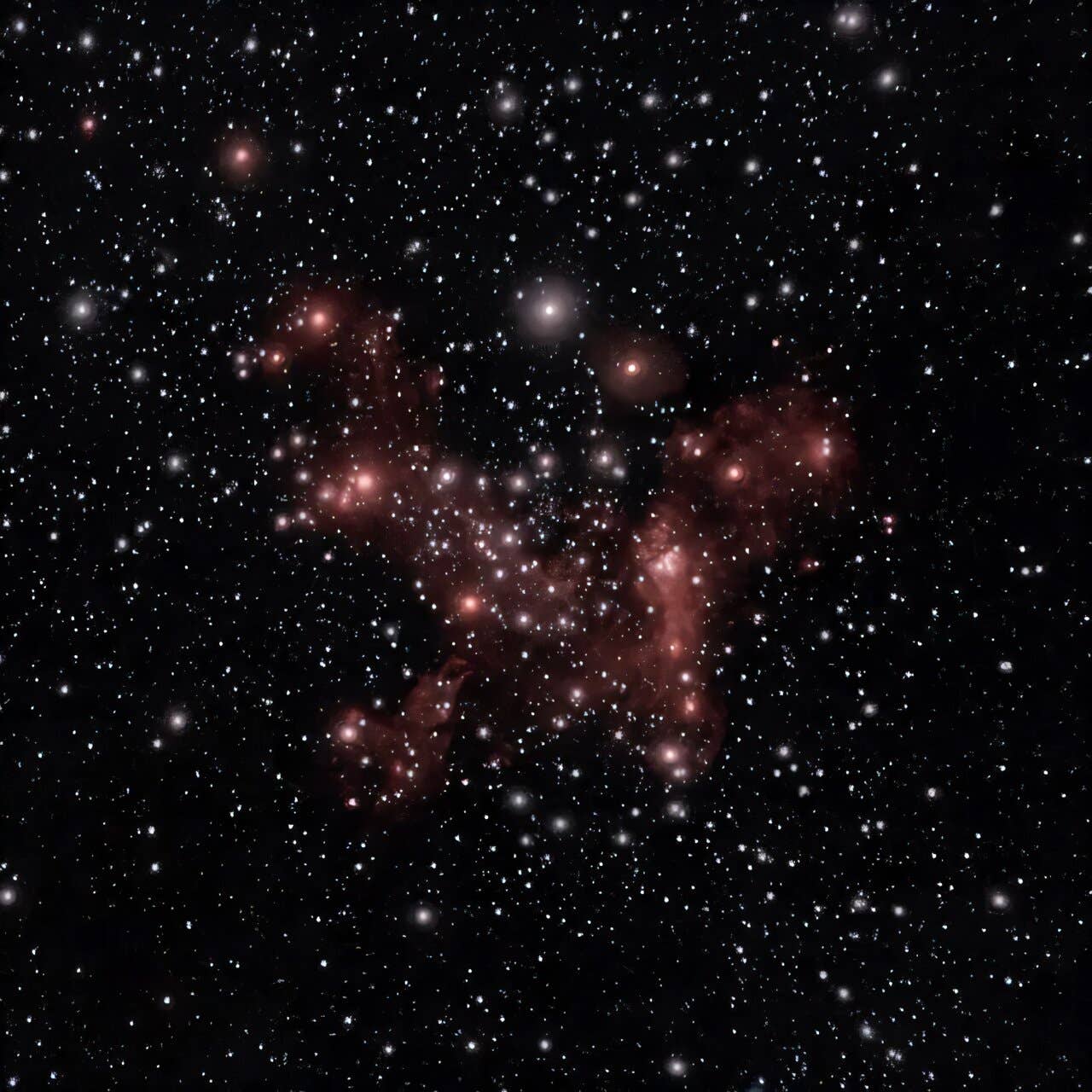
The picture shows the dynamic environment around the supermassive black hole at the Milky Way’s center, featuring the newly discovered gas cloud G2t alongside previously known clouds G1 and G2, whose similar orbits suggest a common origin from the star system IRS16SW. (CREDIT: ESO/D. Ribeiro for the MPE GC team)
A string of small gas clouds near the Milky Way’s central black hole has puzzled astronomers for years. Now, new observations suggest those clouds are not random scraps drifting through space. They appear to be part of a larger flow of material, and a massive binary star may be creating them.
At the center of the galaxy sits Sagittarius A*, or Sgr A*, a supermassive black hole surrounded by stars, gas, and dust moving through an extreme gravitational environment. Astronomers have long treated this region as a natural test site for watching how matter behaves near a black hole. One of the lingering mysteries has been a set of compact gas clumps found close to Sgr A* in infrared observations.
The first of those objects, called G2, was identified in 2012. It looked like a dusty, ionized gas cloud with hydrogen and helium emission, a temperature of about 600 kelvin, and a mass estimated at no more than about 3 Earth masses. It was also stretched out by gravity as it moved along a highly elongated orbit. This orbit carried it close to the black hole in 2014.
Later, astronomers realized G2 was not alone.
A growing chain of clouds
Earlier data revealed another object, G1, moving on a very similar path about 12 years ahead of G2. A faint tail behind G2 also appeared to trace the same general route. In the new work, a team of researchers from the Max Planck Institute for Extraterrestrial Physics in Germany report that this tail has now condensed into a third compact clump. Together, the objects form what the team calls the G1-2-3 streamer.
That matters because these clouds may help feed Sgr A*. The researchers note that the inward fall of a single clump with roughly one Earth mass every decade could be enough to sustain the black hole’s current activity. Figuring out where the clumps come from could therefore help explain how the black hole gets fresh material.
To investigate, the team used adaptive-optics-assisted infrared spectroscopy from the SINFONI and ERIS instruments. They focused on the hydrogen Brackett-γ emission line. Then they reconstructed the positions and velocities of G1, G2, and the new clump, called G2t in the paper.
What they found was striking. The three objects move on orbits with almost the same orientation and shape. The paper estimates that the chance of three unrelated objects lining up this way is about 2 × 10⁻⁶ for a 15-degree agreement in orbital plane and ellipse orientation. This is even before considering other similarities such as orbital phase and size. In other words, a random alignment is extremely unlikely.
Following the trail backward
Once the team treated the three clouds as members of one structure rather than separate curiosities, a source began to stand out: IRS 16SW, a massive contact binary star in the clockwise disk of young stars orbiting Sgr A*.
The researchers traced the gas streamer backward in both position and radial velocity and found that its path points toward IRS 16SW. The orbital differences among G1, G2, and G2t also seem to shift in a systematic way that matches the star’s own motion. In the combined fit, G2t’s closest approach to the black hole is predicted for mid-2031, 17.6 ± 0.3 years after G2’s pericenter passage. The angular change between G2 and G2t works out to 0.74 ± 0.07 degrees per year. This is essentially the same as the rate inferred between G1 and G2, and close to the estimated angular speed of IRS 16SW.
That synchronicity strengthens the case that the binary star is producing the clumps.
The study also argues against the idea that these objects are stars wrapped in gas. G2 only has an L-band counterpart and remains invisible in the K band. Its gas also appears tidally stretched. The authors say the observed gas cannot be gravitationally bound on the measured scale unless it were attached to an intermediate-mass black hole. However, other work has ruled that out at such small radii.
Simulations suggest how the clumps form
The observational case alone does not explain the physical mechanism, so the researchers turned to hydrodynamical simulations. Earlier work had struggled to reproduce G2 from a binary source under simple ballistic assumptions. This new study takes a different approach.
Instead of assuming the gas leaves the binary and simply coasts inward, the simulations examine what happens when the stellar wind interacts with the surrounding medium. If the wind from IRS 16SW is slow enough, the bow shock around the system becomes unstable and fragments into clumps and filaments. Some of that material then loses speed and gets directed onto more radial paths toward Sgr A*.
Using simulations of 30 mass-losing stars orbiting in the Galactic center, the team modeled IRS 16SW with wind speeds of 300, 400, and 600 kilometers per second. The 300 and 400 kilometer per second cases produced dense bow shocks that broke into clumps with masses on the same general scale as the observed objects. The 600 kilometer per second case did not. In the 300 kilometer per second run, the model produced about 20 clumps inside the inner arcsecond with masses above 3 Earth masses.
That result offers a possible formation route for the G1-2-3 streamer. It also fits the idea that gas formation may become more efficient when IRS 16SW nears its own pericenter. This is where the surrounding medium is denser.
Practical implications of the research
The study does not claim the case is closed. The authors say the exact formation process still needs more detailed work, especially because IRS 16SW was modeled as a single source rather than a true binary in the large-scale simulations. They also note uncertainty in how clumps are defined in the simulations and say future work will test how robust the result is to numerical method and resolution.
Still, the broad picture has become much sharper. A long-suspected gas streamer now appears to include a third compact clump. Both the observed orbital pattern and the simulations point back to the same star system.
This work gives astronomers a more specific idea of how Sagittarius A* may be fed. Instead of treating the black hole’s fuel supply as a diffuse, steady inflow, the study suggests that compact clumps from a massive binary star may deliver material in episodes.
That could help explain why Sgr A* varies over decades to centuries, and it gives researchers a concrete target to watch next: G2t, which is expected to swing close to the black hole in 2031.
Research findings are available online in the journal Astronomy & Astrophysics.
The original story "Massive binary star system may be feeding the Milky Way’s central black hole" is published in The Brighter Side of News.
Related Stories
- The Milky Way’s core may be dense dark matter, not a black hole
- Distant galaxy’s black hole offers extraordinary glimpse into the Milky Way's future
- Milky Way’s central black hole spins at nearly light speed, study finds
Like these kind of feel good stories? Get The Brighter Side of News' newsletter.
Joseph Shavit
Writer, Editor-At-Large and Publisher
Joseph Shavit, based in Los Angeles, is a seasoned science journalist, editor and co-founder of The Brighter Side of News, where he transforms complex discoveries into clear, engaging stories for general readers. With vast experience at major media companies like The Los Angeles Times, Times Mirror and Tribune Publishing, he writes with both authority and curiosity. His writing focuses on space science, planetary science, quantum mechanics, geology. Known for linking breakthroughs to real-world markets, he highlights how research transitions into products and industries that shape daily life.