Mississippi State physicist creates neutron star reaction in the lab
A direct measurement of a key reaction suggests neutron star bursts can keep building heavier elements.

 Edited By: Joseph Shavit

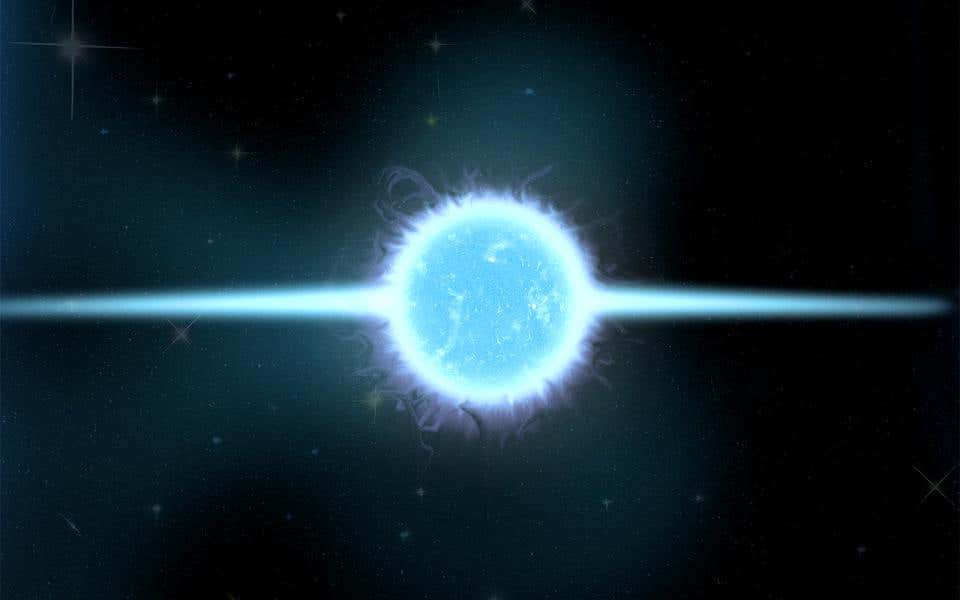
Direct lab data suggests neutron star X-ray bursts face a weaker element-building bottleneck than expected. (CREDIT: Jani Närhi / University of Helsinki)
For years, physicists have wondered whether one unstable form of copper might act like a traffic jam inside some of the most violent explosions in the universe.
That question matters because those explosions, called Type-I X-ray bursts, are part of the cosmic machinery that helps build heavier elements. Hydrogen and helium dominated the early universe. Much of what came later, including the oxygen in the air and the iron deep inside Earth, had to be forged in stars and stellar blasts.
Now, a team led by Mississippi State physicist Jaspreet Randhawa has directly measured a key nuclear reaction tied to that process. The result suggests the suspected slowdown is much weaker than scientists feared. Therefore, heavier elements have a clearer path to form during explosive bursts on neutron stars.
“The universe began almost entirely with hydrogen and helium,” Randhawa said. “Every heavier element, from the oxygen we breathe to the iron in Earth’s core, was forged later in stars and stellar explosions. By identifying how stellar explosions build heavier elements, scientists gain a clearer picture of how the elements that form planets and support life are distributed through the cosmos.”
The work marks the first direct laboratory measurement of this particular reaction under conditions relevant to the problem. Randhawa’s graduate student, Muhammad Asif Zubair, joined the study.
Where the reaction gets stuck
Neutron stars are what remain after massive stars explode. They are only about the size of a city, but they can pack in more mass than the sun. In some binary systems, a neutron star pulls material from a companion star. That stolen matter builds up under crushing pressure and searing heat until the surface ignites in a burst of X-rays.
Inside those outbursts, nuclear reactions can race forward and create heavier nuclei. Scientists have long suspected that one stage in this chain, involving copper-59, might trap the flow of matter in a repeating loop called the NiCu cycle.
The issue comes down to competition between two possible reactions. One route lets the chain keep moving toward heavier elements. The other sends the material back toward nickel-56, effectively recycling it and weakening the larger element-building process.
If that recycling path dominated, the production of heavier material in X-ray bursts could stall.
Copper-59 has made the question especially hard to answer. It decays in less than two minutes, leaving only a brief window to create it, accelerate it and measure what it does before it disappears.
“We wanted to know whether nature had a built-in roadblock that stopped heavier elements from forming during X-ray bursts on neutron star surfaces,” Randhawa said. “Our measurements show this roadblock is much weaker than expected, meaning the process that builds heavier elements can continue.”
A race against the clock in the lab
To make the measurement, the team carried out the experiment at TRIUMF in Canada, one of the few places able to produce a beam of copper-59 in useful amounts.
Researchers created a radioactive beam of copper-59, accelerated it and fired it into a frozen hydrogen target before the isotope decayed. The setup used a windowless solid hydrogen target cooled to about 4 kelvin. In addition, particle detectors downstream then sorted the reaction products, including alpha particles and protons. Separate measurements tracked target thickness and helped remove background from the silver foil backing.
The team collected data at two center-of-mass energies, 4.0 ± 0.4 MeV and 4.68 ± 0.25 MeV. From those runs, it extracted total cross sections of 0.28 ± 0.06 millibarns and 0.85 ± 0.21 millibarns.
Those values matter because they let the researchers calculate the rate of the copper-59 proton-alpha reaction with much tighter bounds than before.
Earlier studies had to rely heavily on theory. Reaction libraries had treated the uncertainty as enormous, sometimes by factors of 100 up and down. The new work cuts that uncertainty to about a factor of two.
That is a major shift for a problem that has lingered as one of the more stubborn nuclear-physics uncertainties in X-ray burst modeling.
What the new numbers change
The team found that the newly recommended reaction rate is about a factor of two lower than a commonly used statistical model prediction. Still, the upper limit from the data does not completely rule out that older prediction.
Even so, when the new result is compared with available estimates for the competing proton-gamma reaction, the picture becomes much clearer. Across the temperatures most relevant to X-ray bursts, the recycling strength of the NiCu cycle appears negligible, at 5% or less.
In plain terms, the feared bottleneck is not doing much blocking.
That has consequences beyond nuclear bookkeeping. The energy released by these reactions helps shape X-ray burst light curves, the brightness patterns astronomers observe with telescopes. Those light curves are used to test models of neutron stars, including efforts to pin down properties such as compactness and the mass-radius relationship.
To see what the new measurement changes, the researchers ran a one-zone X-ray burst model using ignition conditions tuned for the well-studied burster GS1826-24. When they varied the newly measured reaction rate within its tighter uncertainty range, the burst light curve did not change.
That result removes one major source of ambiguity from future comparisons between astrophysical models and observations.
It also sharpens predictions about the “ashes” left behind after bursts, the material that becomes part of the neutron star crust. Earlier sensitivity studies suggested that large swings in this reaction rate could alter the final composition of those ashes across several mass numbers. This experiment narrows that uncertainty. However, the researchers note that full multizone calculations were beyond the scope of the current study.
Why this matters beyond one isotope
This is not the kind of result that changes the night sky overnight.
What it does is make the physics underneath those distant explosions less fuzzy. The better scientists understand which reactions speed up, which ones stall and which ones barely matter, the better they can interpret what space telescopes are seeing when neutron stars flash.
That matters for two connected reasons. First, X-ray bursts are one of the few places where researchers can test models of matter under extreme conditions. Second, the reactions inside them are part of the broader story of where heavy elements come from.
This measurement does not answer every open question. It does not fully settle every reaction rate in the chain, and it does not replace the need for more detailed multizone simulations. But it does close off one long-standing possibility, that a strong NiCu cycle was choking off the path to heavier elements during these bursts.
That possibility now looks far less likely.
Practical implications of the research
The new measurement gives astrophysicists a much firmer value for a reaction that had carried very large uncertainty.
That should improve X-ray burst models, reduce one important source of error in comparisons with telescope data and help researchers make more reliable predictions about how neutron star crusts are built over time.
It also strengthens the case that element-building in these stellar explosions can keep moving past the copper region rather than being trapped in a recycling loop.
Research findings are available online in The Astrophysical Journal.
The original story "Mississippi State physicist creates neutron star reaction in the lab" is published in The Brighter Side of News.
Related Stories
- Astronomers discover the first neutron star–black hole merger with an eccentric orbit
- Gravitational waves finally reveal what's inside neutron stars
- Neutron 'starquake' discovery could revolutionize nuclear physics
Like these kind of feel good stories? Get The Brighter Side of News' newsletter.
Joshua Shavit
Writer and Editor
Joshua Shavit is a NorCal-based science and technology writer with a passion for exploring the breakthroughs shaping the future. As a co-founder of The Brighter Side of News, he focuses on positive and transformative advancements in technology, physics, engineering, robotics, and astronomy. Having published articles on AOL.com, MSN, Yahoo News, and Ground News, Joshua's work highlights the innovators behind the ideas, bringing readers closer to the people driving progress.