Scientists turn carbon dioxide into renewable methane using microbes
Researchers scaled up a reactor that converts carbon dioxide and renewable electricity into methane fuel efficiently.

 Edited By: Joseph Shavit

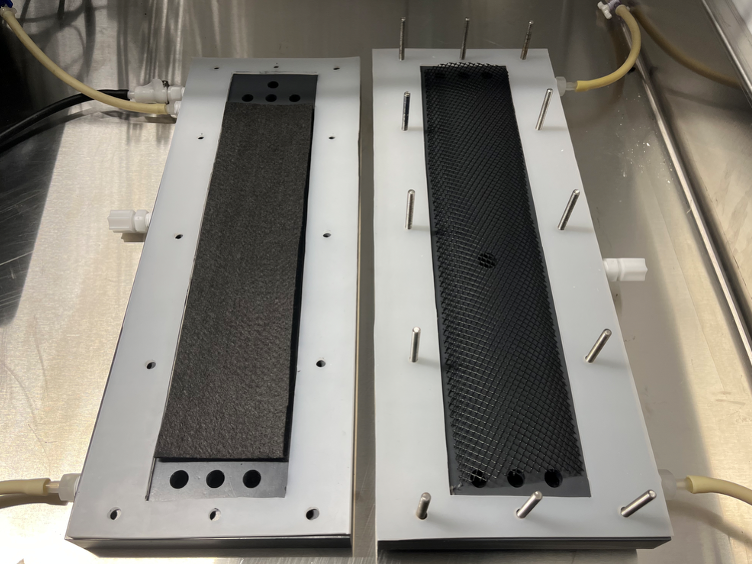
An internal view of the reactor system that efficiently converts carbon dioxide and renewable electricity into methane. (CREDIT: Bruce Logan)
As wind turbines spin and solar panels soak up sunlight, one major problem continues to shadow the clean energy transition: storing energy for long periods of time. Batteries can help for hours or even days, but seasonal storage remains far more difficult.
Researchers at Penn State now believe tiny microbes could help solve part of that challenge.
An international team led by Bruce Logan, director of Penn State’s Institute of Energy and the Environment, has developed a larger and more efficient reactor that converts carbon dioxide and renewable electricity into methane, the main component of natural gas. Their findings show that microbial electrosynthesis systems can scale up dramatically without losing performance.
The work offers a possible pathway for storing renewable energy in chemical form while reusing carbon dioxide that would otherwise enter the atmosphere.
“Traditionally, large-scale, long-term storage means pumping water uphill and letting it flow back down through turbines,” Logan said. “If you’re talking seasonal storage, you really need to put that energy into a chemical form.”
Turning Electricity Into Fuel
The system works by combining renewable electricity, water, microbes and carbon dioxide.
Electricity from solar or wind energy first splits water into hydrogen and oxygen. Microorganisms called methanogens then consume the hydrogen and combine it with carbon dioxide to produce methane.
That methane can later be stored or transported using existing natural gas pipelines and infrastructure.
“The big picture is that we can use low-cost renewable electricity to make methane that can go into existing storage and pipeline systems,” said Logan, Evan Pugh University Professor and Kappe Professor of Environmental Engineering.
Unlike fossil methane pulled from underground reserves, this process recycles carbon dioxide already circulating through industrial systems. Researchers say that could reduce emissions while helping stabilize renewable energy supplies.
Why Scaling Up Has Been Difficult
Microbial electrosynthesis, often called MES, has shown promise in laboratory experiments for years. But small lab systems do not always work at larger scales.
When reactors become larger, internal electrical resistance often increases. That lowers efficiency and weakens methane production. Larger systems can also struggle with uneven hydrogen distribution, which affects microbial growth and performance.
The Penn State-led team focused on redesigning the reactor itself.
Their new system uses what researchers call a “zero-gap” design. In this setup, the electrodes sit extremely close together and are separated only by a membrane. That shorter distance reduces resistance and improves energy transfer.
The researchers also expanded the reactor’s electrode area by roughly tenfold compared to earlier designs. The flow path stretched nearly a foot long, measuring 11.81 inches.
Despite the larger size, the system maintained strong efficiency.
“Even though we made the system much bigger, the internal resistance didn’t get worse,” Logan said. “That’s because we were able to use the hydrogen coming off the electrodes much more efficiently.”
High Methane Production With Strong Efficiency
The reactor operated at 30 degrees Celsius, or 86 degrees Fahrenheit, during laboratory testing.
At its best performance level, the system produced 6.9 liters of methane per liter of reactor volume each day. Researchers said this ranks among the highest methane production rates reported for microbial electrosynthesis systems under standard conditions.
The reactor also achieved coulombic efficiencies above 95%. That means nearly all electrical input became methane instead of unwanted byproducts.
Energy efficiency reached approximately 45% to 47%, another unusually high figure for this type of technology.
“We’re taking electricity and turning it into methane at an efficiency on the order of 45% to 47%,” Logan said. “Starting from carbon dioxide and electrons and upgrading that into methane, that’s pretty good.”
The study found that raising voltage sharply improved performance. At lower voltages, methane production remained modest because hydrogen supplies stayed limited. At higher voltages, dissolved hydrogen levels increased enough to sustain rapid microbial methane production.
Methane generation rose by more than 150% at the highest voltage range compared to the lowest setting tested.
Tiny Microbes Doing Heavy Work
One of the study’s biggest findings involved how methane actually forms inside the reactor.
Earlier theories suggested microbes might directly pull electrons from electrodes. But that process usually generates methane slowly.
Instead, the team showed that hydrogen acts as the critical middle step.
The reactor splits water to produce hydrogen gas. Methanogens immediately consume that hydrogen and rapidly convert carbon dioxide into methane.
“We split water to make hydrogen, and the methanogens are right there to use it immediately,” Logan said. “You can think of it as a water electrolyzer, which uses electricity to split water into hydrogen and oxygen, combined with a biological system.”
The dominant microbial group inside the reactor belonged to Methanobacterium, a hydrogen-consuming methanogen. Researchers found these microbes remained stable throughout the enlarged reactor, suggesting hydrogen spread evenly through the system.
That consistency matters because uneven hydrogen flow could weaken methane production in larger reactors.
Existing Infrastructure Could Help Adoption
One reason methane remains attractive is infrastructure.
Natural gas pipelines, underground storage systems and transport networks already exist across much of the world. Researchers say renewable methane could move through many of those same systems.
That could make large-scale storage easier than building entirely new infrastructure from scratch.
“I see methane generation plants built next to solar or wind farms,” Logan said. “Instead of putting electricity onto the grid, you use it on site to produce methane and inject that into gas lines.”
The technology may also help solve another renewable energy problem: wasted electricity.
Solar and wind farms sometimes generate more electricity than grids can use. In some regions, power prices even fall near zero during periods of oversupply. Researchers say excess electricity could instead feed methane production systems.
Economic and Environmental Questions Remain
The study also explored potential economics.
Electricity currently represents the largest operating expense in MES systems, accounting for as much as 69% of operating costs. But falling renewable energy prices could improve feasibility.
Using utility-scale solar power prices, researchers estimated methane production costs near $0.08 per kilowatt-hour under favorable conditions. That approaches the average U.S. residential natural gas price of roughly $0.09 per kilowatt-hour.
Still, several challenges remain before commercial deployment.
Researchers noted that improvements in catalyst materials and hydrogen generation efficiency will still be necessary. Methane leakage also remains a serious concern because methane is itself a potent greenhouse gas.
If systems leak significant amounts of methane, climate benefits could shrink or disappear.
The team emphasized that careful engineering and monitoring would be essential in future large-scale facilities.
A New Use For Carbon Dioxide
The broader vision behind the research extends beyond methane itself.
Scientists increasingly want technologies that treat carbon dioxide as a reusable resource rather than waste. Instead of only capturing emissions, researchers hope to transform them into fuels, chemicals or industrial products.
This reactor represents one example of that shift.
“We don’t need to dig methane out of the ground,” Logan said. “We can use carbon dioxide we’re already producing and turn it into something useful.”
For communities facing growing pressure to reduce emissions while maintaining reliable energy supplies, that idea carries emotional weight. It suggests waste carbon might someday become part of a cleaner energy cycle instead of remaining a symbol of environmental damage.
Practical Implications of the Research
This research could help renewable energy systems store electricity over much longer periods. Instead of losing excess solar or wind power, future facilities may convert that energy into methane for later use. That could strengthen energy reliability during seasons when sunlight or wind become less available.
The technology may also reduce dependence on fossil fuel extraction by recycling carbon dioxide into usable fuel. Because methane already moves through existing pipeline systems, communities may not need entirely new infrastructure to use renewable methane at scale.
For researchers, the study provides evidence that microbial electrosynthesis systems can expand beyond small laboratory devices without losing efficiency. That could accelerate future work on larger commercial systems and new reactor designs.
The findings also support broader carbon reuse strategies. Instead of treating carbon dioxide only as pollution, scientists may increasingly view it as a raw material for future energy production.
Research findings are available online in the journal Water Research.
The original story "Scientists turn carbon dioxide into renewable methane using microbes" is published in The Brighter Side of News.
Related Stories
- Mini lightning bolts help chemists turn methane into clean-burning fuel
- Methane-eating microbes turn greenhouse gas into fuel, food, and bioplastics
- Deepest Arctic methane seep found at 3,640 meters reveals thriving life
Like these kind of feel good stories? Get The Brighter Side of News' newsletter.
Joshua Shavit
Writer and Editor
Joshua Shavit is a NorCal-based science and technology writer with a passion for exploring the breakthroughs shaping the future. As a co-founder of The Brighter Side of News, he focuses on positive and transformative advancements in technology, physics, engineering, robotics, and astronomy. Having published articles on AOL.com, MSN, Yahoo News, and Ground News, Joshua's work highlights the innovators behind the ideas, bringing readers closer to the people driving progress.