Neanderthals began life more like humans than scientists thought
Rare Neanderthal infant bones and teeth suggest their earliest growth closely matched modern humans before later differences emerged.

 Edited By: Joseph Shavit

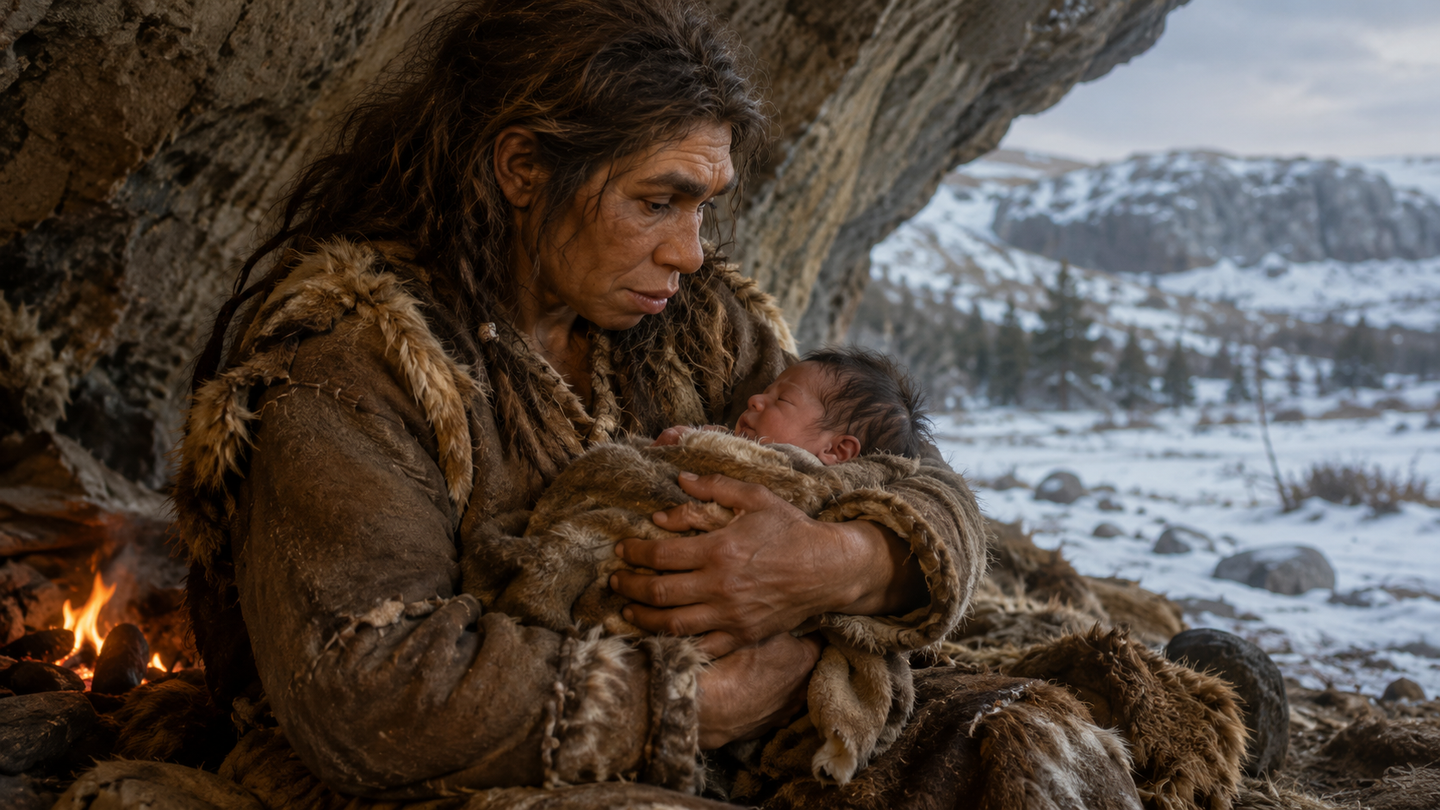
Rare Neanderthal infant fossils suggest prenatal growth was much like modern humans, while teeth reveal signs of early physiological stress. (CREDIT: Wikimedia / CC BY-SA 4.0)
Neanderthal babies have always been hard to study, mostly because their remains are so rare. That scarcity has left one of the oldest arguments in human origins unsettled: were Neanderthals following a fundamentally different developmental path from the start, or did the gap between them and modern humans open later?
A set of fragile bones and milk teeth from Sesselfelsgrotte cave in Lower Bavaria now pushes that debate in a clearer direction.
Using high-resolution micro-CT scans, an international team examined bone fragments from a Neanderthal fetus and two milk teeth from two young children who lived roughly 75,000 to 50,000 years ago. What they found suggests that, at least late in pregnancy, Neanderthals were developing in ways that looked remarkably familiar.
“Our results indicate that both human forms progressed through strikingly similar growth processes, at least during the later stages of pregnancy,” said Prof. Dr. Thorsten Uthmeier, Chair of Prehistoric Archaeology at Friedrich-Alexander-Universität Erlangen-Nürnberg.
The work adds weight to a broader point that has hovered over Neanderthal research for years. “Genetic analyses have demonstrated that Neanderthals and modern humans were closely related,” Uthmeier said. “Nevertheless, there is an intense debate about whether this genetic relatedness is sufficient for Neanderthals to be considered a subspecies of the species we belong to, Homo sapiens.”
A fetus at the edge of birth
The most revealing remains came from Sesselfelsgrotte 1, a collection of 12 bone fragments previously assigned to a Neanderthal near the time of birth. Earlier researchers had estimated an age of about eight months in fetal development. The new scans let the team look inside those bones without cutting into them.
Across the fragments, the internal structure matched a skeleton in a phase of very rapid growth. The bones showed high vascularity, immature tissue and patterns linked to fast formation in the final stretch of pregnancy. In modern humans, those same broad features appear in the last trimester, especially as birth approaches.
The researchers said the closest comparison was to modern human fetal bone from around 30 to 36 weeks of gestation. That does not mean the Neanderthal fetus was identical to a modern human fetus, but it does suggest the overall prenatal program was not radically different.
Some parts of the humerus and femur showed signs of slightly more advanced growth than expected in modern humans at the same stage. Even so, the authors argued that those differences do not overturn the bigger result. The basic developmental pattern still points to strong similarity, not separation.
That matters because adult Neanderthals were built differently. Their bodies were generally more robust, and earlier studies have suggested that some aspects of their skull and skeleton may have followed different growth trajectories after birth. This new analysis indicates those contrasts may not have been in place from the very beginning.
Clues inside tiny teeth
The study also turned to two deciduous molars, known as Sesselfelsgrotte 2 and 3. Both were heavily worn and incomplete, but micro-CT scanning revealed something unusual inside the dentine.
The teeth contained hypodense areas, or regions of reduced mineralization, consistent with interglobular dentine. In living people, that kind of defect can appear when mineral metabolism is disrupted during growth. Possible causes include vitamin D deficiency, calcium deficiency, poor calcium absorption, kidney problems, or other systemic stress. The researchers said it is impossible to pin down one exact cause in fossil teeth.
Still, the pattern did not look random. The defects appear to record a period of physiological difficulty before birth or in early childhood.
Because the timing cannot be fixed precisely, the team could only place the disturbance within a broad window. Based on how these milk molars form, the poorly mineralized dentine may have developed sometime from the third trimester through the middle of the second postnatal year.
That makes the teeth especially important. If the interpretation holds, the Sesselfelsgrotte finds may represent the oldest known evidence of such early developmental disorders in Neanderthals, and possibly the earliest evidence of metabolic bone disease in a non-anatomically modern human lineage.
Similar beginnings, later divergence
The broader lesson from the cave is not that Neanderthals and modern humans were the same. It is that the distance between them may have been smaller at the start of life than some researchers once thought.
The bone evidence supports earlier suggestions that Neanderthal and modern human infants shared comparable developmental trajectories at least through fetal life and perhaps into the first year or two after birth. Differences may have become more obvious later, as body shape, facial growth and skeletal robusticity continued to develop.
The team was careful not to overstate the case. The fossils are fragmentary, infant Neanderthal remains are exceedingly scarce, and some comparisons depend heavily on modern human reference material. The scans also had limits. They were detailed enough to reveal internal structure, but not enough to show some fine cellular features that destructive methods might have captured. The authors avoided more invasive analysis partly to preserve the fossils and limit damage to ancient DNA and proteins.
There are also unanswered questions about the site itself. Ongoing taphonomic work is trying to determine whether the fetal remains were deliberately buried, left exposed and later disturbed, or carried into the shelter by scavengers. Some outer bone surfaces show chemical changes consistent with carnivore activity, though the inner microstructure was still well preserved.
Even with those cautions, the picture that emerges is striking. Neanderthals may have grown into bodies that looked distinct from ours, but before birth their bones were following a developmental script much closer to modern humans than many would expect.
Practical implications of the research
This study sharpens one of the central questions in human evolution: when, exactly, Neanderthals began to diverge from modern humans in growth and biology.
By showing strong overlap in late prenatal development, it narrows the window in which major differences likely emerged.
It also shows how much information can still be pulled from extremely rare infant fossils using non-destructive imaging.
Just as important, the tooth evidence suggests that early-life physiological stress can be traced in Neanderthals much as it is in later human populations, opening a new path for studying health, nutrition and vulnerability in deep prehistory.
Research findings are available online in the journal Royal Society Open Science.
The original story "Neanderthals began life more like humans than scientists thought" is published in The Brighter Side of News.
Related Stories
- Neanderthals practiced dental care 59,000 years ago
- Humans and Neanderthals share ancient DNA linked to human language
- Neanderthal males preferred human females, genetic study finds
Like these kind of feel good stories? Get The Brighter Side of News' newsletter.
Rebecca Shavit
Writer
Based in Los Angeles, Rebecca Shavit is a dedicated science and technology journalist who writes for The Brighter Side of News, an online publication committed to highlighting positive and transformative stories from around the world. Having published articles on MSN, AOL News, and Yahoo News, Rebecca's reporting spans a wide range of topics, from cutting-edge medical breakthroughs to historical discoveries and innovations. With a keen ability to translate complex concepts into engaging and accessible stories, she makes science and innovation relatable to a broad audience.