UCLA engineers build a ‘lying mirror’ that displays a fake reflected image
A deep-learning-designed optical surface can turn unseen objects, colors, and distorted inputs into one predetermined reflected image.

 Edited By: Joseph Shavit


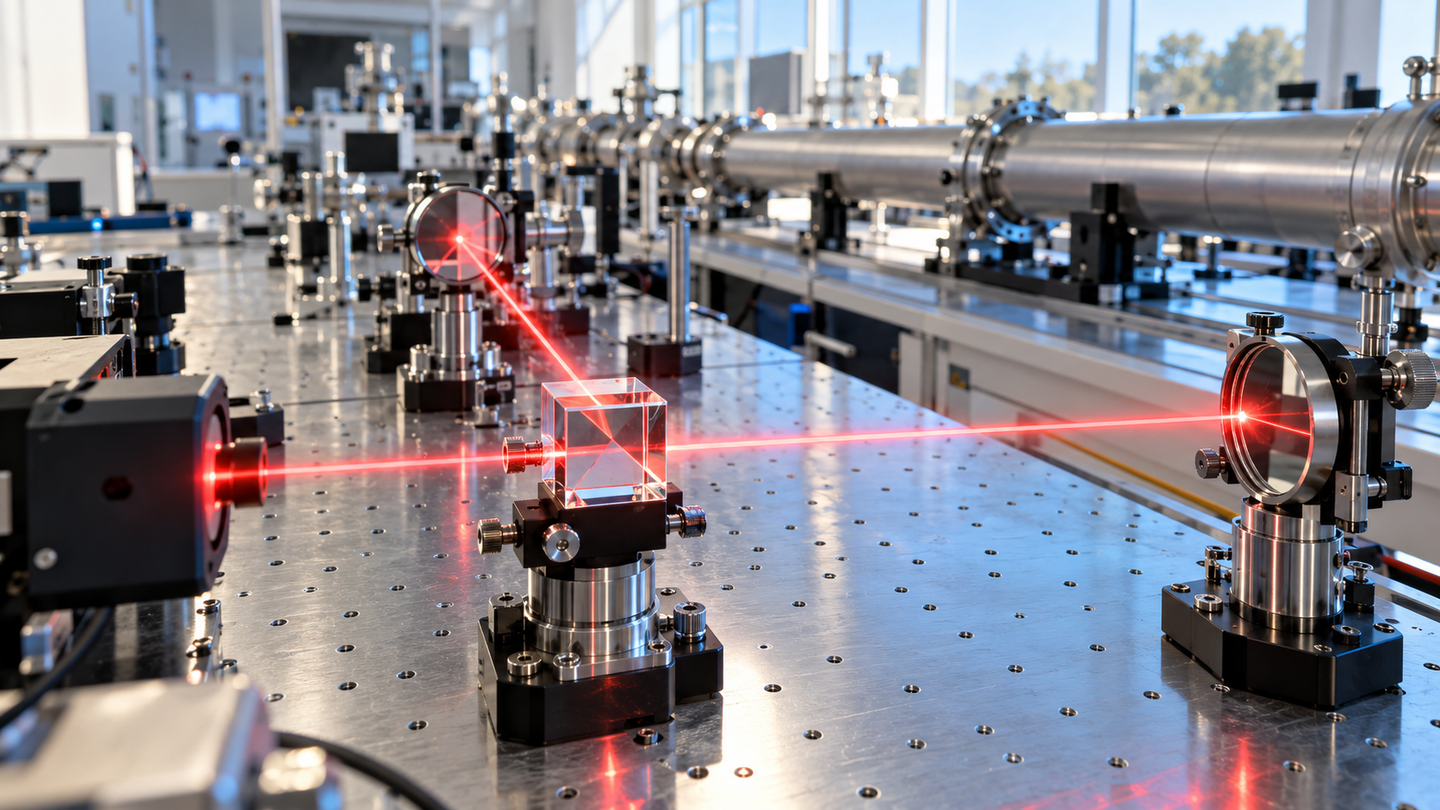
UCLA’s lying mirror optical technology uses structured light to replace many different input images with the same deceptive output. (CREDIT: Shutterstock)
- UCLA engineers built a “lying mirror” that can replace many different reflected images with the same misleading picture using light alone.
- A deep-learning-designed surface redirects incoming light so unseen objects, shifted images, noise, and several visible wavelengths can still produce a chosen decoy.
- The technology remains a laboratory proof of concept, but researchers say it could support future security, defense, anti-surveillance, and entertainment uses.
Mirrors are supposed to return whatever stands before them. A new optical device does something far stranger: it can take many different objects and make their reflected light appear as the same unrelated image.
Engineers at the University of California, Los Angeles have developed what they call a “lying mirror,” an optical system that conceals visual information instead of simply reflecting or distorting it.
Unlike a digital display, the device does not need a computer to alter each incoming image. Deep learning is used during the design process to determine how the structured surface should manipulate light. Once that surface has been created, the transformation occurs optically through diffraction.
“Instead of simply distorting a reflection, the lying mirror is designed to optically replace the visual information carried by many different, unknown inputs with a predefined deceptive pattern,” said UCLA professor Aydogan Ozcan. “This illustrates how a passive structured surface can perform sophisticated visual information processing directly through structured light matter interactions.”
One surface turns many objects into the same image
The system uses tiny phase-modulating features that change how incoming light waves propagate and interfere. One numerical design contained 120 by 120 features, each roughly half the illumination wavelength across.
The goal is not to recognize an object and then select a matching stored response. Instead, one optimized optical surface converts many possible inputs into the same predetermined “dummy” image.
In simulations, the team developed separate mirrors using Fashion-MNIST, MNIST, and QuickDraw image datasets. One transformed images of clothing, backpacks, and shoes into a bag. Another converted handwritten numbers into the digit 8. A third turned drawings into another chosen target pattern.
Tests used images that had never appeared during training. Correlation scores between the desired and produced outputs reached 0.97, 0.97, and 0.95 across the three models.
The engineers then pushed the mirrors beyond the types of images used to design them. A model trained with Fashion-MNIST was tested with MNIST, QuickDraw, and ImageNet images.
Its average correlation scores were 0.84, 0.85, and 0.92, respectively. Although performance declined compared with tests involving the original image distribution, the device still produced the intended deceptive output.
Rotated and noisy inputs still disappeared
Generalization was only part of the challenge. Real images can shift position, change size, rotate, or contain noise.
The team tested one lying mirror with randomly rotated, shifted, and scaled objects. Average correlation values remained 0.95 for rotation, 0.90 for shifting, and 0.94 for scaling.
Adding Gaussian noise lowered image quality, especially at the higher tested noise level. Even then, the mirror continued transforming the original images into recognizable dummy outputs.
Input structure also mattered. The engineers found that performance generally improved as more pixels within an input image became active. Structured images performed better than random noise patterns, suggesting that information density helps the optical surface carry out its concealment task.
The researchers also examined a more compact design that placed the diffractive structure directly onto the reflective surface. That version removed the gap between the optical layer and mirror, simplifying alignment and assembly.
It came with a trade-off. Correlation scores fell to 0.87, 0.84, and 0.79 across the three datasets. The original separated design performed better because light traveled through the optimized layer twice with an axial gap between the components.
A real mirror turns handwritten digits into an 8
The team moved beyond computer modeling with a visible-light laboratory demonstration. Their experimental system used a programmable array of tiny mirrors to perform the optical transformation.
Ten handwritten digit images that had not been included in training were selected for testing. Under illumination at 480, 550, and 600 nanometers, corresponding to blue, green, and red channels, every input was transformed into the same handwritten digit 8.
The wavelengths were tested separately and simultaneously. Both approaches produced the intended decoy.
A second experimental design expanded operation beyond three selected colors. That mirror was trained across a continuous wavelength range from 520 to 570 nanometers and then tested between 500 and 600 nanometers.
Output correlation remained above 0.85 throughout that broader tested spectrum, including wavelengths outside the training range. Ten additional handwritten-number inputs were also successfully transformed into the digit 8 across those wavelengths.
“Our paper demonstrates significant results by moving beyond single-wavelength simulations to experimental validation using multi-wavelength RGB (red/green/blue) channels and a broadband design,” Ozcan said.
Laboratory control remains a major obstacle
The proof of concept still operates under carefully controlled conditions. The main experimental results relied on coherent illumination and precisely arranged optical components.
“However, it still largely relies on a tightly controlled optical setup in a lab setting (using micro-mirror arrays and precise beam alignment) rather than a plug-and-play device you can hang on a living room wall,” Ozcan said.
The researchers modeled versions that work with partially coherent illumination, showing that the approach could also conceal images under less controlled light conditions. They also tested viewing-angle tolerance.
A design trained only at a zero-degree viewing angle remained effective at plus or minus 5 degrees. Mean peak signal-to-noise ratio decreased about 8.2 percent, while mean correlation fell roughly 1.6 percent compared with the original viewing angle.
Another limitation involves security itself. A digital neural network trained on paired input and output images could eventually reconstruct concealed information. With 500 examples, finer details began to emerge. With about 10,000 training pairs, the network produced high-quality reconstructions of the original inputs.
Practical implications of the research
The lying mirror offers a way to process visual information directly through light instead of performing the transformation electronically after an image has been captured.
That distinction could matter wherever compact optical concealment is useful. The UCLA team identifies security, defense, camouflage, anti-surveillance technologies, experimental psychology, and entertainment as possible areas for further development.
The work also shows how learned diffractive surfaces can perform the same transformation across different objects, image perturbations, wavelengths, and viewing angles. Future designs could incorporate incoherent illumination and more complex optical structures to broaden operating conditions.
For now, the device remains a controlled laboratory demonstration rather than an ordinary mirror capable of disguising objects under everyday lighting. Its central achievement is more fundamental: a passive optical structure can be designed to replace incoming visual information with a deliberately misleading picture before digital image processing ever begins.
Dig deeper into diffractive optical computing and structured light
These resources explore how engineered optical surfaces can process information, manipulate light, operate under less controlled illumination, and create deceptive or camouflage effects across multiple wavelengths.
Diffractive Optical Neural Networks: Pathways Toward Intelligent and Scalable Photonic Computing
This recent review examines how diffractive optical neural networks use engineered surfaces and light propagation to perform computation, tracing their development from free-space systems toward compact and scalable photonic hardware. (Nanophotonics, 2026)
High-capacity directional information processor using all-optical multilayered neural networks
Researchers developed a directional diffractive neural network that encodes light-propagation direction into optical processing, expanding the amount and type of information that passive multilayer optical systems can manipulate. (Science Advances, 2025)
Structured light meets machine intelligence
This comprehensive review explains how machine learning and optical neural networks can recognize, transform, sort, and process structured light, including systems built from phase masks, spatial light modulators, and metasurfaces. (eLight, 2025)
Digital camouflage encompassing optical hyperspectra and thermal infrared-terahertz-microwave tri-bands
This research demonstrates camouflage spanning visible, infrared, terahertz, and microwave regions, showing how engineered optical responses can imitate environmental signals across multiple detection systems rather than relying on visible appearance alone. (Nature Communications, 2025)
Partially coherent diffractive optical neural network
The authors developed and experimentally tested a diffractive optical neural network designed for partially coherent visible light, addressing an important challenge for optical processors that must function beyond highly controlled coherent illumination. (Optica, 2024)
Research findings are available online in the journal Nature Communications.
The original story "UCLA engineers build a 'lying mirror' that displays a fake reflected image" is published in The Brighter Side of News.
Related Stories
- Researchers analyze 25 billion neutrons and find that they don’t disappear into a mirror world
- FCC approves giant space mirror as astronomers warn of risks to the night sky
- Mirror universe where time runs backwards could help explain dark matter, antimatter and neutrinos
Like these kind of feel good stories? Get The Brighter Side of News' newsletter.
Joshua Shavit
Writer and Editor
Joshua Shavit is a NorCal-based science and technology writer with a passion for exploring the breakthroughs shaping the future. As a co-founder of The Brighter Side of News, he focuses on positive and transformative advancements in technology, physics, engineering, robotics, and astronomy. Having published articles on AOL.com, MSN, Yahoo News, and Ground News, Joshua's work highlights the innovators behind the ideas, bringing readers closer to the people driving progress.