New AI system identifies 102 brain tumor types in minutes instead of weeks
Hetairos uses standard tissue slides to predict brain tumor subtypes quickly, helping pathologists narrow diagnoses faster.

 Edited By: Joseph Shavit

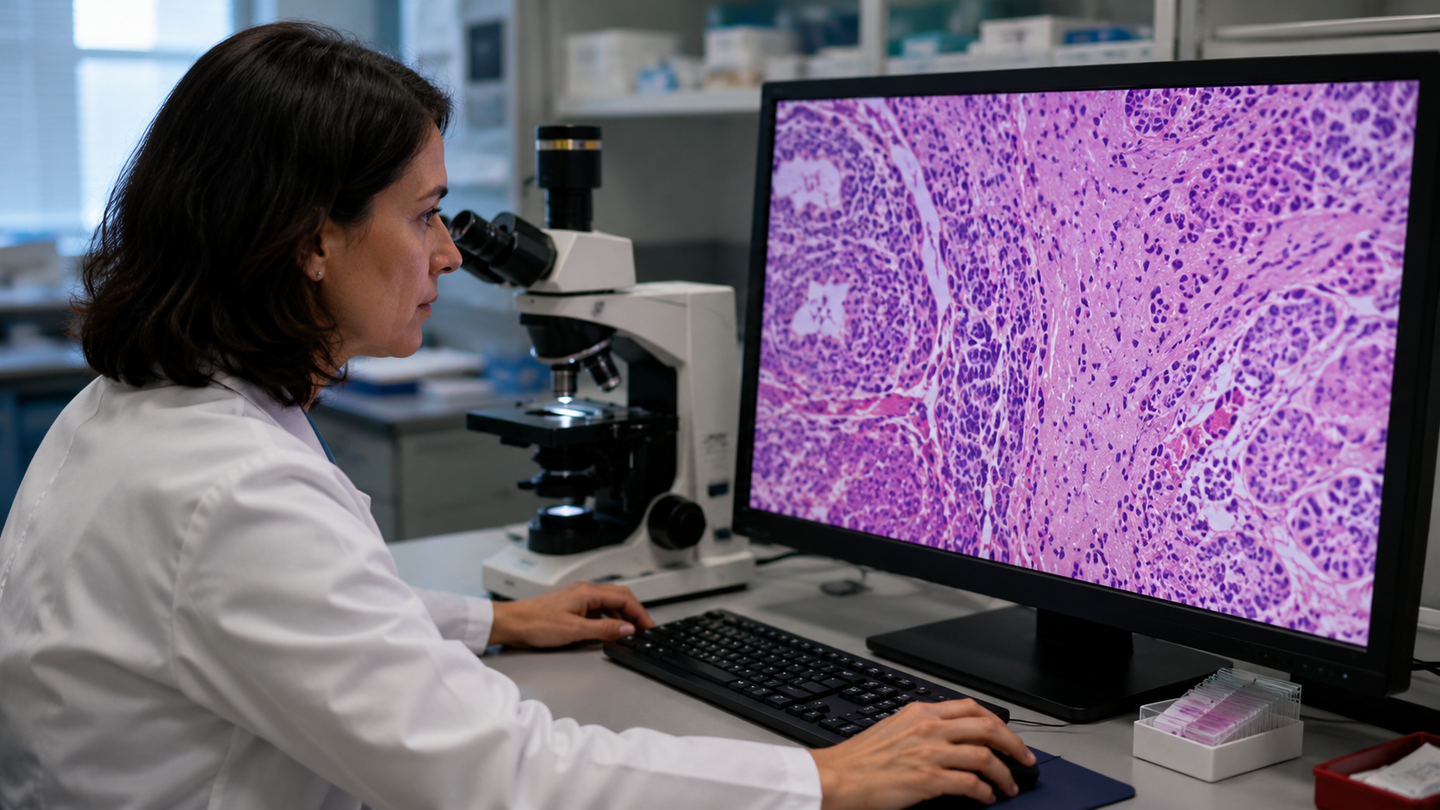
AI system Hetairos classifies 102 brain tumor subtypes from routine slides in minutes, offering faster support for diagnosis. (CREDIT: Wikimedia / CC BY-SA 4.0)
Brain tumors have long forced pathologists into a difficult balancing act. Under the microscope, many look alike at first glance. However, small molecular differences can separate a relatively manageable disease from one that demands urgent, aggressive treatment. Getting that distinction right often depends on specialized testing that can take days and costs hundreds of euros. Unfortunately, this kind of testing is still out of reach in many parts of the world.
A team in Heidelberg says it has built an artificial intelligence system that could sharply shorten that wait.
The system, called Hetairos, was designed to read routine hematoxylin and eosin, or H&E, tissue sections. These are the standard stained slides used in pathology labs worldwide. From those digitized slides alone, it predicts which molecular subgroup a central nervous system tumor belongs to. This covers 102 tumor subtypes drawn from the current World Health Organization classification.
That matters because brain and spinal cord tumors are not a single disease. They are a sprawling family of cancers and related growths with striking biological diversity. In recent years, DNA methylation profiling has become one of the most important tools for sorting them accurately. It can reveal tumor identities that are not obvious from shape and staining alone. In some cases, it is essential to reaching the right diagnosis.
But methylation testing has drawbacks. It needs specialized equipment, specialized labs, and enough tumor material to run the analysis. It also tends to take about two weeks. In the new prospective clinical evaluation, the average time from receiving a neurosurgical specimen to an integrated diagnosis was 12 days. For cases requiring molecular testing, it took about 16 days.
Hetairos worked much faster. Once a slide had been scanned, the system took an average of 12 minutes to process it and generate a report on standard computer hardware. Including staining, fixation, and digitization, results were usually available within 24 hours to two days.
Reading what routine slides cannot easily reveal
The model was trained and evaluated on more than 11,000 digitized tissue sections from 9,606 patients. These were collected at 11 institutions across four continents. The researchers used paired molecular diagnoses, primarily based on DNA methylation profiling, as the reference standard. From that material, the team trained Hetairos to recognize 102 diagnostically relevant subtypes and 34 broader tumor superfamilies.
In internal validation, Hetairos’s top prediction matched the methylation-based class in 75 percent of tumors. When the three most likely predictions were considered together, accuracy rose to 87 percent.
The system’s confidence turned out to be central to how useful it was. Hetairos marked cases as high confidence when its probability score exceeded 0.5. Those high-confidence cases made up 70 percent of the internal validation set. Within that group, the top prediction was correct 88 percent of the time. On the other hand, in lower-confidence cases, top-1 accuracy dropped to 46 percent. Yet the correct answer was still among the top three predictions in 71 percent of tumors.
That means the system does not always hand over a single answer, but it can often shrink a long, intimidating list of possibilities into a short, workable one. For a neuropathologist deciding what test to order next, that narrowing could be valuable on its own.
“The study shows that artificial intelligence is capable of deriving molecular information directly from routine tissue sections and thus fundamentally changing cancer diagnostics,” said Darui Jin, one of the lead authors.
A stronger showing than specialists on slides alone
The researchers also tested Hetairos against five experienced neuropathologists in a blinded comparison using 210 cases. Each specialist had to rank diagnoses from the same list of 102 molecular subtypes, based only on the H&E slides.
Hetairos was far more accurate in that setting. Its top choice was correct in 68 percent of cases, compared with an average of 30 percent for the specialists. When the top three guesses were counted, Hetairos reached 84 percent, while the neuropathologists averaged about 50 percent.
“The results show that modern AI systems are now capable of recognizing extremely subtle morphological patterns that are difficult even for experienced specialists to distinguish,” said Felix Sahm of Heidelberg University and Heidelberg University Hospital.
The margin narrowed for the rarest tumor types. For subtypes with fewer than ten cases in the training set, human specialists performed about as well as the model. The paper notes that diagnoses such as metastatic melanoma and teratoma were still difficult for Hetairos. That weakness reflects a broader limitation: rare tumors remain hard to classify when the training data are sparse.
“Currently, the diagnosis of very rare tumor types still poses a major challenge for Hetairos; in this regard, experienced neuropathologists appear to be at least on par. However, we expect the system’s performance to improve even further with larger and more diverse datasets,” said Moritz Gerstung of the German Cancer Research Center.
Faster help in difficult cases
The system was not built to replace molecular testing. Its role is closer to that of a guide, or as the name suggests, a companion.
In routine practice, pathologists often begin with H&E slides, then add immunohistochemistry and, if needed, more advanced molecular methods. Roughly 30 percent of cases cannot be fully resolved without additional molecular testing. Some also fail because there is not enough material, a common problem in small stereotactic biopsies.
That is where Hetairos may be most useful. In 96 specimens where methylation analysis could not be performed because tissue was limited, the model correctly predicted 76 cases. In another cohort of 50 samples diagnosed only through a combination of molecular assays after methylation testing failed to give a clear answer, Hetairos correctly predicted 27.
The system also highlights the regions of a tissue section that were most important to its decision. Those maps do not make the diagnosis for a doctor, but they can show which parts of a specimen carry the most informative morphology. These may be the best areas for additional testing.
“We developed Hetairos primarily as a tool to support diagnostics,” Sahm said. “It is not intended to replace molecular analyses, but rather to specifically complement and accelerate them. The technology could make an important contribution, particularly in countries or regions with limited resources, as it is based on standard tissue sections used worldwide.”
A step toward wider access
The study also points to cost. DNA methylation analysis is estimated at about €400 per case. Running Hetairos, the authors estimate, costs about €1 to €2 per case. However, it still depends on access to digital slide scanning.
Even so, scanners are more widely available than the infrastructure needed for methylation profiling. The authors suggest future versions may even work with images captured using smartphone adapters on basic microscopes.
The broader promise is not just speed. It is access. In places where molecular testing is unavailable or delayed, a reliable first-pass system based on ordinary stained slides could help doctors reach better-informed decisions sooner.
“Hetairos demonstrates the enormous potential of AI-supported digital pathology to provide rapid and widely available diagnostic methods that were previously only possible with considerable technical effort,” Gerstung said.
Practical implications of the research
If the system performs as reported in broader real-world use, it could change how brain tumors are worked up in pathology labs. In well-resourced centers, Hetairos could help triage cases and shorten the path to treatment. Molecular testing, which is more expensive, could then be reserved for the tumors that most need it.
In lower-resource settings, it could offer a practical way to extract far more diagnostic value from slides that are already part of routine care.
Its biggest immediate role may be as a decision-support tool, one that speeds difficult cases and flags uncertainty honestly. It also gives doctors a narrower, more useful set of possibilities when molecular answers are delayed, inconclusive, or impossible to obtain.
Research findings are available online in the journal Nature Cancer.
The original story "New AI system identifies 102 brain tumor types in minutes instead of weeks" is published in The Brighter Side of News.
Related Stories
- New drug combination boosts life expectancy from grade 3 brain tumors by 45% or more
- AI tool predicts brain tumors before surgery with near-perfect precision
- AI breakthrough detects brain tumors the size of a pinhead with 97% accuracy
Like these kind of feel good stories? Get The Brighter Side of News' newsletter.
Shy Cohen
Writer