New class of planet with a permanent magma ocean found 35 light-years away
In a distant part of our cosmos, an intriguing new world exists. This newly discovered exoplanet, identified as L 98-59 d, seems to play host to a rare type of…

 Edited By: Joseph Shavit

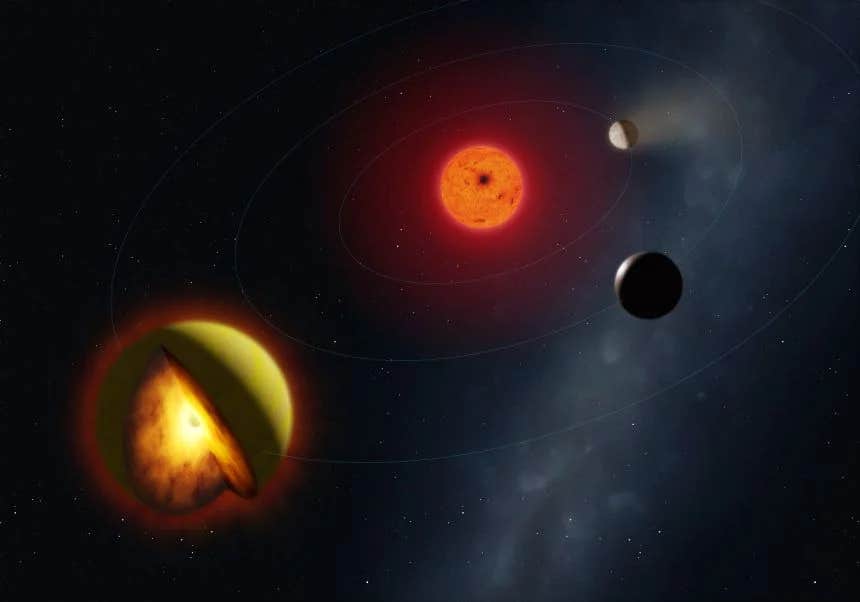
An artist’s impression of L 98-59 d. (CREDIT: Mark A. Garlick / markgarlick.com)
In a distant part of our cosmos, an intriguing new world exists. This newly discovered exoplanet, identified as L 98-59 d, seems to play host to a rare type of planetary environment. While many small planets orbiting distant stars are categorized as either gas dwarfs or ocean worlds, this one has been classified as something different.
L 98-59 d is roughly 1.5 times larger than Earth's diameter. Unlike most planets of this size discovered by astronomers to date, L 98-59 d appears to be a very active and dynamic body. It likely sits atop an extremely extensive molten lava ocean, estimated to be hundreds of miles deep. The lava ocean continually supplies and removes sulfur from the atmosphere of L 98-59 d and ultimately contributes to a sulfur-rich atmosphere.
Astronomers studying exoplanets typically consider two scenarios when examining small planets. The first is a gas dwarf with a hydrogen atmosphere surrounding a rocky core. The second is a water world made primarily of liquid water and ice. However, the existence of an active molten lava ocean on L 98-59 d presents a unique case that does not fit either classification.
It also makes L 98-59 d distinct from other small planet forms currently known to astronomers and provides a significant opportunity to develop a new classification for such objects based on how they are defined.
Unusual Density And Atmospheric Composition
The planet has an unusually low bulk density for its size. This, combined with its atmospheric composition, suggests that it cannot simply be explained as being made of rock and iron. Analyzing the planet's atmosphere indicates that hydrogen and/or water were probable components, but they are not necessarily definitive of its composition.
In April 2024, the James Webb Space Telescope observed gases containing sulfur in the planet's upper atmosphere. These gases included hydrogen sulfide and sulfur dioxide. The combination of low density and the presence of sulfur therefore does not correspond to a well-established framework for understanding planets.
Lead author of the study, Harrison Nicholls of University of Oxford Department of Physics, commented: “The discovery of this unusual planet indicates that our existing categorizations of small planets may be overly simplistic. Although this planet has minimal potential for supporting life, it demonstrates the vast diversity of planets that exist outside of our solar system.”
The research team also developed models that enabled them to retrace the history of the planet by conducting many different calculations. Through these simulations, the research team created 900 models of possible scenarios for how the planet formed and developed over the course of nearly 5 billion years.
Modeling The Planet’s Formation
In every scenario studied by the research team, the models indicated that the planet formed from an excess of volatiles, meaning gas. It had significantly more than 100 times the estimated volume of hydrogen in the early Earth's mantle at the time of its formation.
Subsequently, due to extreme X-ray radiation emitted from the host star, L 98-59, the majority of the original gaseous material was lost. The remaining material consists of an atmosphere rich in hydrogen, with sulfur being the most prevalent element.
Sulfur’s abundance is primarily due to the presence of the large magma ocean that lies beneath the crust of the planet. The mineral sulfur readily dissolves into molten silicate rock, which is the main ingredient for lava found on Earth.
The interior has also maintained its molten state throughout time. This allows the large amount of sulfur in this reservoir to remain trapped and be released slowly over the course of geological history rather than being lost to space. In contrast, hydrogen is much lighter. As such, it escapes into space much more readily than sulfur. Over time, the sulfur signature of this planet has therefore become more concentrated.
Chemical Processes In The Atmosphere
In addition to sulfur produced through chemical processes caused by the dissociation, or splitting, of water molecules by ultraviolet light from the host star, sulfur dioxide is also found at the highest altitudes of the atmosphere. This occurs because chemical reactions in the atmosphere produce additional sulfur compounds.
On Earth, the production of sulfur dioxide can be traced back to sulfur trapped deep within the planet by the magma ocean and released through volcanic processes. On L 98-59 d, however, sulfur compounds can also form high in the atmosphere where they are shaped by the energy of the planet’s sunlight.
“We are able to use computer simulations to investigate the internal structure of worlds we will never visit,” said co-author Raymond Pierrehumbert from the University of Oxford Department of Physics. Researchers can then use this information to reveal the nature of many types of planets that exist outside the Solar System.
Another researcher emphasized an unusual aspect of the planet’s chemistry. Richard Chatterjee from the University of Leeds noted, “Hydrogen sulfide gas, which has the smell of rotting eggs, appears likely to play a major role here. Future exploration will likely reveal that planets with this pungent odor are quite common.”
A Possible New Planetary Category
This possibility carries more weight than it initially seems. The models indicate that L 98-59 d is likely the first member of a broader group of planets that are predominantly sulfurous and that possess liquid magma oceans lasting millions of years.
If such worlds exist elsewhere, the models suggest that the conditions required for the formation of L 98-59 d are not particularly exotic. As a result, astronomers may need to reconsider how certain planets are classified and how their formation processes are understood.
Currently, L 98-59 d is situated within what astronomers refer to as the “radius valley.” This is a gap in the distribution of known exoplanets based on their size.
Within this region lies a boundary separating smaller rocky planets from larger planets that retain thick atmospheres. L 98-59 d occupies that boundary and offers a unique perspective.
It has an overall size that classifies it as a super-Earth. However, its density indicates that it must possess a significant gaseous atmospheric component. Models therefore suggest that it may once have resembled a larger sub-Neptune millions or billions of years ago. Over time it likely lost much of its atmosphere.
What Magma Oceans Teach Us
There is another reason this discovery is important beyond cataloguing the chemistry of alien worlds. All planets formed at some stage of their history in a molten state. This includes rocky planets such as Earth and Mars.
As these planets cooled, their molten oceans gradually solidified. During this process they began to develop gaseous atmospheres, which became the foundation for later planetary evolution.
L 98-59 d is unique among the analyzed exoplanets because it appears to have maintained its molten state for billions of years. In doing so, it continues to experience processes similar to those that Earth experienced during its early formation.
This provides scientists with an opportunity to study planetary conditions that cannot be directly observed within our own Solar System today.
Practical Implications
Currently, the research group intends to apply the simulation framework used in this study to future data obtained from upcoming space observatories. These include missions such as Ariel and PLATO.
They also plan to use machine-learning techniques to identify potential candidates that may belong to this newly proposed class of planets. Some sulfur-rich magma-ocean worlds may already exist in observational datasets but remain unclassified because astronomers lacked a framework to identify them.
Identifying a new classification of planetary bodies has important implications for how astronomers interpret the growing amount of atmospheric data generated by space missions. Instruments like the James Webb Space Telescope are providing increasingly detailed measurements of distant planetary systems.
If planets are placed into the wrong categories, scientists may produce misleading models about their composition, habitability, or origins. A clearer classification framework helps avoid those errors.
Recognizing sulfur-rich magma-ocean planets as a distinct category also helps researchers analyze ambiguous cases. This is especially true for moderate-density exoplanets located within the radius valley.
The discovery highlights an important principle in planetary science. The chemical characteristics of a planet’s atmosphere are closely linked to the chemical properties of its interior. Understanding both together allows scientists to better interpret the nature of distant worlds.
Research findings are available online in the journal Nature Astronomy.
The original story "New class of planet with a permanent magma ocean found 35 light-years away" is published in The Brighter Side of News.
Related Stories
- JWST solves a longstanding mystery of giant planet formation
- Deep magma oceans generate magnetic fields to protect planets and support life
- Oceans in the fire: How magma and hydrogen forge massive quantities of planetary water
Like these kind of feel good stories? Get The Brighter Side of News' newsletter.
Joshua Shavit
Writer and Editor
Joshua Shavit is a NorCal-based science and technology writer with a passion for exploring the breakthroughs shaping the future. As a co-founder of The Brighter Side of News, he focuses on positive and transformative advancements in technology, physics, engineering, robotics, and astronomy. Joshua's work highlights the innovators behind the ideas, bringing readers closer to the people driving progress.