New discovery reveals how the Moon’s largest and oldest crater formed
New lunar models suggest South Pole-Aitken ejecta may have carried deep mantle material into Artemis exploration zones.

 Edited By: Joshua Shavit

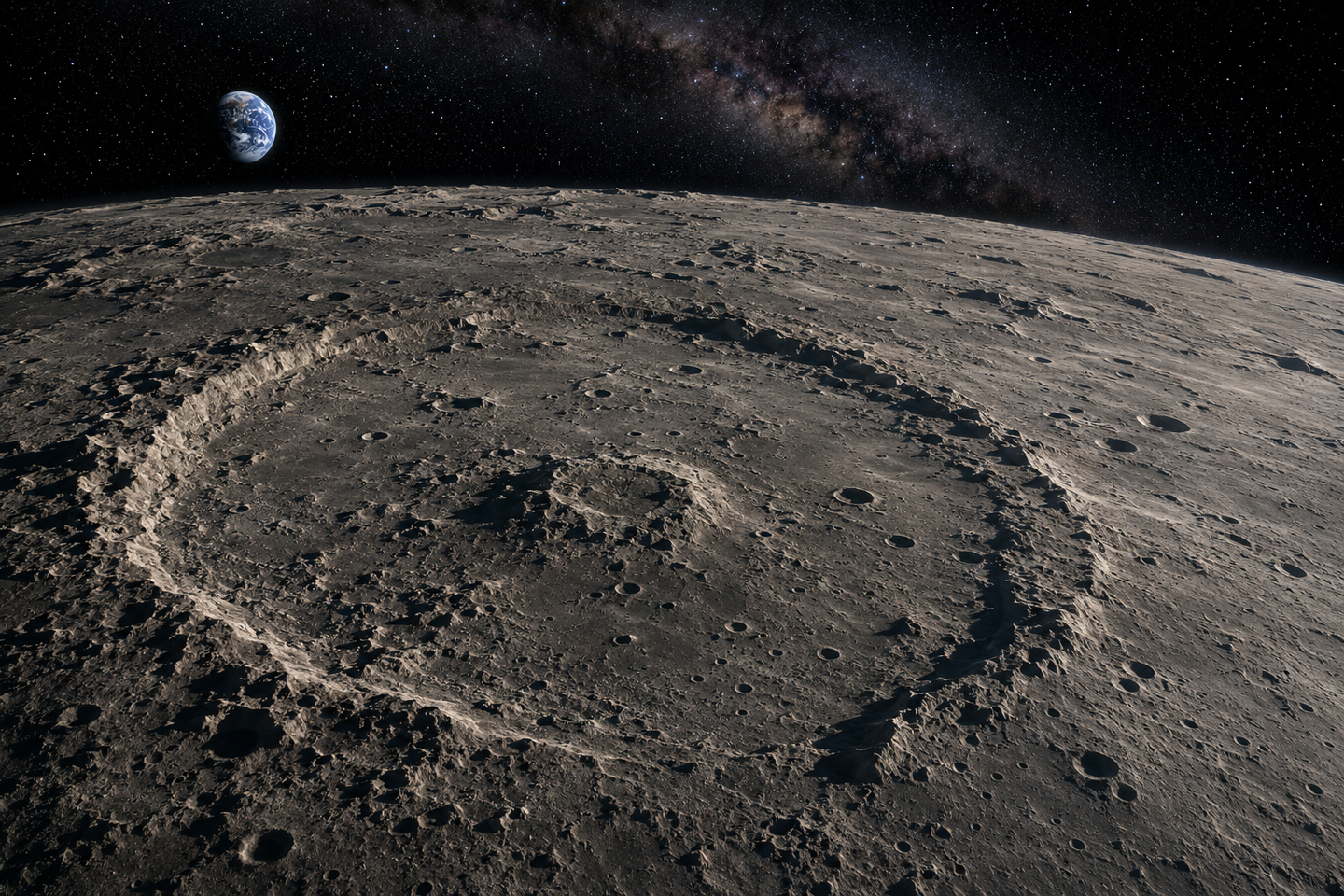
New Moon impact models suggest South Pole-Aitken ejecta may place deep mantle material near Artemis south pole landing zones. (CREDIT: Wikimedia / CC BY-SA 4.0)
The Moon’s biggest scar does not sit quietly in the background. The South Pole-Aitken basin is a vast impact structure more than 2,000 kilometers wide on the lunar far side. It has long looked slightly off. The basin appears stretched and tapered in a way that hinted at a more complicated collision. Now, two companion studies argue that its odd shape may preserve the direction and speed of the body that carved it out. Moreover, the studies may reflect the internal makeup of the impactor.
That matters for more than lunar history. The same work suggests material blasted up from deep inside the Moon may still lie in parts of the south polar region. These areas are now under consideration for Artemis exploration.
Scientists modeled the impact that formed the South Pole-Aitken basin, which is often called SPA. They compared those results with gravity data from the region. Together, the studies point to a large object coming from the north, moving south, and striking the Moon at a low angle. Rather than hitting straight on, it appears to have skimmed in at about 30 degrees from the horizontal. In addition, the impact speed was roughly 13 kilometers per second.
“The basin offers scientists a rare opportunity to study the Moon’s earliest history,” said Dr. William Bottke, director of the Center for Lunar Origin and Evolution and executive director of Southwest Research Institute’s Science Directorate in Boulder, Colorado. “The collision struck the lunar surface with such force that it may have excavated material from deep inside the Moon, including portions of the lunar mantle.”
A crater shape that kept pointing south
SPA is one of the Moon’s oldest surviving features, a relic from the chaotic period when large bodies still slammed into the young planets. Because it is so old and so large, scientists have long treated it as a window into the early solar system. However, its outline has been especially important. The basin narrows toward the south, and that taper has been difficult to reproduce in simulations.
The new modeling found that the best match came from a 260-kilometer-wide impactor that was not uniform all the way through. Instead, it appears to have been differentiated, with a dense iron core and rocky outer layers. This structure is more like a small protoplanet or a differentiated asteroid than a simple rubble body.
“Our simulation produces the right shape and nature of the impact basin. It also tells us about the projectile that created it and the direction of the impact,” said Dr. Shigeru Wakita of Purdue University, lead author of the impact study.
In the simulations, the upper part of the impactor deformed heavily during the strike, but the dense core kept driving forward in a process called decapitation. That continuing push appears to have helped excavate the basin in a way that made it elongated and tapered downrange. When the team removed the core from the model and used an undifferentiated impactor instead, the result was a more circular basin. In contrast, this version did not match the real one as well.
The models also tested different speeds and impact angles. Faster impacts made the basin too circular. Shallower angles made it too small. The 30-degree case, with a differentiated impactor and a southward trajectory, fit the observed planform best.
Deep lunar material may be closer to the surface
The second study followed the debris. It examined how material thrown out by the impact, including rock from the lunar mantle, may have been distributed beneath and around the basin. By comparing high-resolution gravity measurements with models that included both crustal and mantle material, the team concluded that mantle-derived rocks likely remain inside SPA. Similarly, these rocks exist in the ejecta blanket surrounding it.
That is a major point because the Moon’s mantle is not easy to access. If material from deep below the crust was excavated and redeposited nearer the surface, it could offer rare clues to the Moon’s composition and early evolution.
“The precise distribution of mantle material has been a big unknown,” said Dr. Gabriel Gowman of the University of Arizona, lead author of the gravity-based study. “Our models indicate that the SPA impact ejected enough deep material to form a significant deposit that should still be accessible today. Most importantly, some of that material at a trace level may exist in regions being considered for the Artemis landings.”
The simulations suggest the ejecta pattern was strongly asymmetric. More material was flung in the downrange direction than behind the impact. Mantle ejecta extended hundreds of kilometers beyond the basin rim in some directions. Meanwhile, none was expected in the uprange direction. Deeper mantle material appears to have been concentrated more in the cross-range directions, while shallower mantle material spread more broadly.
The team estimated a total mantle ejecta volume of 4.2 × 10^6 cubic kilometers in its best-fitting simulation. This was somewhat below but still close to previous estimates from gravity data. In the south polar Artemis region, the model gives an average mantle-material thickness of about 350 meters. Some spots reach roughly 3 kilometers.
What Artemis could find near the south pole
That possibility shifts the practical map for lunar exploration. Earlier ideas had suggested the deepest ejecta from SPA might be concentrated far from the south polar zones now receiving attention. However, the new work points the other way. If the impact really came from north to south, then areas near the lunar south pole may sit within the path of mantle-bearing ejecta.
“The combination of impact and gravity modeling gives us a powerful roadmap,” Bottke said. “It tells us not just how SPA formed, but where to look for the rocks that can answer some of our biggest questions about the Moon’s origin and evolution.”
The authors also note that later impacts inside the basin may have dug into those buried deposits and exposed some of them at the surface. That means robotic rovers or astronauts may not need to drill deeply to reach valuable samples.
There are still limits. The researchers say higher-resolution simulations could refine the best-fit angle, speed, and internal structure of the impactor. Some questions also remain about what became of the impactor’s core and how later processes may have shifted or mixed the deposits over time. The material in the south polar region has also been churned for billions of years by smaller impacts.
Even so, the picture is sharper than before. A giant body, likely with an iron core, appears to have come in low from the north and gouged out the Moon’s largest basin. It scattered deep material in patterns that may still be readable today.
Practical implications of the research
For Artemis planners, the studies suggest that south polar landing zones may offer access to ancient material excavated from deep inside the Moon. This includes mantle-bearing ejecta linked to the South Pole-Aitken impact.
That could help astronauts collect samples capable of constraining the age of the basin and improving estimates of the Moon’s internal composition.
The work also gives mission teams a more targeted guide for where high-value rocks may be concentrated. This is important when surface time, traverse distance, and sample return capacity are limited.
Research findings are available online in the journal Science Advances.
The original story "New discovery reveals how the Moon’s largest and oldest crater formed" is published in The Brighter Side of News.
Related Stories
- Moon's largest impact crater helps explain why the near side and far side look so different
- Massive buried structure found under the Moon’s largest crater
- Compact X-ray telescope could deliver the first full chemical map of the Moon
Like these kind of feel good stories? Get The Brighter Side of News' newsletter.
Joseph Shavit
Writer, Editor-At-Large and Publisher
Joseph Shavit, based in Los Angeles, is a seasoned science journalist, editor and co-founder of The Brighter Side of News, where he transforms complex discoveries into clear, engaging stories for general readers. With vast experience at major media companies like The Los Angeles Times, Times Mirror and Tribune Publishing, he writes with both authority and curiosity. His writing focuses on space science, planetary science, quantum mechanics, geology. Known for linking breakthroughs to real-world markets, he highlights how research transitions into products and industries that shape daily life.