JWST captures stunning images of one of the lightest known exoplanets
A faint giant planet hid near Beta Pictoris b for over a decade before astronomers recognized it in archived images.
 ESO Writer: Barbara Ferreira

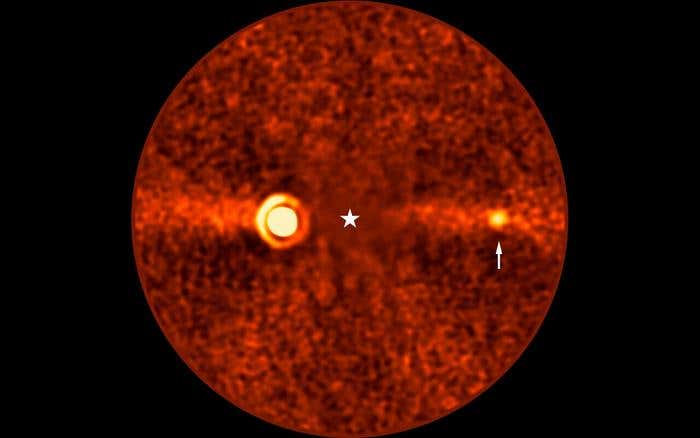
A faint giant planet hid near Beta Pictoris b for over a decade before astronomers recognized it in archived images. (Credit: ESO/B. Sutlieff, M. Bonse et al.)
- Astronomers discovered Beta Pictoris d, a gas giant about 2.4 times Jupiter’s mass, after spotting it in VLT data and tracing it through 11 years of archived observations.
- The planet is roughly 100 times fainter than Beta Pictoris b, making it one of the lightest and faintest exoplanets ever directly imaged from the ground.
- Its mass and orbit may explain features in the system’s debris disc, while the discovery shows that other hidden planets could be found by reanalyzing old telescope data.
“There’s something else there, did you see it?”
That question redirected an effort to study a known planet around Beta Pictoris. Instead, astronomers found a third world hiding in old observations.
The newly identified planet, Beta Pictoris d, is about 100 times fainter than Beta Pictoris b. It ranks among the lightest exoplanets ever directly imaged from the ground.
Its first clear ground-based detection came from the European Southern Observatory’s Very Large Telescope, or VLT. Astronomers later found the planet in archived images stretching back 11 years.
“This was a serendipitous discovery,” said Ben Sutlieff, an astronomer at the University of Edinburgh.
“We initially wanted to look more at a known planet in the system, Beta Pictoris b, to see how it changed over time.”
Sutlieff co-led the study with Markus Bonse, an ESO astronomer in Germany.
A Planet Lost in the Glare
Beta Pictoris lies 63 light-years from Earth.
Astronomers had already identified two giant planets around the star. Beta Pictoris b and Beta Pictoris c each have about 10 times Jupiter’s mass.
The new planet is much lighter. Researchers estimate Beta Pictoris d has about 2.4 times Jupiter’s mass. Like the system’s other planets, it is a gas giant.
Its orbit reaches farther from the star than those of planets b and c.
The greater distance did not make it easy to find. Beta Pictoris d is relatively cold and extremely faint beside its host star. It is also much dimmer than Beta Pictoris b. Direct imaging captures a planet’s own light, much like taking a photograph.
That method works only when astronomers can separate the planet from the overwhelming brightness of its star.
“The new planet is 100 times fainter than Beta Pictoris b, the famous planet in the same system,” Bonse said.
He described it as the faintest exoplanet directly imaged from Earth when measured by absolute magnitude.
That distinction corrects for the system’s distance. It reflects the planet’s size and temperature, not simply how faint it appears from Earth.
One Detection Opens an Archive
Sutlieff, Bonse and their colleagues first clearly detected the planet with ERIS, an instrument on the VLT.
The team then needed to confirm that the faint object was real.
Astronomers usually make follow-up observations after a possible detection. Beta Pictoris offered another route because telescopes had watched the system for years.
The researchers searched ESO’s archive for older observations.
“To our joy, out it popped in previous SPHERE observations,” said Jayne Birkby of the University of Oxford.
SPHERE is another VLT instrument that had previously observed the system. The planet appeared in several images, including one taken 11 years earlier. In that observation, it barely separated from the glare of Beta Pictoris b.
“Planet d, it seems, has been playing a game of hide-and-seek with us for over a decade,” Birkby said.
“Only now can we say ‘found you!’”
The discovery turned earlier images into a record of the planet’s movement. Once astronomers knew where to look, a signal that had seemed insignificant became recognizable.
“It turns out it was hiding in the data all along!” Birkby said.
Space and Ground Telescopes Converge
A separate team also found Beta Pictoris d with the James Webb Space Telescope.
Aidan Gibbs of the University of California led that independent effort. The space telescope’s NIRCam instrument had recorded the planet in archived observations. Together, the detections connected several instruments across Earth and space.
The VLT supplied the first clear ground-based identification through ERIS. Earlier SPHERE data extended the planet’s history.
JWST provided an independent discovery and another archival confirmation.
This overlap strengthened the case that the object belonged to the Beta Pictoris system. It also highlighted the scientific value of old observations.
“The detections in the archival SPHERE data are not only very exciting on their own,” said Valentin Christiaens.
“They suggest a number of treasures are still hidden in the archives of VLT instruments!”
Christiaens is a researcher at CEA Paris-Saclay in France and a co-author of the study.
A Rare Family Portrait
Beta Pictoris now joins a very small group.
It is only the second planetary system with more than two directly imaged exoplanets. The first was HR 8799.
“Systems with multiple directly imaged exoplanets are the ‘holy grails’ of discoveries,” Sutlieff said.
“They can teach us a lot about what different exoplanets are like in the same formation environment.”
That shared environment gives astronomers a natural comparison. The planets formed around the same star and within the same broad system. Yet they differ in mass, orbit, temperature and brightness.
Beta Pictoris d also resembles another planet called 51 Eridani b.
Both belong to stars in the same group and appear nearly like twins. Astronomers may use them to test models of how planets grow and change over time.
The comparison matters because direct images capture only a small number of exoplanets. Most known planets appear through indirect methods, such as changes in a star’s light or motion.
A faint world captured directly offers a different kind of evidence.
The Missing Sculptor of a Debris Disc
The new planet also addresses an old puzzle.
Beta Pictoris contains a surrounding debris disc made from material left after planet formation. Its shape could not be fully explained by the two known planets.
Beta Pictoris d has the right position and mass to help account for the disc’s structure.
A planet can shape nearby debris through gravity.
Its repeated pull can clear regions, bend material or help create visible patterns around a star. The newly found world occupies the area where an additional planet could influence the disc.
That agreement links the direct image with features already seen in the wider system.
The planet was not simply another faint point near the star. Its location fits a role that astronomers had reason to suspect.
Why the Planet Stayed Hidden
Beta Pictoris d escaped detection partly because direct imaging depends strongly on timing and position. A planet may appear too close to its star during one observation.
At another moment, it may overlap with the glare of a larger companion.
The Beta Pictoris system appears nearly edge-on from Earth. Its planets can move into difficult viewing positions. In some archived observations, planet d lay near Beta Pictoris b. In others, it approached the bright central star.
The planet’s faintness added another barrier. Even advanced instruments must separate its light from atmospheric noise, starlight and nearby objects.
These limits help explain why extensive observations did not produce an immediate discovery.
The evidence became convincing only after researchers connected detections across many years.
That process also leaves uncertainties.
Direct imaging favors relatively bright planets that remain far enough from their stars to separate. Dimmer or lower-mass worlds may still remain unseen.
More Companions Could Be Waiting
“Planets seem to have friends,” said Beth Biller of the University of Edinburgh.
Many famous directly imaged systems contain several giant planets. Biller said lower-mass planets may still hide within them.
ESO’s Extremely Large Telescope could help expose those worlds. The telescope, known as the ELT, will offer new opportunities to image faint planets around nearby stars.
Beta Pictoris d provides a clear reason to revisit familiar targets.
A system observed many times may still contain a planet buried in glare or stored unnoticed in an archive.
The discovery also rewards cooperation between instruments. Ground telescopes can provide long histories and powerful adaptive optics. Space observatories can add exceptional infrared sensitivity.
Neither replaces the other.
For Beta Pictoris d, both became part of the same planetary portrait.
Practical Implications of the Research
The finding gives astronomers a stronger reason to reanalyze archival telescope data.
Known planetary systems may contain faint companions that earlier searches missed. Improved processing and better orbital predictions can make those signals easier to recognize.
Multiple planets around one star also provide valuable tests of formation models. Because the worlds share an environment, their differences can help researchers separate the effects of mass, distance and temperature.
Beta Pictoris d adds another gravitational influence to models of the system’s debris disc.
Its presence may improve explanations for how planets reshape leftover material after formation.
The discovery also sets a target for future instruments. Telescopes such as the ELT may find smaller and fainter planets in systems already considered well studied. A decade of hidden appearances carries a simple lesson.
Sometimes the next planet is not beyond the reach of existing observations. It is already inside them, waiting for someone to notice.
Research findings are available online in the journal The Astrophysical Journal Letters.
The original story "JWST captures stunning images of one of the lightest known exoplanets" is published in The Brighter Side of News.
Related Stories
- NASA’s Webb telescope detects a third giant planet orbiting Beta Pictoris
- ESA's Euclid telescope discovers 31 new quasars dating back 800 million years
- NASA’s risky bid to save Swift telescope before solar drag pulls it into Earth's atmosphere
Like these kind of feel good stories? Get The Brighter Side of News' newsletter.
Joseph Shavit
Writer, Editor-At-Large and Publisher
Joseph Shavit, based in Los Angeles, is a seasoned science journalist, editor and co-founder of The Brighter Side of News, where he transforms complex discoveries into clear, engaging stories for general readers. With vast experience at major media companies like The Los Angeles Times, Times Mirror and Tribune Publishing, he writes with both authority and curiosity. His writing focuses on space science, planetary science, quantum mechanics, geology. Known for linking breakthroughs to real-world markets, he highlights how research transitions into products and industries that shape daily life.