New glassfrog species named in honor of Equadorian Olympic champion Neisi Dajomes
Ecuador’s newly described Dajomes glassfrog may be one sign of a much larger amphibian hotspot.

 Edited By: Joseph Shavit

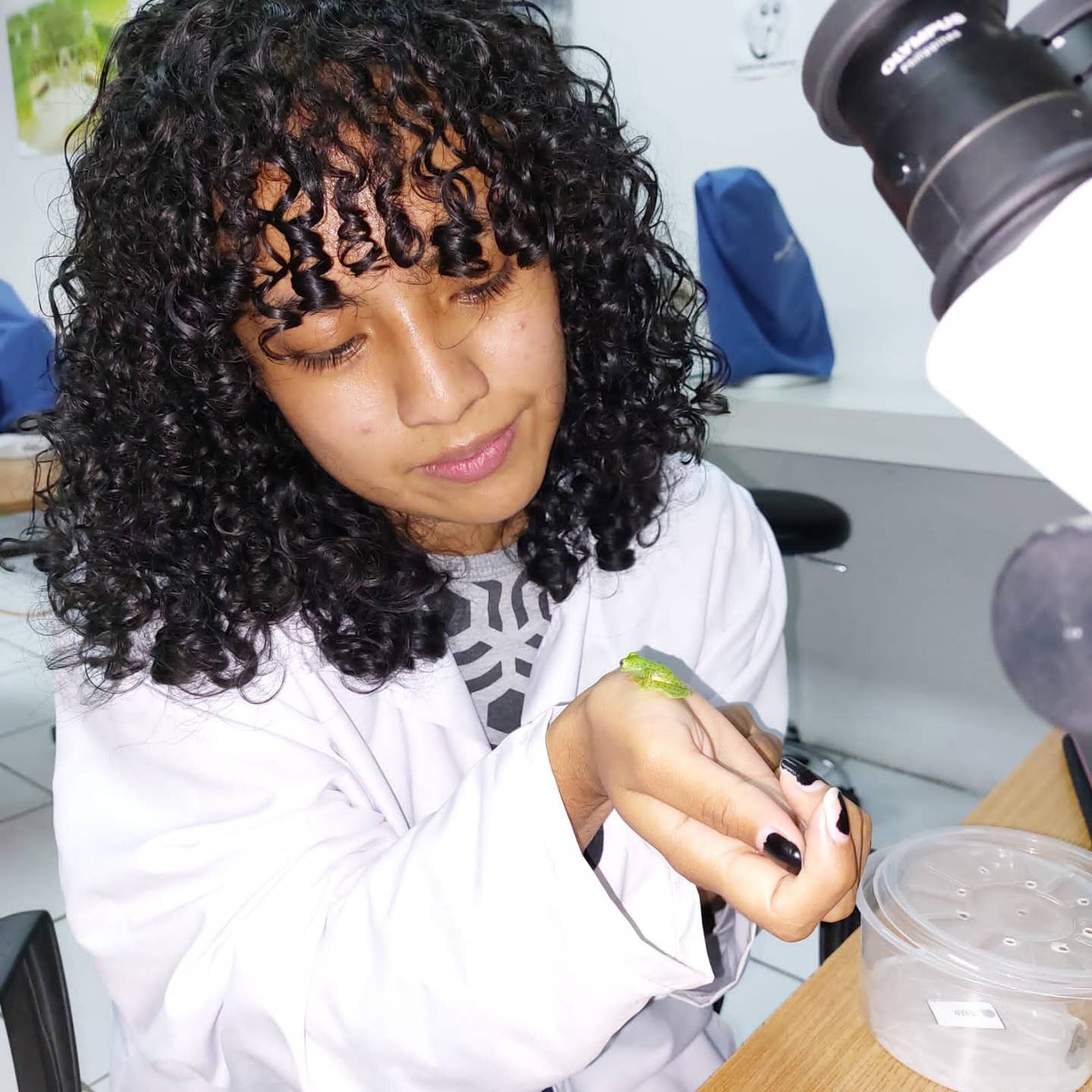
After fieldwork, genomic samples were analyzed at the molecular laboratories of Pontificia Universidad Católica del Ecuador in Quito. The results demonstrated that the population found represented a new species. (CREDIT: PUCE-BIOWEB (CC-BY 4.0))
The frogs were sitting low over dark, slow-moving streams, their bodies bright green against moss, bromeliads, and sandstone. At night, on a plateau in southern Ecuador, they looked almost simple at first glance. Then the details started to matter: yellow fingers and toes, a pebbly back, green bones, and a pale underside that hid some organs while leaving others visible.
That combination turned out to belong to something no one had formally described before.
In a study published in PLOS One, Mylena Masache of the Pontificia Universidad Católica del Ecuador and colleagues identified the animal as a new species of glassfrog, now named Nymphargus dajomesae, or the Dajomes glassfrog. The species honors Neisi Dajomes, the first Ecuadorian woman to win Olympic gold. She earned her medal at the Tokyo 2020 Games in women’s 76-kilogram weightlifting.
Glassfrogs, a family known as Centrolenidae, live in tropical forests across Central and South America. Many are green on top, but some are best known for the transparent skin on their undersides, which can expose the heart and other organs. The newly described frog fits within that strange and delicate group. However, it also carries a set of traits that separates it from its closest relatives.
A frog hidden in plain sight
The animals were first collected during surveys in 2017 and 2018 at Reserva Biológica El Quimi in Ecuador’s Cordillera del Cóndor, a remote Subandean mountain range along the border with Peru. At first, the population had been misidentified as another species, Nymphargus cariticommatus.
The closer the team looked, the less that label held up.
The new frog has a uniformly green back with a shagreen, or finely pebbled, texture. Its underside carries a white parietal membrane, and light-reflecting cells cover the membranes around the heart, esophagus, stomach, and kidneys. Other internal membranes remain clear. In life, its iris ranges from tan to grayish tan with fine dark reticulations and punctuations, and adult males measured 20.8 to 27.2 millimeters from snout to vent.
Its call is brief and sharp. Based on one recorded male, the advertisement call is a single pulsed note with a click-like sound, repeated 33.6 times per minute. The average call lasts 0.049 seconds, with a dominant frequency around 4154.3 hertz.
The holotype, an adult male, was collected on July 7, 2017, at 2,070 meters elevation. Most individuals were found at night on leaves 60 to 180 centimeters above the ground near streams, though one was on a bromeliad.
Sorting out its place on the frog family tree
To test whether the El Quimi frogs really represented a separate species, the researchers combined morphology with genetics. They compared physical traits across museum specimens and published descriptions. In addition, they built a phylogeny using 10 genes from 102 individuals.
That analysis placed the El Quimi population within the genus Nymphargus, the most species-rich genus in the glassfrog family. The researchers estimated that Nymphargus itself originated about 17 million years ago. Most of its species appear to have arisen during the Miocene and Pliocene.
Nymphargus dajomesae seems to be old enough to stand on its own. The team estimated that it diverged from a closely related unnamed lineage during the Pliocene, about 4.4 million years ago. It also split from the closest named species, including N. griffithsi and N. lasgralarias, roughly 6 million years ago. The researchers argued that such a long divergence, along with clear morphological differences, supports treating the El Quimi population as a distinct species.
They also checked whether the result might be skewed by conflicts between mitochondrial and nuclear DNA. A separate phylogeny built only from nuclear genes still recovered the El Quimi frogs as a distinct lineage, although support for some nodes was weak.
That uncertainty did not erase the main result, but it did show that parts of the Nymphargus family tree remain messy. The authors noted weak support for some of the deepest branches in the genus. Additionally, they pointed to other taxonomic problems as well, including evidence that what is currently called Nymphargus cochranae may actually hide more than one species.
A “lost world” on a sandstone plateau
The setting matters almost as much as the frog.
El Quimi sits on a quartzite sandstone plateau in the Cordillera del Cóndor, between 1,992 and 2,090 meters elevation. The habitat is an evergreen montane forest with a low, open canopy, scattered trees 10 to 15 meters high, dense shrubs, mosses, roots, and terrestrial bromeliads. The streams there are blackwater and rich in tannins.
This mountain range already holds remarkable amphibian endemism. The paper lists at least 23 endemic frog species from the Cordillera del Cóndor. Nymphargus dajomesae is now the fourth known species of Nymphargus from the region.
The surprise is not just the frog itself, but how many other unfamiliar species turned up nearby. During two El Quimi expeditions that totaled 22 days, researchers found that more than 85% of the amphibian species observed were new to science. The authors wrote, “We were astonished by the high number of new species found at the site. Few places in the tropical Andes harbor amphibian assemblages as novel as the one found at El Quimi.”
They suggest that southeastern Ecuador and neighboring northeastern Peru may contain what they call “lost worlds” of amphibian diversity, especially in upland habitats above 1,800 meters. By contrast, amphibian communities below the plateau were made up entirely of already described species.
Dr. Diego Cisneros said the naming of the frog carries another layer of meaning: “It is especially meaningful that this discovery is led by a young woman scientist and honours an Ecuadorian Olympic champion, this species becomes a symbol of how science and society can recognise and celebrate women shaping the future.”
Close to danger, but still poorly known
For now, the frog’s conservation status remains uncertain.
The researchers recommend classifying Nymphargus dajomesae as Data Deficient under IUCN Red List criteria. It is known from only a single locality, and surveys in the Cordillera del Cóndor have been limited and sporadic. The team cannot rule out the possibility that more populations exist.
Still, the location of the known site raises concerns. The type locality lies about 5 kilometers from agricultural areas and 7 kilometers from a large-scale mining operation. The paper notes that mining in the Cordillera del Cóndor has already harmed amphibian populations and could threaten this species in the future.
That leaves the Dajomes glassfrog in an uneasy position: newly named, visually striking, evolutionarily distinct, and already close to pressures that have damaged amphibians elsewhere in the same landscape.
Practical implications of the research
This study adds one more species to a fast-growing list from the Cordillera del Cóndor, but its larger value is geographic. It points researchers toward montane sandstone habitats that may hold a high number of undescribed amphibians.
It also gives conservation planners a clearer signal about where biodiversity surveys should continue, especially in southeastern Ecuador and across the border in northeastern Peru.
Because the frog is known from only one site near agriculture and mining, the work also gives local officials and conservation groups a documented species to consider before habitat pressure grows further.
Research findings are available online in the journal PLOS One.
The original story "New glassfrog species named in honor of Equadorian Olympic champion Neisi Dajomes" is published in The Brighter Side of News.
Related Stories
- Scientist discovers seven never-before-seen species of a distinctive frog-like insect
- The missing ingredient in limb regeneration may be oxygen
- 250-million-year-old Australian ‘sea-salamander’ sheds new light on the dawn of the dinosaurs
Like these kind of feel good stories? Get The Brighter Side of News' newsletter.