New glowing liquid technology could revolutionize the fight against counterfeit goods
Lanthanide-containing liquids produce detailed optical fingerprints, with paper tests demonstrating potential for security markings.
 NTU Writer: David Rogers

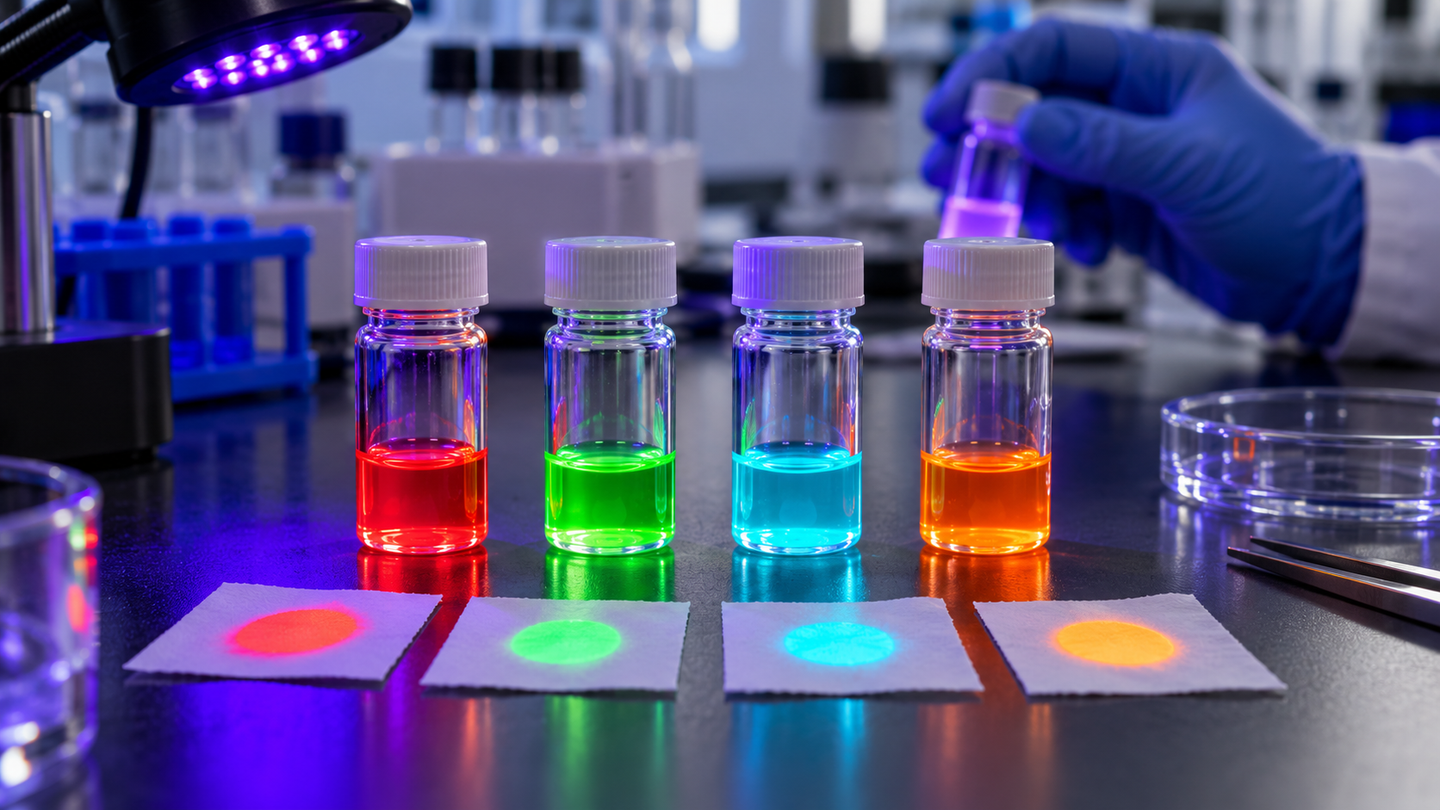
Four glowing ionic liquids can be mixed to create distinctive light signatures, offering a potential route to new security markings. (CREDIT: The Brighter Side of News)
- Four room-temperature liquids retained the distinctive light emissions of europium, terbium, dysprosium and samarium compounds.
- Mixing them produced more detailed spectra, allowing similar-looking samples to carry different optical signatures.
- Paper tests demonstrated the concept, while printing performance, durability and practical resistance to copying remain to be established.
Two security marks could glow almost the same color under ultraviolet light yet reveal different identities when their light is analyzed. That possibility lies behind a set of glowing liquids designed to make optical identification more adaptable. Their signature depends on more than what the eye can distinguish.
A team led by Nottingham Trent University developed four room-temperature liquids containing light-emitting lanthanide compounds. The study, published in RSC Advances, also involved the universities of Liverpool and Manchester. Mixing the liquids preserved recognizable emissions from their components while producing more detailed patterns of wavelengths.
The researchers demonstrated those responses in liquid samples and on treated paper. Their work offers a route toward tailored security markings, rather than a finished commercial ink. It has not yet established how reliably the materials would withstand everyday use or attempts at replication.
Four liquids form a chemical starting kit
The materials belong to a class called ionic liquids: salts that remain liquid at relatively low temperatures. In this case, the researchers designed compounds that stay liquid at room temperature. That makes them easier to combine than materials that require separate dissolution or film-making steps.
Each liquid contains one of four lanthanides: europium, terbium, dysprosium or samarium. These metallic elements belong to a group known for distinctive optical properties. In suitable compounds, their electrons release absorbed energy as light at characteristic wavelengths.
The team combined the lanthanides with dipicolinate ligands, molecules that bind the metal ions and help transfer excitation energy to them. A bulky phosphonium ion supplied the other charged component of the salt. Together, those chemical building blocks produced moderately viscous liquids with recognizable lanthanide emissions.
Under ultraviolet illumination, the parent materials emitted red, green, aqua and orange light, respectively. Those visible colors provide an immediate distinction between some samples. More importantly, each material produces a spectrum containing individual emission peaks that can be measured with an instrument.
Mixing creates signatures without starting synthesis again
The main advantage is modularity. Rather than inventing a different compound for every desired tag, a manufacturer could potentially blend known amounts of existing liquids. Changing the combination would alter the optical response without requiring another complete chemical synthesis.
“Creating a more complex security signature does not require creating more complicated materials,” said senior author Anthony Fitzpatrick of Nottingham Trent’s School of Science and Technology. “Instead, different luminescent liquids can be combined to produce new signatures.”
The researchers tested all six two-component combinations available from the four parent liquids. They also examined four three-component mixtures and one mixture containing all four. Together with the parent materials, that produced 15 formulations for investigation, rather than demonstrating every possible mixing ratio.
The blends retained emission peaks associated with their ingredients. Researchers translated the positions of major peaks between 400 and 750 nanometers into simple barcode-like representations. These illustrate a possible way to encode and compare spectral information, rather than a fully validated authentication system.
This distinction separates the visible glow from the proposed security information. Matching an orange appearance would not necessarily reproduce the full set of wavelengths in an authentic sample. A detailed spectral measurement could therefore distinguish materials that look alike under the same lamp.
Paper tests move the concept beyond a vial
To test a potential substrate, the team treated paper with each parent liquid and two selected mixtures. One blend contained three lanthanides and the other contained all four. The researchers then imaged the papers under white light and ultraviolet illumination at several wavelengths.
The tests used 254, 312 and 365 nanometers, covering different ultraviolet bands. The shortest wavelength, 254 nanometers, produced the best color contrast for these materials. That result matters because the appearance and relative strength of the emissions depend on how the sample is excited.
Some treated papers looked similar under that illumination while having different spectra. The experiment demonstrated that the liquids could impart distinguishable optical responses to paper. It did not demonstrate high-volume printing, performance in a particular printer or long-term behavior on commercial packaging.
PhD student and first author Annie Prasad emphasized the practical attraction of the liquid state. “A key feature is that the new materials remain liquid at room temperature, making them easier to mix and formulate than materials that need to be processed as solid compounds,” she said. Compatibility with established production methods remains a goal that further testing must substantiate.
More emitters do not always mean more information
Combining components also introduced complications. Some lanthanides emitted at overlapping wavelengths, making particular peaks harder to separate. The phosphonium component contributed its own emission near 500 nanometers under 254-nanometer excitation, broadening features in some mixtures.
The choice of ultraviolet wavelength could favor one emitter over another. Europium and terbium often dominated the visible responses, while dysprosium and samarium contributed weaker signals under the tested conditions. A formulation’s ingredients alone therefore do not determine how clearly each component can be read.
Adding all four emitters did not produce an obvious improvement over the three-component mixtures in spectral complexity. Additional overlap limited the benefit. The finding shows why an effective security formulation would require careful selection and calibration, rather than simply adding more ingredients.
The team also measured how quickly emissions decayed, finding characteristic lifetimes on millisecond and shorter timescales. Mixtures changed some of those lifetimes, suggesting another possible source of identification information. Quantitative authentication based on emission timing remains an area for future development.
From a promising material to a reliable security feature
Thermal tests supported the materials’ room-temperature liquid behavior and identified major decomposition around 240 to 250 degrees Celsius. The samples also absorbed atmospheric moisture. These results help characterize processing conditions, but do not establish resistance to years of handling, sunlight or environmental exposure.
Future work will examine excitation wavelengths, chemical variations, viscosity and durability under realistic processing and aging conditions. Those studies will help determine whether the spectral differences remain consistent enough for dependable readout. A practical product would also need a suitable way to record and compare its expected signature.
The present contribution is a flexible chemical platform: four liquid ingredients can generate several distinguishable optical responses. If those responses prove durable and reproducible, they could become an additional layer in product or document verification. The paper establishes the materials and their signals; real-world security performance remains the next test.
Dig deeper into optical security materials
These studies and reviews explore luminescent tags, printing approaches and other ways to encode information in materials.
Luminescent nanomaterials based covert tags for anti-counterfeiting applications: A review: Surveys luminescent security materials, ink formulation and printing methods, including lanthanide-based systems. (Advances in Colloid and Interface Science, 2025)
Luminescent Metal–Organic Frameworks as Multimodal Platforms for Advanced Anticounterfeiting and Security Applications: Reviews approaches that use several optical responses to build more detailed security features. (Chemistry of Materials, 2024)
Anti-Counterfeiting Application of Persistent Luminescence Materials and Its Research Progress: Explains security strategies based on materials that continue emitting after excitation stops. (Laser & Photonics Reviews, 2024)
Emerging Luminescent Materials for Information Encryption and Anti-Counterfeiting: Stimulus-Response AIEgens and Room-Temperature Phosphorescent Materials: Examines responsive materials whose light emission can be used to conceal and reveal information. (Chemosensors, 2023)
Printed smart devices for anti-counterfeiting allowing precise identification with household equipment: Demonstrates a separate approach combining printed electrical and optical patterns for identification. (Nature Communications, 2024)
Research findings are available online in the journal RSC Advances.
The original story "New glowing liquid technology could revolutionize the fight against counterfeit goods" is published in The Brighter Side of News.
Related Stories
- An edible QR code takes a shot at fake whiskey
- Candy-coated pills could prevent pharmaceutical fraud
- UCLA engineers build a 'lying mirror' that displays a fake reflected image
Like these kind of feel good stories? Get The Brighter Side of News' newsletter.
Joshua Shavit
Writer and Editor
Joshua Shavit is a NorCal-based science and technology writer with a passion for exploring the breakthroughs shaping the future. As a co-founder of The Brighter Side of News, he focuses on positive and transformative advancements in technology, physics, engineering, robotics, and astronomy. Having published articles on AOL.com, MSN, Yahoo News, and Ground News, Joshua's work highlights the innovators behind the ideas, bringing readers closer to the people driving progress.