New one-hour brush swab test can detect oral cancers without painful biopsies
A rapid brush swab test may help doctors detect oral cancer sooner and avoid many painful biopsies.

 Edited By: Joseph Shavit

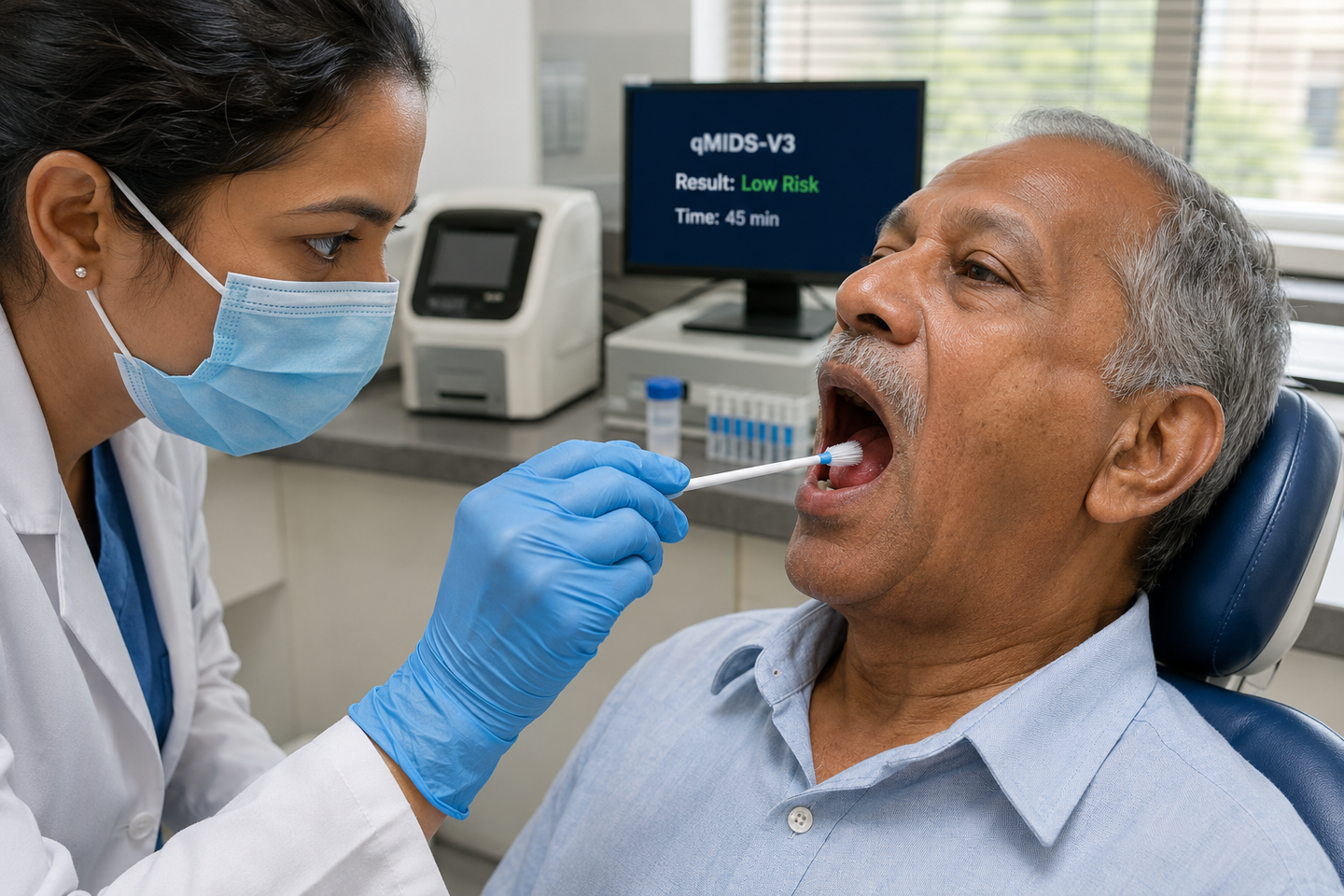
A new one-hour brush swab test could detect oral cancer early and cut unnecessary painful mouth biopsies for many patients. (CREDIT: Wikimedia / CC BY-SA 4.0)
A painless brush swab may soon change one of the most unpleasant parts of oral cancer care, sorting dangerous mouth lesions from low-risk ones in under an hour and potentially sparing many patients an invasive biopsy.
That matters because oral cancer is often found late, when treatment is harder and survival drops. It also matters because the current pathway can be rough on patients. Suspicious lesions frequently lead to scalpel biopsies, even though most turn out not to be cancer.
In the new study, published in Biomarker Research, a cross-university team led by Queen Mary University of London tested a non-invasive oral brush biopsy assay called qMIDSV3. The researchers found that the test could accurately detect oral squamous cell carcinoma, the main form of oral cancer, using cells collected from the surface of the mouth rather than cut tissue.
The analysis included 1,090 brush biopsy samples from 545 patients, making it the largest study of its kind, according to the authors. The team said the test could help spare more than 90% of low-risk patients with potentially malignant oral disorders from unnecessary invasive tissue biopsies.
A gentler way to sort risk
The problem is not just diagnosis, but triage. Many oral lesions look worrying enough to trigger referral or biopsy, yet most are benign or remain cancer-free for years. In the UK, the paper notes, a 10-year audit found a 450% rise in urgent two-week-wait referrals alongside a 50% drop in cancer detection rates. Later audits found that 92.5% to 99.5% of referred patients were cancer-free, and most stayed cancer-free at five-year follow-up.
At the same time, oral cancer itself is becoming a bigger global threat. The paper cites an estimated 422,000 new cases worldwide in 2023 and about 229,000 deaths. Five-year survival has remained around 50% for decades.
That puts clinicians in a bind. A scalpel biopsy remains the standard way to check a suspicious lesion, but it can be painful, especially on the tongue, one of the most common sites for oral cancer. Repeating the procedure over time is even harder for patients with persistent lesions that need monitoring.
“Oral cancer survival is directly linked to how early it is found, yet our current diagnostic pathway is blunt, most patients with a suspicious lesion end up having an invasive biopsy even when the overwhelming likelihood is that it is benign,” said Muy-Teck Teh, Professor of Molecular Oral Oncology at Queen Mary. “This test changes that. It gives clinicians a rapid, accurate, and non-invasive way to triage patients, and crucially, it can be repeated.”
Four genes, one fast result
The test builds on an earlier qMIDS platform that used a tiny tissue microbiopsy. For this study, the team wanted to see whether the same approach could work with a simple brush sample.
Patients brushed both the lesion and a matching area of mucosa on the opposite side of the mouth. The entire sampling step generally took less than five minutes. In the lab, the sample was run through a molecular assay that measured gene activity and converted it into a malignancy index. The full test took less than 60 minutes.
The researchers started with a 16-gene assay, then narrowed it to a four-gene panel that worked best with brush biopsy samples. That final version, qMIDSV3, used two target genes, INHBA and S100A16, plus two reference genes, YAP1 and POLR2A.
When the team compared oral cancer samples with contralateral normal mucosa from cancer patients, the test achieved an area under the curve of 0.913, with sensitivity, specificity, and overall accuracy each at 84%. When oral cancer was compared with oral potentially malignant disorders alone, performance improved sharply, with an area under the curve of 0.975, sensitivity of 95.7%, specificity of 95.1%, and accuracy of 95.5%.
That second comparison may be the more clinically important one, because the real challenge is separating dangerous disease from lesions that may look suspicious but are less likely to become cancer.
Comparable to a more invasive method
One of the study’s more surprising findings was how well the brush test held up against the earlier microbiopsy version. The tissue-based qMIDSV2 assay had slightly stronger performance overall, but the gap was small enough to catch the team off guard.
“We were genuinely astonished by the fact that the brush swab test performance is comparable to a microbiopsy,” Teh said. “It suggests that the biological signal captured by these four genes is sufficiently strong and consistent that it can be detected even from the superficial exfoliated cells collected by a brush biopsy. The clinical implications are significant: patients no longer need even a minimally invasive procedure to benefit from molecularly guided triage.”
The test also held up across age and sex groups, according to the study. And because the samples remained stable in storage buffer for extended periods, including at room temperature, the authors said the method may be useful in lower-resource settings where cold-chain storage is harder to maintain.
The assay uses standard RT-qPCR infrastructure, which became more widely available after the COVID-19 pandemic, and the paper says consumables cost less than $10 per sample.
What the test can, and cannot, do yet
The authors are careful not to present the brush test as a replacement for pathology. Instead, they frame it as a triage and surveillance tool, one that could help decide who most needs a scalpel biopsy and who may be monitored with repeat testing.
That repeatability may be one of its biggest strengths. Some oral potentially malignant disorders carry a risk of transforming into cancer, but that risk can be difficult to judge clinically. A non-invasive brush test could make long-term surveillance more practical and less painful.
The study also has limits. The cohort came from a single regional population in Uttar Pradesh, India, which may restrict broader generalizability. The sample sizes of cancer, leukoplakia, and lichen planus groups were uneven, and the study did not include an independent healthy normal mucosa brush biopsy cohort.
Still, the researchers argue that the work stands on a stronger base than a single cohort alone. Earlier versions of the qMIDS platform had already been validated on samples from the UK, China, and India.
Practical implications of the research
For patients, the clearest benefit is obvious: fewer painful biopsies for lesions that are unlikely to be cancer, and a faster path to escalation when the risk is real. For clinics, the value is more efficient triage at a time when referrals are rising and detection rates are falling.
Because the test is non-invasive and repeatable, it could also change follow-up care for people with persistent oral lesions, allowing regular surveillance without repeated cutting.
The team says Queen Mary is now seeking a commercial partner to help bring the assay into clinical use, and with the right backing, the test could be in use within two years.
Research findings are available online in the journal Biomarker Research.
The original story "New one-hour brush swab test can detect oral cancers without painful biopsies" is published in The Brighter Side of News.
Related Stories
- Three genes may hold the key to treating deadly oral cancer
- UPenn researchers develop bioengineered chewing gum to fight head and neck cancers
- Study finds surprising new link between vaping and cancer
Like these kind of feel good stories? Get The Brighter Side of News' newsletter.
Hannah Shavit-Weiner
Medical & Health Writer
Hannah Shavit-Weiner is a Los Angeles–based medical and health journalist for The Brighter Side of News, an online publication focused on uplifting, transformative stories from around the globe. Having published articles on AOL.com, MSN and Yahoo News, Hannah covers a broad spectrum of topics—from medical breakthroughs and health information to animal science. With a talent for making complex science clear and compelling, she connects readers to the advancements shaping a brighter, more hopeful future.