Interstellar comet 3I/ATLAS may come from a solar system much older than our own
3I/ATLAS carries chemical fingerprints that point to a planetary system older than our own.

 Edited By: Joseph Shavit

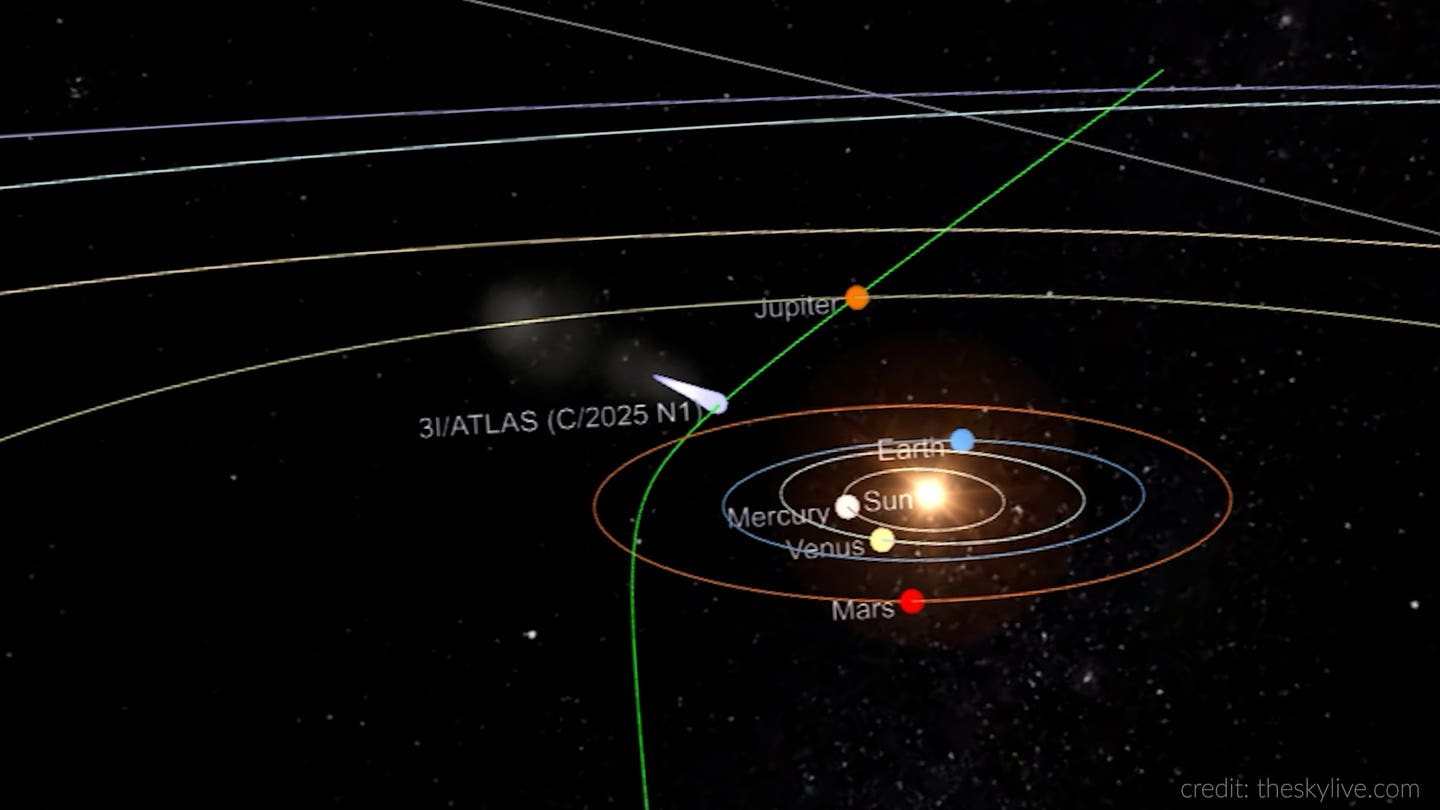
Strange isotope signals in 3I/ATLAS suggest the interstellar comet formed around an ancient, metal-poor star. (CREDIT: Wikimedia / CC BY-SA 4.0)
Comet 3I/ATLAS arrived from beyond the Solar System carrying a chemical story unlike anything astronomers had measured before. In the gas around it, they found isotope ratios that do not match the pattern seen in known Solar System comets, raising a striking possibility: this visitor may have formed around a star far older than the Sun.
That makes 3I/ATLAS more than a passing curiosity. It may be a surviving fragment from a planetary system that took shape when the universe was younger and less chemically enriched than it is today.
The object is only the third known interstellar visitor ever detected, following 1I/ʻOumuamua in 2017 and 2I/Borisov in 2019. But unlike those earlier objects, 3I/ATLAS proved bright enough for astronomers to probe in much greater detail. That brightness gave researchers a rare chance to examine its isotopic makeup, the relative amounts of different forms of the same element, and use those ratios as clues to where the comet formed.
“They are sort of fossils from a planetary formation process that happened very far away, but that we get the chance to study from much closer,” said Cyrielle Opitom, an astronomer at the University of Edinburgh who led the new work with Jean Manfroid and Damien Hutsemékers of the University of Liège.
Their study, published in Nature Astronomy, used the European Southern Observatory’s Very Large Telescope in Chile to analyze cyanide gas in the comet’s coma, the cloud of gas surrounding its nucleus. With the UVES instrument, the team measured carbon and nitrogen isotope ratios in that gas, the first such observations for a comet formed outside the Solar System.
A comet that does not fit the local pattern
What stood out was not just that the team could make the measurement, but what the measurement implied.
“Unlike comets from our Solar System, this interstellar visitor carries unusually high carbon and nitrogen isotopic ratios,” said Aravind Krishnakumar of the University of Liège, a co-author on the study.
Those ratios matter because they are sensitive to the physical conditions in the environment where a comet forms. They are also expected to remain fairly stable over long stretches of time, making them useful markers of origin. In Solar System comets, nitrogen and carbon isotope ratios tend to cluster within a much narrower range. 3I/ATLAS appears to fall outside that familiar pattern.
The nitrogen result suggests the comet formed in a region where isotope-selective chemistry involving nitrogen gas was less efficient, something that could happen farther from a star or in a part of a disk where shielding changed how radiation penetrated the material. The carbon result also points away from a Solar System-like origin. Together, the two measurements line up with the idea that 3I/ATLAS formed in the outer reaches of a disk around an old, low-metallicity star.
A low-metallicity star is one that contains relatively few elements heavier than helium. Such stars are thought to have formed earlier in cosmic history, before repeated generations of stars enriched the galaxy with heavier elements.
That connection has consequences beyond simple classification. If 3I/ATLAS really came from a low-metallicity system, it may preserve chemical conditions from a much earlier era of planet formation.
Older than the Sun, and from far outside our neighborhood
Other observations of 3I/ATLAS had already hinted that it was unusual. Earlier measurements found the comet rich in carbon dioxide and carbon monoxide relative to water. High-resolution optical data also revealed unusually strong nickel in the coma and, later, iron. Another study reported an exceptionally high methanol-to-hydrogen-cyanide ratio.
Taken together, those signatures suggested that 3I/ATLAS formed under conditions very different from those that shaped most comets in our own system. The new isotope data sharpen that picture.
A separate study led by Martin Cordiner at NASA’s Goddard Space Flight Center, using the James Webb Space Telescope, found a similarly unusual carbon isotope signature along with elevated deuterium, or heavy hydrogen. The agreement between the telescope studies strengthens the case that 3I/ATLAS did not simply experience odd chemistry after entering our system, but instead inherited these traits from the environment where it was born.
“3I/ATLAS is a really exciting opportunity to probe the composition of another planetary system, one that formed long before our Sun and Solar System even existed," said co-author Rosemary Dorsey of the University of Helsinki.
Evidence from the different teams points to the comet being more than twice as old as the Sun.
That does not mean astronomers can identify its home star. The isotope values are not precise enough to trace the object back to one region of the Milky Way or to one specific stellar type. But they do seem consistent with an older, chemically poorer system, and perhaps with formation far from that star, in the colder outer disk where comets and icy bodies can take shape.
A brief visit with long-term consequences
There are still caveats. The comet may have spent billions of years crossing interstellar space, and cosmic rays could have altered its outer layers. The authors argue that their observations were made after perihelion, once the comet had already shed material and exposed deeper layers, which may better reflect its original composition. Even so, they note that this cannot yet be confirmed directly.
That uncertainty does little to reduce the importance of the result. Interstellar objects are rare, and astronomers are still learning what kinds of bodies drift between stars. Each one offers a sample, however limited, from another planetary system. Until now, those chances have been frustratingly incomplete. ʻOumuamua showed no detected gas, and Borisov was too faint for this kind of isotopic work.
3I/ATLAS changed that.
Its brightness let astronomers treat it not just as a curiosity moving on a strange path, but as a readable archive of planetary history. And that archive hints that some of the icy debris wandering through the galaxy may come from ancient systems born under very different conditions from our own.
Practical implications of the research
The main value of this work is not that it solves the history of one comet, but that it shows how interstellar objects can be used as direct probes of planet formation beyond the Solar System.
Instead of studying distant protoplanetary disks only from afar, astronomers can examine actual material from another system when one of these objects passes nearby.
The study also shows what becomes possible when an interstellar visitor is bright enough for detailed spectroscopy.
Future facilities, including ESO’s Extremely Large Telescope, could measure the chemistry of dimmer objects and begin building a much larger sample. That would help researchers test whether 3I/ATLAS is an outlier, or the first clear sign that the galaxy is filled with planetary leftovers from ancient stars.
Research findings are available online in the journal Nature Astronomy.
The original story "Interstellar comet 3I/ATLAS may come from a solar system much older than our own" is published in The Brighter Side of News.
Related Stories
- 12 billion years old interstellar comet 3I/ATLAS may be older than the solar system
- SETI checked 3I/ATLAS for alien signals — Here’s what they found
- 3I/ATLAS had a far colder birthplace than our Solar System
Like these kind of feel good stories? Get The Brighter Side of News' newsletter.
Joshua Shavit
Writer and Editor
Joshua Shavit is a NorCal-based science and technology writer with a passion for exploring the breakthroughs shaping the future. As a co-founder of The Brighter Side of News, he focuses on positive and transformative advancements in technology, physics, engineering, robotics, and astronomy. Having published articles on AOL.com, MSN, Yahoo News, and Ground News, Joshua's work highlights the innovators behind the ideas, bringing readers closer to the people driving progress.